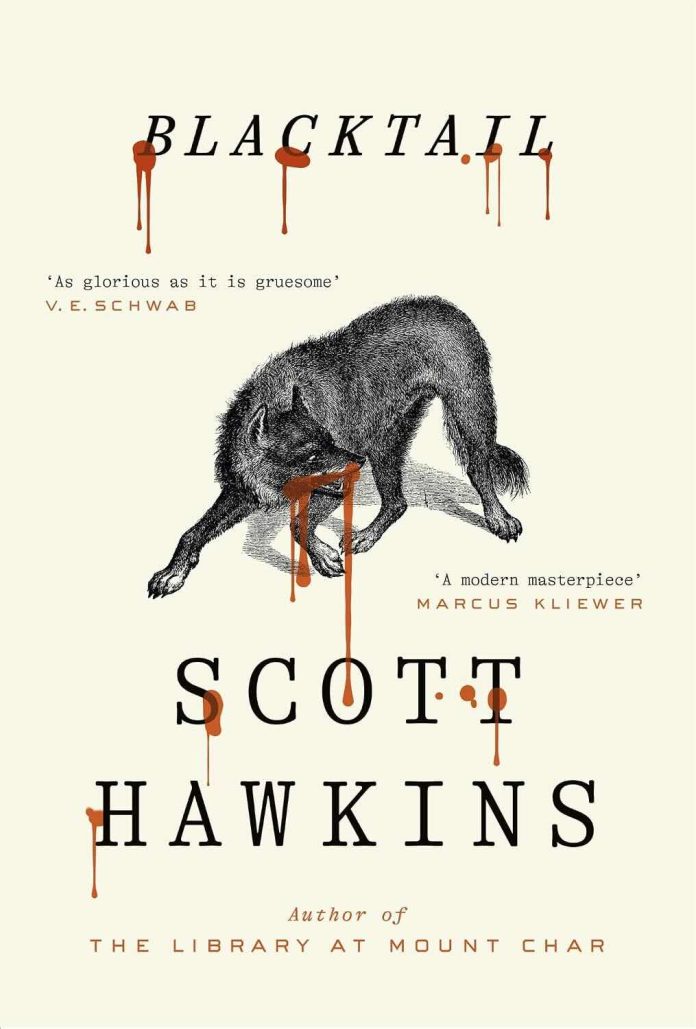
The novel opens on an old lynx named Hate who is planning to eat a wolf puppy. You spend forty pages inside his skull: his bad hip, the bullet still in it, his contempt for his wife, the rough love he feels for his kittens, the roadside night his father died screaming. By the time he goes, you are sorry. That is the whole machine of Blacktail by Scott Hawkins demonstrated once before the story proper begins. Whoever is doing the killing, you will be standing inside them while it happens.
How Scott Hawkins Builds an Animal World
This is the part that will decide whether the book works for you, and it is done with more rigour than the genre usually attempts.
Wolves mark territory with scent poems, which are read like verse and answered in kind, and which the prey beasts find pompous. Distance is measured in longruns. Large numbers are a many-of-manys, and a thousand has to be explained twice. There is a common tongue called the language of the hunt that every creature is born speaking, that men lost when they took up reason, and that a dying man may fall back into. Cars are a species. The squirrels have founded a death cult in their honour, sacrificing one of their number nightly on the asphalt, and are quietly furious that Car has never once noticed.
None of this is decoration. The plot turns on it repeatedly: a fox survives a manhunt because he knows hounds have poor eyes, a bear is bluffed off a hill by a chipmunk with an imaginary atrocity, and a lynx dies because he misjudges a silhouette against a rising moon. Blacktail by Scott Hawkins is a fantasy novel where the magic system is, essentially, woodcraft.
What the Book Is Actually Arguing
The plot is a walk. A half-wolf whose mother was shot, and whose mate was chained in a suburban garden, is sent south by an ancient cat witch to find the Forest God, who has been asleep since before anyone’s grandmother. Each chapter is a stop: a starving wolf pack under a bear’s thumb, a dying dog abandoned in the desert, a suburban cult, a thing in a fire.
Underneath that is a theological argument, made seriously and at length. The Forest God is the god of the hunt, and the hunt in this book is not cruelty but an order: you kill to eat, you are killed to feed, the prey has as much faith in the arrangement as the hunter does. What men did, in the book’s telling, was pray to be exempted, get refused, and go find a different god who would say yes. Everything they have done since, the roadkill left to rot, the cages, the lab, is not predation. It is the breaking of a covenant.
That gives the book its unusual moral temperature. Blacktail is not angry that animals die. He is a hunter and kills constantly and cheerfully. He is angry that they die for nothing.
What works
The strengths of Blacktail by Scott Hawkins are mostly in the supporting cast, which is unusually large for a quest novel.
- The Old Kitty Mother. An ancient house cat who terrifies cougars, casts spells at real cost, and carries a backstory involving her own mother that is the single best thing in the book.
- Trap-Slipper. A middle-aged fox with a running mouth who attaches himself to the hero for no better reason than that he has hated men longer than the hero has been alive.
- The comedy. Constant and dry. A chipmunk talks a grizzly off a hill by inventing a landmark. A dog greets an acquaintance mid-crisis by asking if she is in heat yet.
- Chester. A pet abandoned at a desert trailhead, starving through three seasons, taunted by prairie dogs who nickname him the King of the Skeletons. His chapter is the most upsetting in the book and the best written.
- The prose. Plain, unshowy, exact. Hawkins never once reaches for a fine phrase when a concrete noun will do the job.
Where Blacktail by Scott Hawkins Gives Ground
Four things stop this from matching The Library at Mount Char, which is the comparison every reader will make.
- The middle is a series of stops. Each encounter is self-contained and satisfying, and several of them could be removed without the plot noticing. The bear chapter in particular resolves a problem the hero did not have.
- The hero grows offstage. Everyone keeps saying he is getting bigger and more terrible, and other characters keep having visions of it, but the reader is mostly told rather than shown. The transformation happens in other creatures’ reactions.
- One chapter is a different book. A long detour involving a human serial killer is the most tonally jarring stretch here. It is arguing something the novel needs argued, but it sits in the throat.
- The last act asks a great deal. Where the ending goes is legitimately audacious, and the machinery that gets it there is elaborate enough that some readers will feel the author’s hand on the lever.
Content Notes for Blacktail by Scott Hawkins
Take these seriously. One of the cover blurbs warns readers who cannot bear to see an animal hurt to guard their hearts, and that is not a marketing line. Blacktail by Scott Hawkins contains sustained, detailed cruelty to animals: laboratory testing described from inside the cages, a companion animal mutilated with a knife, a dog abandoned to starve over three seasons, boiling fat thrown in a dog’s face, roadkill dwelt on at length, and the killing of puppies. There is also the on-page killing of a child, torture of a bound human, cannibalism, a graphic depiction of a serial killer’s ritual, animal death in childbirth, and a haunting sequence involving mutilated corpses that is the most frightening writing in the book. Readers who work in animal welfare may find whole chapters unreadable, which is more or less the intention.
Read it if / Skip it if
Read it if The Library at Mount Char is on your permanent shelf; if you want a fantasy novel whose worldbuilding is entirely sensory rather than systemic; if you can take a book that means its anger.
Skip it if depictions of animal suffering are a hard limit; if you need a plot that escalates rather than accumulates; if you want the puzzle-box construction of Hawkins’s first novel, because this is a straight road.
Read these next
Five for readers who finish Blacktail by Scott Hawkins and want the same air:
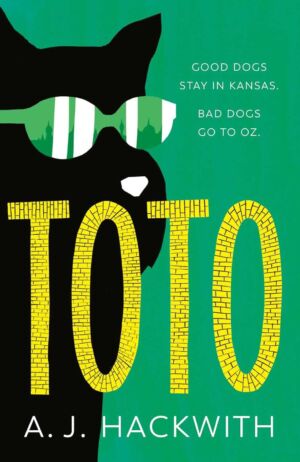
- Toto by A. J. Hackwith. The other recent novel that takes a dog’s interiority completely seriously, in a much warmer key.
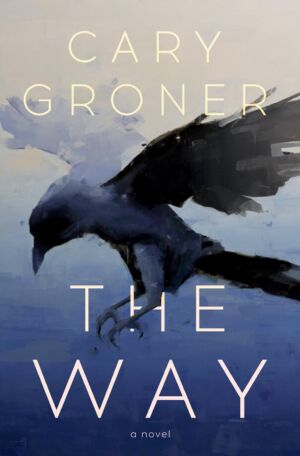
- The Way by Cary Groner. A ruined America walked end to end with animals for company, and a similar interest in what we owe them.
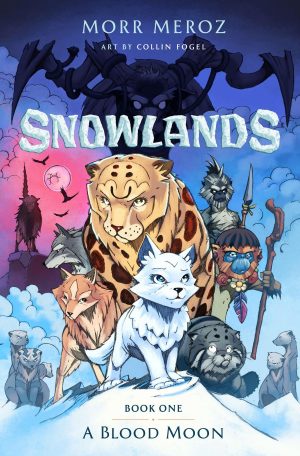
- Snowlands: A Blood Moon by Morr Meroz. Animal fantasy with the violence left in.
- Blightfall by Brandon Sanderson and Janci Patterson. For readers who want the invented-ecology pleasures without the grief.
- The rise of grimdark fantasy, our guide to where a book this bleak sits in the current shelf.
The Verdict
Ten years is a long wait, and Blacktail by Scott Hawkins is not the novel most people were waiting for. It has none of the puzzle-box architecture of his first. What it has instead is conviction, which is rarer and harder. This is a book that has decided the arrangement between people and animals is a broken promise rather than a regrettable side effect, and then commits to that position without once softening it for comfort. The best chapter is the one where a suburban terrier stands in the road and argues the opposite case, sincerely and well, and is not answered so much as overruled. Hawkins lets that argument land. He just does not let it win. Whether you finish this exhilarated or wrung out will depend almost entirely on how much you have ever loved an animal, and both reactions are correct.