 2
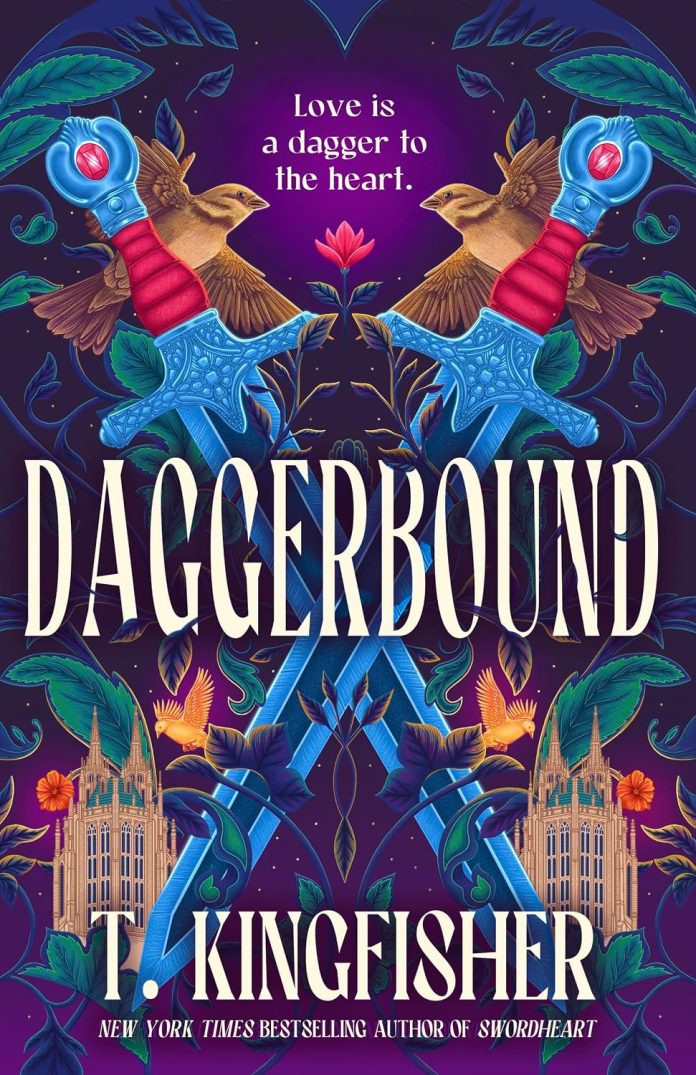
2Three days out from the temple he has just abandoned, a scholar is beaten senseless in the road by men who want his money and are annoyed to find only books. Trying to shield the books with his body, he lands on a wrapped bundle, drags a blade half out of its sheath, and a man made of silver light appears and kills all three of them in under a minute. The scholar, skull ringing and jaw swelling shut, asks the only question that seems important: is he addressing a seraph, or an archangel? One should not get the form of address wrong with angels. That is the first three pages of Daggerbound by T. Kingfisher.
The joke has a floor under it. The man is not an angel. He is the third of three people a mad blacksmith once welded into swords, and his opening plan is to sit down on the verge and wait patiently for his new owner to die of exposure.
What Daggerbound by T. Kingfisher Knows About Damage
The Dervish is vain, restless, profane and very funny, and he does both halves of every conversation out loud when there is nobody to talk to. It reads as comedy for about forty pages before it reads as a symptom.
His last wielder held the sword for something like a century: a priest with a lunar hypothesis and an experimental subject who did not stay dead. The silver lines running from the Dervish’s wrists to his jaw are the record. He was dropped through a weighted net onto a marked slab, opened up, prayed over, and healed inside the blade in time for the next quarter.
What Daggerbound by T. Kingfisher does with this is the reason to read it. The Dervish has organised five hundred years around the belief that if he could locate the correct person and kill them, the past would rearrange itself. Then he is handed the opportunity, in the shape of his old commander, and finds that the man has been carrying it as his life’s great regret the entire time, and that nothing whatsoever is repaired by punching him. The conclusion he reaches out loud, unwillingly, is that some things cannot be made right, and that the sensible response is to stop trying to make them right and go and do something else. He will be touchy about the scars. He will never want to be pinned down. Those can simply be facts about him rather than problems awaiting a solution.
It is an unusual position for a fantasy novel to take about its own wounded hero, and Kingfisher gets there without a speech.
The Scholar Who Cannot Be Paid Back
Edmund is the counterweight, and he is the better idea. He is twenty-seven, was given to his order at five, and has finally accepted that an institution built on the conviction that women are an inferior creation is not going to be argued out of it by one earnest dedicate. And he walks out, more or less steals a mule, and spends the book being mistaken for helpless.
He is not helpless. He is the man who worked out the treatment for a flesh-destroying illness seven years ago and saved tens of thousands of people, and who mentions this to precisely nobody, on the grounds that the healers did the actual work. And he is also sitting on the one thing he can never write down: he knows what causes the illness, and publishing it would get an entire species massacred. A man whose whole faith is that unrecorded knowledge is a cure lost for a century has buried the most important thing he ever learned, and he counts the people it costs.
The way the two threads meet is the smartest thing in Daggerbound by T. Kingfisher. An immortal is an archive. The secret finally has somewhere to live that outlasts the three people who currently carry it, and Kingfisher does not underline it, which is why it lands.
Daggerbound by T. Kingfisher Is Funny About Terrible Things
The tonal control is the craft achievement here. A cliff fortress is infiltrated by wrapping a sword in raw bacon and letting the guard dogs drag it inside, a plan derived from an earlier digression about ants carrying trillium seeds home for the edible part and discarding the rest in the compost. It is a farce, and it is delightful, and the reason the Dervish knows the magic will drop him as close to the blade as physically possible is that his torturer worked it out first and used it to control him.
Both things are true on the same page, and neither is diluted. Very few writers can hold that.
The supporting cast is the other pleasure. Dog Violet, a rag-and-bone gnole found chained in a raiders’ kitchen, gets an arc that is a masterclass in restraint. Large Francis Building, a seven-foot pillbug diplomat, arrives out of a pitch-dark crypt tapping out a numerical sequence on her own shell, which Edmund answers, to the Dervish’s absolute despair. And Sweetness the mule is the most convincing animal in recent fantasy, as well as the direct cause of every catastrophe in the first third of Daggerbound by T. Kingfisher.
Where Daggerbound by T. Kingfisher Gives Ground
- The middle is a chain rather than an escalation. Bandits, then a bandit camp, then a dragon, then a village that feeds travellers to it, then a cult. Every link is good. The chain does not tighten, and the book keeps joking about how often its hero gets kidnapped, which acknowledges the problem without fixing it.
- The antagonist is a locked door. Scholar Andraste has one excellent tell and no interior life at all, and she is gone well before the ending.
- The dragon is handed off. Six paladins ride past an inn, get briefed over cold pies, and ride out. A hundred pages of threat resolve somewhere the reader is not.
- The running joke runs long. “He isn’t my type” is very funny at the tenth repetition and merely load-bearing by the thirtieth.
- The ending is a doorway. The cult survives, the curse is unbroken, and the third sword is still missing. This is book two of at least three, and it reads like it.
Content Notes
Torture and repeated vivisection, recalled in specifics; panic responses to restraint and binding; captivity, forced drugging with opiates, and a broken-finger threat; attempted human sacrifice; a chained and beaten nonhuman servant; a graphic skin-destroying illness; throat-cutting and battlefield violence; arson; animal peril; slavery referenced. The sex is between two men, consensual, negotiated on the page, and reasonably explicit without being the point.
Do You Need Swordheart First?
Honestly, yes. The plot of Daggerbound by T. Kingfisher stands alone, but two of its best scenes are reunions, and a reunion only works if you were there the first time. Sarkis and Halla arrive halfway through carrying an entire previous novel with them; readers who have not met them will register a pleasant married couple rather than a payoff. For the full effect of Edmund’s arc you would also want Clockwork Boys and The Wonder Engine, where he turns up at nineteen as an insufferable prig.
Read These Next
- Swordheart by T. Kingfisher, the direct predecessor, and still the tighter of the two.
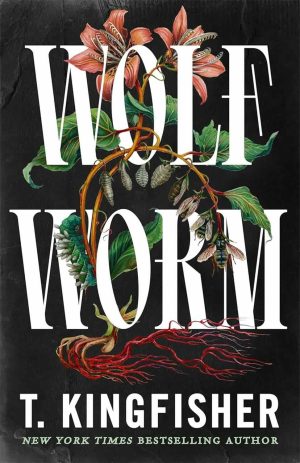
- Wolf Worm by T. Kingfisher, for the same voice pointed at something considerably nastier.
- Hemlock & Silver by T. Kingfisher, if the competent-professional-in-over-her-head register is what you came for.
- Snake-Eater by T. Kingfisher, for more of her nonhuman people written as people.
- Agnes Aubert’s Mystical Cat Shelter by Heather Fawcett, for a gentler book with the same conviction that kindness is a plot device.
Kingfisher’s tie-in novel Astarion: Baldur’s Gate 3 braids two centuries of one vampire’s life and takes the character more seriously than the format usually allows.
Worth Your Shelf
The plan that saves everybody comes out of a conversation about flowers. Somewhere in the middle of the book, Edmund explains myrmecochory to a man who does not care about flowers, and the man listens anyway, and four hundred pages later it is the reason he gets inside a fortress carved into a cliff. That is the whole argument of Daggerbound by T. Kingfisher in one mechanism: the useless fact is the useful one, eventually, if somebody bothers to write it down.
It is not the tightest novel Kingfisher has written and the middle wanders. It is also a rare fantasy romance that tells its damaged hero he does not have to be repaired in order to be loved, and then declines to repair him. Read Swordheart first. Then read this one slowly, because the sequel will be a while.