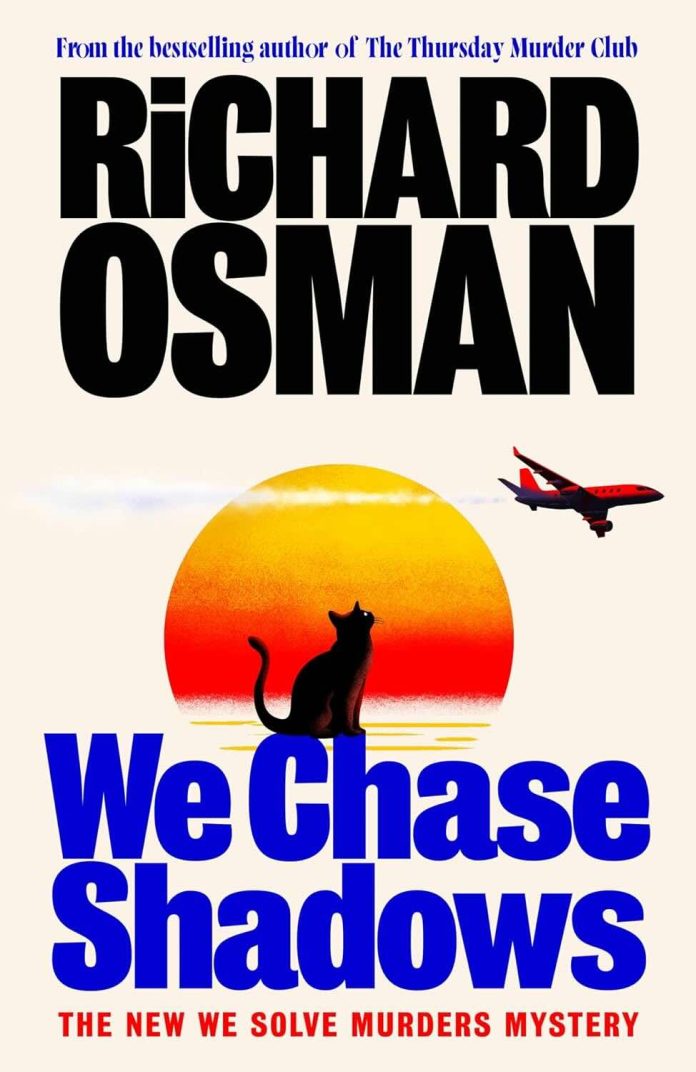
In August 2001 a man on a Spanish beach folds his clothes, leaves a note he has taken some care to make look sincere, and walks out of his own life. Twenty-five years later, a detective agency with a perfect record of solving nothing at all is trying to work out what he did next. That distance is the shape of We Chase Shadows by Richard Osman, and the joke buried inside it is how little anybody in the book can actually confirm about the man they are all so frightened of.
Six Months Trading, Zero Murders Solved
We Solve Murders is Rosie D’Antonio’s idea and Rosie D’Antonio’s money. She is the world’s bestselling novelist, she says, if you do not count Freida McFadden. The staff are Steve Wheeler, twenty-five years in the Met and now retired to the New Forest with a cat and a bench by a duck pond, and his daughter-in-law Amy, a close-protection officer with a resting heart rate of thirty-two. There is also an office manager, Felicity Woollaston, on a hundred and twenty thousand a year to answer a phone that never rings. Half a year in, they have solved precisely no murders, which Steve compares to Kentucky Fried Chicken selling no chicken.
The work arrives, as these things do, through the Graham Norton sofa. Vern Blackwood sells vitamins that are not vitamins from a fifteen-million-euro villa outside Lucca, and one morning he finds one of his three bodyguards shot through the back of the head on the doorstep with a note pinned to him. The note is misspelled. It is signed by Jakob Eriksson, a Swedish operator in the same trade who has reportedly killed a great many people. Vern’s position, held with a calm that gets more interesting the longer you look at it, is that Eriksson did not write it.
The Trick at the Heart of We Chase Shadows by Richard Osman
What follows is not a whodunnit so much as a who-is-it. Interpol has Eriksson at three airports on three days when three rivals died. Vern calls him a friend. The most dangerous woman in Sweden, interviewed on a Stockholm roof terrace in a fur coat, says flatly that she knows every criminal in the country and has never heard of him. An American in Palm Springs who once split the world with him over dinner will bet a testicle that the man is English.
Osman is doing something structurally sly here. Every witness hands over a fragment, and every fragment contradicts the last, so the investigation is really a slow argument about whether a person can be assembled out of other people’s fear of him. The novel breaks twice for a first-person chapter dated Málaga, 2001, and both are placed with real precision. The industry underneath all of it is genuine, incidentally, and readers who want the scale of it will find the World Health Organization’s figures on falsified medical products more alarming than anything in the plot.
What Works
Four things make We Chase Shadows by Richard Osman the better of the two books so far.
- Steve and Tony. Tony Taylor times journeys to the minute, cannot say which animal bacon comes from, and derails an entire hospital visit by calculating that Steve must have driven at eighty-three miles an hour. Their friendship is the warmest thing Osman has written.
- Ernesto Manuelo Santiago de Sousa de Cuellar. Interpol, Bilbao, a backfiring SEAT Ibiza with a wing mirror that falls off in his hand, and an unshakeable belief that Led Zeppelin II is the greatest album ever recorded. He walks in on page fifty and takes the book with him.
- Amy. Her past arrives in slivers, always during phone calls to a husband in the Gulf, always about a nine-year-old on a staircase with beige carpet and small blue flowers. It is the most controlled writing in the novel.
- Rosie’s other plot. Her new book enters the charts at five, then falls to fourteen, and her twenty-six-year-old stand-in manager suggests a YouTube show involving hot wings. The publishing satire is merciless and it is not only satire.
Where It Drags
Four things stop We Chase Shadows by Richard Osman short of flawless.
- The world tour is thinner than it looks. Stockholm is one conversation. Barcelona is one conversation. The jet lands, somebody says something useful, the jet leaves.
- The middle third eliminates rather than advances. For a long stretch the team is confirming that suspects did not do things, which is honest detective work and slow reading.
- Vern Blackwood stays a cipher too long. He is deliberately opaque, and the payoff justifies it, but he is a hole in the middle of two hundred pages.
- The riffing sometimes wins. A pub-quiz digression, a walk-in-bath advert, an extended debate about invisibility and trousers. All funny. All brakes.
Content, and Who This Is For
A Word on Content Warnings
Moderate. Several shootings and one knifing, none dwelt on. A sustained assault on an older man and its aftermath, including nightmares and flashbacks. One quiet passage in which a widower describes wanting to go to sleep and not wake up, written without alarm and without comfort. Grief throughout.
The We Solve Murders Series in Order
The case in We Chase Shadows by Richard Osman stands alone, but the four leads do not. Their histories, and one bereavement in particular, are carried over whole from the first book.
- We Solve Murders
- We Chase Shadows (this one)
Osman’s other series, the Thursday Murder Club, shares no characters but plenty of temperament:
- The Thursday Murder Club
- The Man Who Died Twice
- The Bullet That Missed
- The Last Devil to Die
- The Impossible Fortune
Who Should Read We Chase Shadows by Richard Osman
Read it if you want a crime novel that is genuinely funny on the page rather than merely described as such, if you like an investigation where the question is identity rather than guilt, or if you have ever suspected that the frightening people are mostly frightening because everybody agrees to say so. Approach with patience if you need constant forward motion, and start with book one if you have not met these four before, because the emotional weight here is borrowed from it.
What to Read After We Chase Shadows by Richard Osman
- We Solve Murders by Richard Osman. The obvious next step, and the one that explains why Steve dislikes leaving Hampshire so much.
- The Impossible Fortune by Richard Osman. The most recent Thursday Murder Club, for the same jokes aimed at a slightly gentler target.
- Vera Wong’s Unsolicited Advice for Murderers by Jesse Q. Sutanto. Another amateur who has no business investigating anything and is very good at it.
- Everyone in My Family Has Killed Someone by Benjamin Stevenson. For readers who enjoy a narrator playing fair and showing you the mechanism.
- The Appeal by Janice Hallett. If the pleasure here was watching a case get built out of what people are willing to say about each other.
The Last Word on We Chase Shadows by Richard Osman
The title is the thesis. Everybody in this novel is pursuing something that only exists because other people believe in it: a reputation, a name on a passport, a bestseller list, a marriage conducted almost entirely by telephone, a dead wife who still answers back from a bench. Osman lets the comedy carry all of that without ever announcing it, and then, in the last fifty pages, quietly asks what a person is left holding when the thing they were chasing turns out to have no substance. It is a very funny book about being replaceable. The middle sags, the geography is decorative, and none of that will matter to you at all.