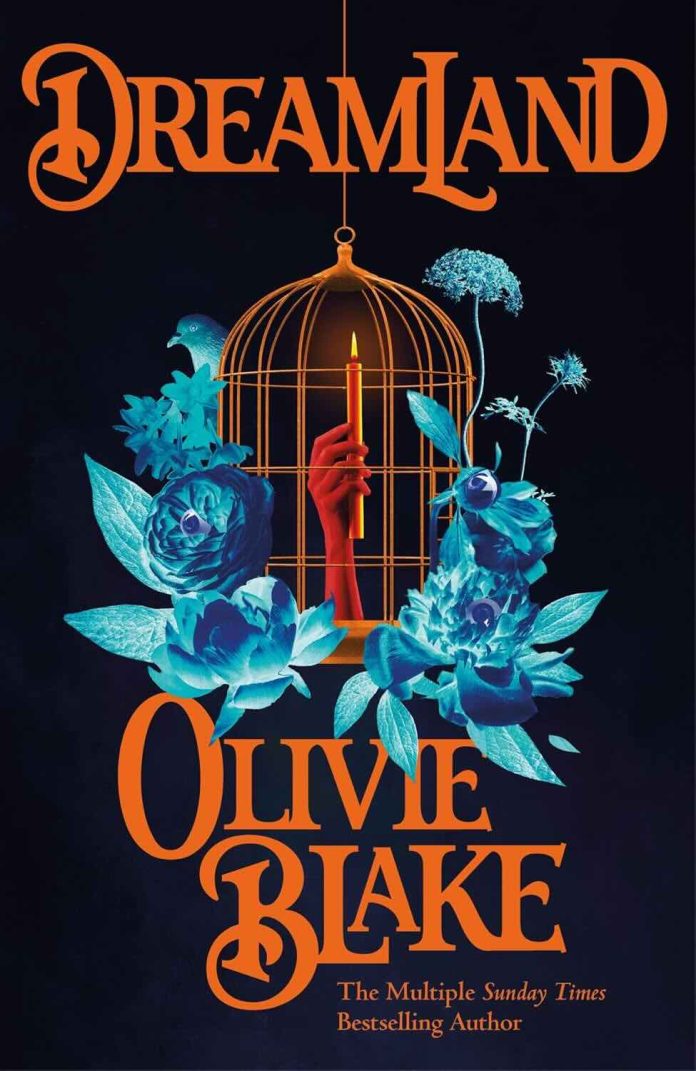
Anya Morris plays a game with herself. Every room she walks into, every canyon road she drives, she runs the same private calculation: Could I Survive It? She is twenty-two, half Filipina, an actress who has just lost the streamer pilot that was supposed to make her, and Dreamland by Olivie Blake is the story of what happens when she stops doing the arithmetic and starts wanting the danger instead. What follows is a Los Angeles horror novel that is caustic, extremely funny, structurally overstuffed, and entirely aware that you have read this story before.
A Job No Sane Person Takes
At a charity gala she does not belong at, Anya is befriended by Emmanuelle de Witt, sister to the movie star William de Witt, who smells faintly of overripe fruit and offers her ten thousand dollars a month to keep an eye on someone called Julian. There is an NDA. Her phone is confiscated at the door. She is handed a baby monitor and discovers, several drinks in, that Julian is a grown man, that nobody has seen him in years, that he is described as severely epileptic, and that the bed on the monitor screen is empty.
The house is a limestone villa built into a Hollywood hillside, mid-renovation, reeking of fresh paint over something worse. Outside, the Santa Anas are blowing and women keep turning up dead. Inside, a private doctor answers at any hour, the doors lock from the corridor, and the man upstairs sometimes speaks in a voice that is not his.
The Game Is the Whole Book
The finest thing in Dreamland by Olivie Blake is not the demon. It is Anya’s narration, and specifically two devices that run the length of the novel.
The first is the survival game, a compulsive risk assessment she has been running since childhood, which the book gradually reveals as the tell of a person raised to expect harm. The second is what she calls her prayers, always to the same effect: if I fail, let it not be because I passed up an opportunity. Blake uses them the way a lesser novel would use flashback. Each one arrives at the moment Anya is about to do something appalling to herself, and each one lands as ambition, self-harm and comedy at once.
The satire is genuinely excellent, and it is specific. An agent tells Anya she is not believable as a woman who could be dumped. A casting director says they are looking for someone more diverse, then brightens when told she is Filipina, then suggests they turn it up a little. Productions have decamped for Queensland and built a fake Los Angeles there. Tech money is buying its way into film and finds the film part tedious. Her cousin Roro is making a gallery installation out of photographs of murdered women, and the book is honest enough to point out that Roro has to eat.
Blake also gives the possessed man his own chapters, timestamped AWAKE and ASLEEP, written in second person to the thing that shares his skull. They are the most inventive prose here: dream sequences where the same woman appears hanging upside down in a greenhouse, or leaping from a theatre balcony, always with cheap red lipstick drawn badly across her mouth. By the end the novel has quietly reframed him as a case study in what a lifetime of engineered post-traumatic stress does to a person who was raised to believe he is the monster.
What Works
Four things make Dreamland by Olivie Blake worth the time.
- The voice. Anya is vain, transactional, cruel about herself, and very funny. She narrates her own degradation in the tone of someone reading out a shopping list.
- The Filipino family. Her mother’s occult shop, Tita Linda relaying warnings from a dead grandmother, and cousin JR breeding a prize pygmy pigeon called Alistair. The pigeon subplot is absurd and it is also the only tenderness in the book.
- The rot as metaphor. Something fungal is growing inside the people who run this house, and the novel never once explains the joke.
- The last twenty pages. A framing reveal that recasts everything, followed by a coda so quietly sinister it is worth the wait.
Where It Sags
Four things keep Dreamland by Olivie Blake off the top shelf, and only one is pacing.
- Three modes is one too many. First-person retrospective, second-person demon chapters, and full screenplay interludes complete with stage directions about the audience. The screenplay scenes start clever and end smug.
- The middle idles. Roughly two hundred pages of parties, smoothies, a woman being cryptic, and a narrator who will not leave. The refusal is the point. It is still slow.
- The mystery is not one. Readers will identify the killer very early. The novel then waits, at length, for Anya to arrive.
- Emmanuelle deserved better. The most interesting person here, a groomed teenager with a surgically rebuilt face and a missing persons file, is kept offstage as a drunk caricature and then explained in a paragraph after she is dead.
There is also the matter of the novel talking back. It tells you when you are about to cover your eyes, tells you the heroine is being an idiot, tells you it knows the trope. Pre-empting an objection is not the same as answering it, and the more the book insists it is in on the joke, the more the joke has to do.
Content, and Who This Is For
A Word on Content Warnings
Do not hand this to anyone unprepared. Serial murder of women, extensively and graphically. On-page evisceration and posed bodies. A teenage girl groomed by a much older man who narrates it as devotion. Sexual assault throughout. Sedation, confinement and coercion. Repeated attempts at self-destruction. Fungal body horror. Explicit sex, including a hand at a throat. Racial fetishisation, both on the page and by the plot.
Who Should Read Dreamland by Olivie Blake
Reach for it if you want horror that is really an argument about who gets cast as the victim, if you like a narrator who is honest about her own complicity, or if the phrase Hollywood gothic makes you sit up. Skip it if you want a tight thriller, a mystery you cannot solve by page ninety, or a romance where the danger is decorative rather than real.
What to Read After Dreamland by Olivie Blake
- Girl Dinner by Olivie Blake. Her previous novel, and the closest sibling: appetite, ambition, and women being consumed by institutions.
- The Possession of Alba Diaz by Isabel Cañas. For readers here mainly for the demon, and for possession written as inheritance.
- The Close-up by Pip Drysdale. If the appeal is Los Angeles as a machine that eats young women with dreams.
- The Bell Jar by Sylvia Plath. Not horror, but the ancestor of Anya’s flat, itemising voice.
- Slouching Towards Bethlehem by Joan Didion. Blake quotes it in the epigraph, and the essay on the Santa Anas is the book’s actual thesis statement.
The Last Word on Dreamland by Olivie Blake
This is a novel about a young woman who has spent her life auditioning for parts other people wrote, and who decides that if the only roles going are victim or monster, she would rather be miscast. That argument is sharp, angry and worth the price of admission. What surrounds it is a book that cannot stop performing: an overture, a chorus, a director’s note, screenplay interludes and a narrator who keeps turning to explain what she is doing while she does it. Trust the voice and the final chapter and you will have a very good time. Ask the plot to surprise you and it will not. The horror was never the thing living inside the man. It is a city where being wanted and being consumed share a vocabulary, and a girl who noticed far too late to care.







