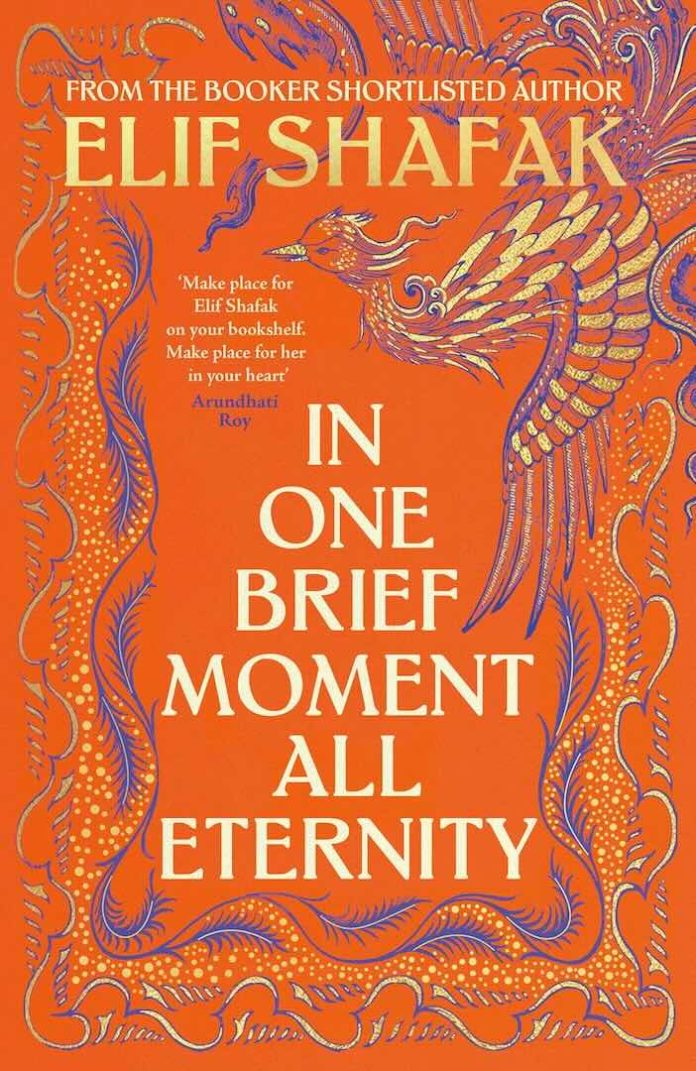
A character who has never drawn breath opens In One Brief Moment All Eternity by Elif Shafak by accusing the man who made her of a poisoning. Emma Bovary has had one hundred and sixty-nine years to think about the arsenic, and she starts talking on page one.
What follows is not the argument you expect. This is a life of Gustave Flaubert assembled almost entirely out of women’s testimony: the nursemaid who told him folk tales, the mother who could not forgive him for surviving, the dancer in Esna who gave him a shawl and something worse, the prosecutor’s wife who read every book her husband banned. Thirty of them speak, in numbered chapters, and the novel withholds until its final pages exactly why the number is thirty.
The Man in the Third Person, the Women in the First
Shafak makes one structural decision early and never wavers from it. Flaubert himself is rendered in a cool, present-tense third person, chapter by chapter, each headed with a colour and an object: the yellow butterfly, the verdigris teapot, the crimson flag, the ebony bread. Every woman who interrupts him speaks in first person, and speaks for herself.
The effect is quietly devastating and takes a while to register. He is the one being observed, catalogued, described. They are the ones with interiority. A novelist famous for the sentence “Madame Bovary, c’est moi” spends four hundred pages being watched by people he assumed were scenery.
Not all of the thirty narrators in In One Brief Moment All Eternity by Elif Shafak are human. Istanbul narrates a chapter as one enormous unspooling sentence and ends it with a piece of information Flaubert took home with him. Opium introduces itself as the Brown Fairy. Syphilis has a chapter. So does Jamilah, a camel who appears first at a provincial circus and later in the Paris zoo during the siege, and whose account of her own end is the single hardest page in the book. That Shafak can move from a bacterium to a bereaved baker without the register cracking is the technical achievement here.
Five Parts, One Long Illness
The frame is a life in five stages, from childhood at the Hotel-Dieu in Rouen, where the young Gustave climbs a trellis to look at cadavers in his father’s dissection theatre, through the Paris law years, the Egyptian voyage, the obscenity trial of 1857, and the long decline at Croisset. Readers who come to In One Brief Moment All Eternity by Elif Shafak for the writing life will find it: the five years of composition, the shouting of sentences aloud, the mercury pills that make his gums bleed.
What they may not expect is how much of the book is about illness and political violence. Epilepsy structures the whole novel, since every appearance of the mythical Simurgh turns out to be attached to a seizure. The Paris Commune occupies most of Part Four, and the chapter narrated by a baker shot at Pere Lachaise, who becomes a ghost and follows Flaubert through the graves trying to make him hear her, is the best thing in the book by some distance.
The title of In One Brief Moment All Eternity by Elif Shafak comes from Attar’s The Conference of the Birds, which Flaubert buys in a Smyrna bazaar in Part Three. Anyone who knows what si-murgh means in Persian will see the ending coming a long way off. That does not spoil it. It makes the last chapter land harder.
What Works
- The ventriloquism. Eleanor Marx, who really did produce the first English translation of Madame Bovary, gets a chapter of extraordinary pressure, moving between dock strikes, her father’s concealed son, and a novel she rereads three times and understands differently each time. It reads like nobody else in the book.
- The physical world. Rouen smells of ether and river mud; Esna smells of rose otto and dust. Shafak keeps her sensory detail specific and unshowy, and it does most of the historical work without a single lecture.
- Caroline. The niece Flaubert raised gets the coolest and cruellest testimony of the thirty, and her account of what she later did with his manuscripts turns the novel’s argument about censorship inside out.
- The last fifty pages. A vision, an old Persian poem, and a diagnosis modern medicine did not have a name for until the 1990s, folded together without a wasted movement.
Where It Stumbles
- Not every voice earns its number. A few testimonies run three pages and function as historical footnotes rather than people. The chorus is strongest when a woman has a grievance and weakest when she has only information.
- The Commune chapters lecture. Shafak’s own convictions about political extremism arrive in long authorial paragraphs that step away from Flaubert entirely. They are convincing and they are also the place where the novel most obviously stops being a novel.
- The thesis gets stated. A scene in which a young critic publishes an article asking why Flaubert’s female characters never speak explains the book’s design out loud, several hundred pages after we had understood it.
- The aphorisms accumulate. Some are superb. Some read like the wisdom-literature register Shafak has always been drawn to, and by Part Five they arrive faster than they can be absorbed.
Who Should Read In One Brief Moment All Eternity by Elif Shafak
Reach for it if you like polyphonic historical fiction, novels about how books get made, or any book that hands the microphone to whoever the record ignored. Skip it if you want a conventional biographical novel with a single narrative line, or if 1870s French political history sounds like homework.
What to Read After In One Brief Moment All Eternity by Elif Shafak
- There Are Rivers in the Sky by Elif Shafak. Her previous novel runs the same trick with water instead of women, three lives braided across millennia. The better place to start if this one sounds daunting.
- The Forty Rules of Love by Elif Shafak. The earlier book that established her interest in Sufi structure, which is doing quiet work under everything here.
- Hamnet by Maggie O’Farrell. A canonical male writer displaced from the centre of his own story by the women around him. The closest comparison in recent fiction.
- Flaubert’s Parrot by Julian Barnes. The other great English-language novel about the impossibility of pinning Flaubert down, and a useful corrective if you finish this one feeling too certain.
- Tolstoy vs. Dickens. An article for readers who leave this book wanting more of the century that produced it.
If you want to test Shafak’s central conceit yourself, Eleanor Marx’s translation is the one most English readers have unknowingly read.
The Last Word on In One Brief Moment All Eternity by Elif Shafak
Ambitious books usually pay for their ambition somewhere, and this one pays for it in a slack middle stretch and a handful of narrators who exist to fill a slot. What it buys with that spending is a final movement of real beauty, and an argument about literature that it earns rather than asserts: that a story can outlive the storyteller, and that the people written into the margins were never as quiet as the margins made them look. Flaubert said talent was only a long patience. So, it turns out, is being heard.







