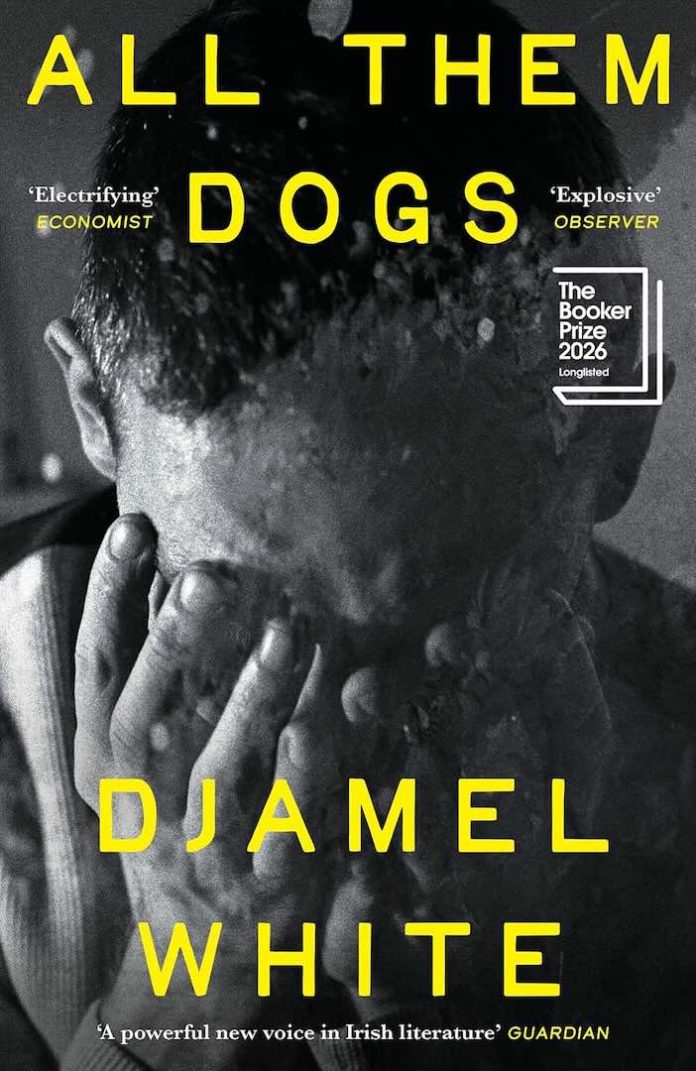
All Them Dogs by Djamel White opens in a stranger's kitchen with scales on the table, dog dirt hardening on the balcony and a toddler asleep beside a man who owes money. The narrator takes it all in and gives you his verdict on the smell. Damp first. Then the sweet one.
He is Tony Ward, and he wants you to call him Wardy. He is twenty-eight, back from five years in England, and he has come home for a job. What he actually wants is to be somebody again, in the only place he has ever known how.
This is a debut novel by the youngest writer on the Booker Prize 2026 longlist, and it announces itself in about four sentences. The judges called it a ballsy, unsentimental portrait of West Dublin gangland with an ear for dialogue both racy and real. That is accurate and it undersells the book, because the thing that stays with you is not the gangland at all.
What Happens in All Them Dogs
Tony left Dublin in 2018 with an envelope of cash and instructions to drop a knife over the side of the Holyhead ferry. A young fella called Eddie Glackin died on scorched grass in a heatwave, and the man Tony did it for, Philly Mooney, put him on a boat that night.
Philly is dead now, shot in his own driveway with his seatbelt half fastened. Tony has come back because his old friend Kenny Boyle has an in: Kenny's nine-year-old daughter trains at Lavelle's Combat Emporium, a boxing gym in an industrial estate that is also the head office of the biggest crime organisation in the country.
The job is driving. The man he drives is Darren Walsh, six foot four, nicknamed Flute since school, enforcer to Aengus Lavelle. Tony spends the first fifty pages telling you exactly how little he thinks about Darren Walsh, in the manner of a man who thinks about nothing else.
The Voice Is the Achievement of All Them Dogs
There is no glossary and no translation. You are dropped into gaffs and bandos, youngfellas and youngones, fellas getting clipped and cunts getting plugged, and you either swim or you put the book down around page twenty. I would strongly advise swimming.
What White does with that register is the trick of the book. Tony narrates in the past tense, from somewhere after the events, and he is constantly telling you how he feels, and he is wrong about all of it. He tells you he felt nothing after the stabbing. He tells you he did not care that his mother stopped him at the door. He describes a man's mouth and cheekbones for half a page and then explains that he was only checking whether the fella looked like an eejit in his coat.
The prose never once breaks character to help you. Nobody explains that Tony is in love, or closeted, or grieving, or that his boss groomed him at sixteen. The sentences simply behave in a way that a reader can read and a narrator cannot.
All Them Dogs sustains that for its full length in one unbroken voice, without a second perspective or an authorial hand reaching in to apologise, and White holds it to the last line.
What Works
- The comedy is genuinely funny and it is doing structural work. Finto Maher's laugh is one short honk like a man trying to cough up a cufflink. Getting six-foot-four Darren into the back of a 1980s Opel Corsa reduces two grown adults to tears in a car park. Every laugh buys another inch of your sympathy, so that when the violence lands you have already agreed to care.
- The dog motif of All Them Dogs never announces itself. An old Jack Russell noses through the opening scene and later sniffs at a head wound in the road. Finto is breeding an XL Bully called Jacinta for money. Darren has the blue eyes of a dog that stares without wagging. Tony waits for a ring to be released into his palm like a dog waiting for a treat. Under a Facebook memorial someone has typed that Dublin has gone to the dogs. Men here are bred, kennelled, set on each other and put down, and the novel never once stops to tell you so.
- Christmas and Stephen's Day. Two chapters, back to back, that are the best writing in the book. A vicious family row over a roast chicken, then a pub by the Liffey with tinsel on the ceiling, a pizza from a food truck and a wrapped present on the back seat. Nothing happens. It is unbearable.
- The Opel. A baby-blue Corsa-A GSI, his mother's car before it was his, the first thing he ever owned. White gets more out of one bad hatchback than most novels get out of a marriage.
- Fanny Lavelle. The boss's daughter, twenty-two, doing a microbiology degree on a second chance after being thrown out for fighting, planning to buy her way into medicine with money she did not choose. She is the only person in the book with a future and she knows exactly what it cost.
Where It Stumbles
- The middle of All Them Dogs sags. There is a stretch of debt collections, pub visits and errands where the novel is marking time until Christmas. The scenes are individually good and there are too many of them.
- The plot machinery is too neat, and the book half knows it. Tony says so himself, twice. A dead man's brother turns up alone in the gang's own pub, gets into a scrap at the jukebox, tags a shop on camera, then attempts a shooting through a windscreen from thirty feet. Every link in that chain is a coincidence, and the third act is built on all of them at once.
- A stray bullet does an enormous amount of work. I will not say more than that. The moment is written with real control, and it is still the oldest device there is for making a reader feel something at speed, in a book that had earned better.
- Melissa Lavelle is asked to carry too much. Darren's mother appears properly twice and is the hinge of the entire theme of maternal power. She is terrifying both times, and she needed a third scene.
- Gemma is a device before she is a person. The young mother in debt exists to show us what Tony has become, and the worst thing that happens to her happens off the page. Her scene with a cast on her hand is one of the most disturbing things here, which only makes her thinness elsewhere more of a shame.
What All Them Dogs Is Really About
Not drugs. Not turf. Loyalty, and the confidence trick underneath it.
Every older man in this novel offers Tony the same deal in slightly different words. Philly gave him a song, an onyx ring, and a line about loving the bones of him. Lavelle offers protection, then explains that any retribution for acts carried out elsewhere is Tony's alone to deal with. Finto calls his operation a brotherhood, hands over a watch, and requires a body in exchange. All of them want the same thing from him, and it is not his company.
The novel's cruellest and best line comes late, when someone finally says out loud what Tony was at sixteen and what Philly was doing. It is delivered as an insult in the middle of a standoff, which is the only way this book would ever be able to say it, and it detonates.
Against that, one man in the whole novel ever offered Tony anything without a price: a Juvenile Liaison Officer who once dropped course pamphlets through the letterbox because a thirteen-year-old told him he sometimes thought about being a fashion designer. Tony has spent fifteen years despising him for it.
A Word on Content Warnings
All Them Dogs contains several killings, one of them at close range and described plainly. The death of a child. A serious assault on a woman, shown in aftermath rather than in the act. Grooming of a teenage boy by an older man, handled retrospectively and without explicit detail. Explicit sex between two men. Heavy drug use and dealing, a neglected toddler, suicidal ideation with a firearm, homophobic language and a great deal of internalised shame. The language is unrelenting from the first page.
Who This Is For
Reach for All Them Dogs by Djamel White if you want a voice you have not heard in a novel before, if you loved Douglas Stuart's young men and wished someone would write them funnier, if you believe a crime novel can be a love story with the labels torn off. Skip it if heavy dialect is a wall for you, if you need your gangland fiction to keep its distance from the people it is about, or if you cannot be near a book in which a child is harmed.
It is one of the shorter books on the longlist and it moves. It does not let you off.
Read These Next
Five books to go to if All Them Dogs has left you wanting more of the same weather.
- John of John by Douglas Stuart. Also on this longlist, and the closest relative in the room: family, violence, shame and a tenderness the men involved have no vocabulary for.
- Young Mungo by Douglas Stuart. The other half of that comparison. Two boys, a city that will not permit it, and a mother at the centre of the damage.
- Kala by Colin Walsh. Irish, propulsive, and similarly interested in what a group of friends agrees never to say about one summer.
- Ordinary Human Failings by Megan Nolan. An Irish family in England under the glare of a press pack, and another novel that refuses to let you decide who the monster is.
- Night Boat to Tangier by Kevin Barry. Two ageing Irish criminals in a ferry terminal, all talk and dread, for readers who want the same music at a slower tempo.
We have reviewed Dirty Myrtle by Kennedy Weible too, if another literary fiction is what you are after.
Another crime novel that hands its best writing to the hired muscle rather than the man giving the orders: Cool Machine by Colson Whitehead closes his Harlem Trilogy across 1981 to 1986.
The Last Word on All Them Dogs
Late in the book Tony stares down a gun barrel and thinks that a gun barrel does not think anything of you, that everyone is equal at the end of one. What has just frightened him is not the barrel. It is his brother's face.
That is the register All Them Dogs by Djamel White works in for three hundred pages: a man who can take a beating, a bullet, a stint in England and a body on his conscience, and who is comprehensively undone by being looked at with contempt across a kitchen table.
The last line hands the whole novel back to you. Every authority figure Tony has ever had has defined him, and the book stops at the exact moment another one takes over. It is not a redemption. It is a young man face down on cold tarmac, relieved.
White is the youngest author on this year's list and this is his first book. Whoever publishes the second one is lucky.







