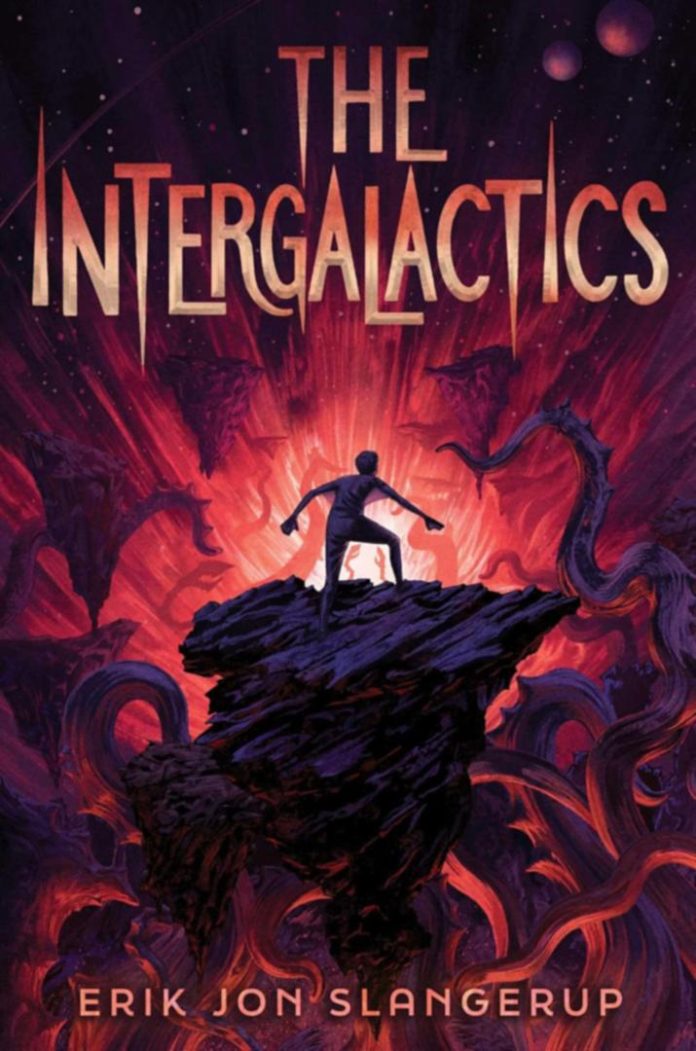






Brinx has 999 bars of ink on his forearm, one for every test he has survived since a lab pulled him out of a vat. Each test is a game designed by adults who watch from a deck above: buzz-saw robot spiders, mazes with spiked pits, the odd written exam. Pass and you get a bar. Fail and you get beaten by guards with electric sticks. Fail badly and your name goes on a brick in the corridor wall, and thirteen, Brinx’s age, is the number carved most often. The Intergalactics by Erik Jon Slangerup begins on the morning of his thousandth test, and the first two chapters set out the stakes so clearly that a nine-year-old will understand exactly what graduation means and why nobody quite trusts it.
How the Thousand-Test System Works
The planet is Grimulus, a pink-skied world with two suns, a ring of shattered moon overhead and a long chain of floating rocks called the Driftlands. At one end sits Base Lab 9, where the company HyperHelix grows children spliced from the DNA of species across several galaxies. At the far end sits Havenport, where graduates go and from which nobody returns. In between lie a few hundred miles of things that want to eat you.
Each class of hybrid has its trick. Brinx is a Featherbone: his bones are laced with something that weakens gravity’s pull, so he glides when he jumps. Shieldskins are armoured, Griplocks climb anything and have tails, Allseers can see through walls, Fourfists have four arms, Ghostwalkers fade into the scenery and Howlers run in packs. The rules are simple, and The Intergalactics by Erik Jon Slangerup never cheats on them. When the graduates’ transport goes down halfway across the Driftlands, a handful of survivors from rival classes have to cross the wild together, using exactly the gifts they were engineered for.
What Erik Jon Slangerup Is Really Testing
The structure is a survival run with a moving map. Three parts, fifty-one short chapters, each ending on a hook, and nearly every chapter introduces a new threat drawn from the planet’s ecology: flowers that sedate you with spores before swallowing you, spiny lizard packs, a cave predator with too many legs, gas-filled jellyfish in the fog. It reads like the bestiary of a tabletop game, and Slangerup clearly loves inventing it.
Underneath the chases, The Intergalactics by Erik Jon Slangerup is asking whether children raised to compete can learn to cooperate. The tests on base pit classes against each other; the wilderness rewards the opposite. The survivors start out trading insults and stealing water. By the midpoint they have a pact, a team name and a running joke about what each class calls everyone else. Meanwhile the question of what Havenport is actually for grows louder, and the second half answers it in a way that turns the adventure into something with a conscience.
Where Erik Jon Slangerup gets it right
- The creatures. A herd of six-legged beasts that look like boulders, inflate themselves and fly across chasms (with spectacularly rude noises on landing) is the best set piece, and one of them becomes Brinx’s devoted pet. A bridge made from the skeleton of a giant animal is another highlight.
- The humour. Sig the Griplock never stops talking, and the banter is genuinely funny rather than dutiful. Kids will repeat the jokes.
- Clean, kinetic prose. Action is easy to follow, and one breathless test sequence is written as a single run-on sentence of dashes that young readers will find thrilling.
- A theme with weight. The book trusts its audience with an idea about how labels make cruelty easier, and it earns that idea through events, not speeches, for most of its length.
Where It Gives Ground
- One rhythm, repeated. Something attacks, a power saves them, someone is lost, they rest. The Intergalactics by Erik Jon Slangerup runs that loop many times through its middle third, and the sense of a journey with a shape thins out between set pieces.
- Powers on cue. Hidden abilities surface under stress, which the book sets up early. Even so, in the finale three characters discover new gifts at precisely the moment the plot needs them, and the climax feels arranged rather than won.
- An ending in a hurry. The last two chapters resolve the central rescue at speed and leave several threads, from a missing pack of hybrids to the lab itself, waiting for a sequel nobody has announced.
- The invented swearing. Made-up curse words stand in for real ones on almost every page. Most children will love them; some parents may tire of hearing them at dinner.
Read These Next
Publisher listings put The Intergalactics by Erik Jon Slangerup at ages eight to twelve. If it lands, try these next:
- The Percy Jackson and the Olympians series by Rick Riordan, for half-human kids discovering what their bodies can do, with jokes on every page.
- The Wild Robot by Peter Brown, for survival on a dangerous island and a hero who learns the creatures around it.
- The Last Kids on Earth by Max Brallier, for monster-of-the-week action with friends who bicker and stick together.
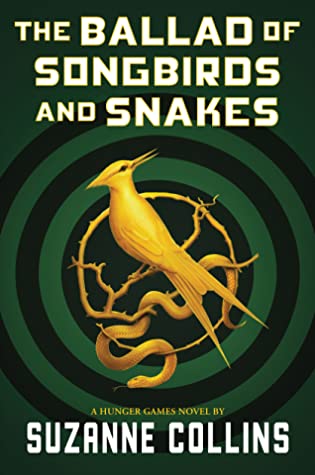
- The Ballad of Songbirds and Snakes by Suzanne Collins, for older readers ready for young people forced to fight while adults watch.
- Never Let Me Go by Kazuo Ishiguro, for the grown-up sharing this book: a quieter, devastating novel about children raised for a purpose they are not told.
About Erik Jon Slangerup
Slangerup lives in Columbus, Ohio, where he is the father of six, and he has been writing about monsters, robots and spaceships since childhood. He began with picture books before moving into middle-grade fiction. Aladdin published The Intergalactics by Erik Jon Slangerup in hardcover on 29 September 2026, and it is out now.
- His first middle-grade novel, Molly and the Machine, came out in 2022 and opened the Far Flung Falls series.
- Its sequel, Molly and the Mutants, followed in 2023.
- His earlier picture books include Dirt Boy, first published in 2000.
- The science behind the hybrids leans loosely on real genetic engineering, stretched across galaxies.
The Verdict
There is a good deal to admire here. The world is built with real invention, the gang of misfits is easy to love and the book’s central idea, that a child is a person and never a product, is one every young reader deserves to meet in an adventure this lively. The Intergalactics by Erik Jon Slangerup is let down by a repetitive middle and a finale that leans on luck, but it moves fast, makes children laugh and gives them something to argue about afterwards.
Hand it to a reader who has outgrown being told which test comes next.
Content notes tap to reveal
Where to read The Intergalactics
Amazon lists the current Kindle, print and audiobook editions, and shows whether the ebook is in Kindle Unlimited right now.
To borrow it free, try your library: Libby and OverDrive lend ebooks and audiobooks with a library card, and WorldCat finds print copies near you.
We don’t link to “free PDF” sites. Those copies are pirated and pay the author nothing.