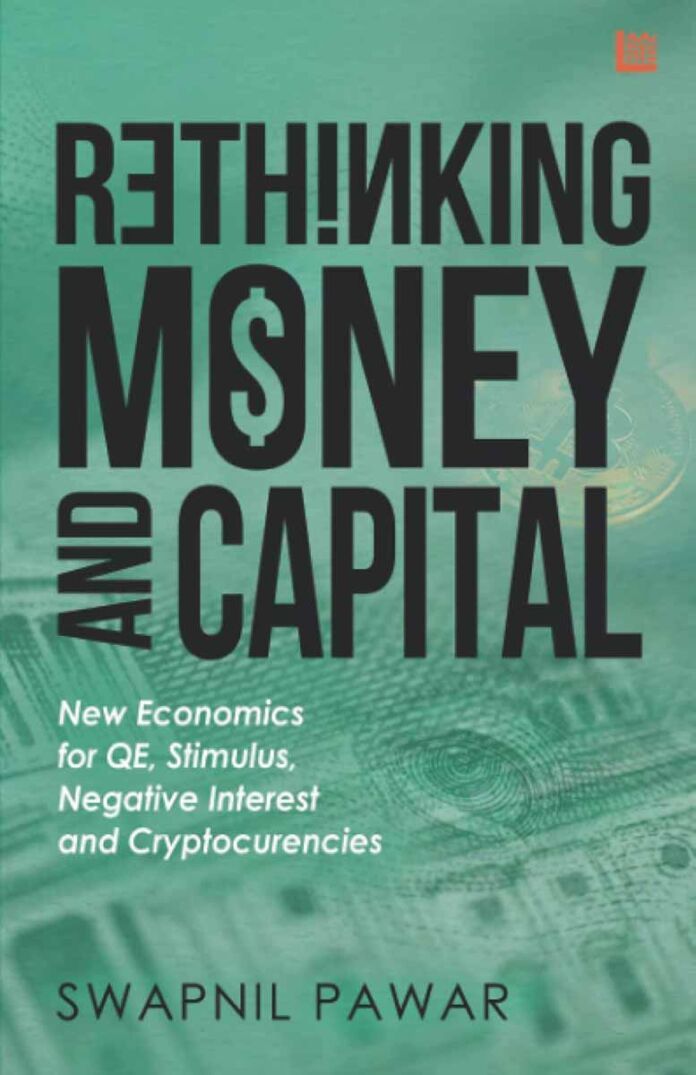
Book Summary: Rethinking Money and Capital by Swapnil Pawar
While money and capital occupy a centre stage in our daily lives, we rarely pause to think about their real nature. Contrary to an intuitive and unstated belief of most people, money and capital are not resources but simply bidding tokens. This rethinking of their nature can free the collective energies of human race from several artificially imposed constraints that hold no water upon closer scrutiny.
The analysis in this book leads to many counterintuitive conclusions. For example, the fiscal deficit is the counterpart of the demand for net savings by individuals and not an evil to be battled. Inflation is sometimes an indicator of more egalitarian distribution of incomes and not always a scourge that hurts the poor. There is a strong case for negative real interest rates on risk-free debt.
The book employs these and several other such inferences into a broad program for reinvigorating our economic policy towards a better life for all.
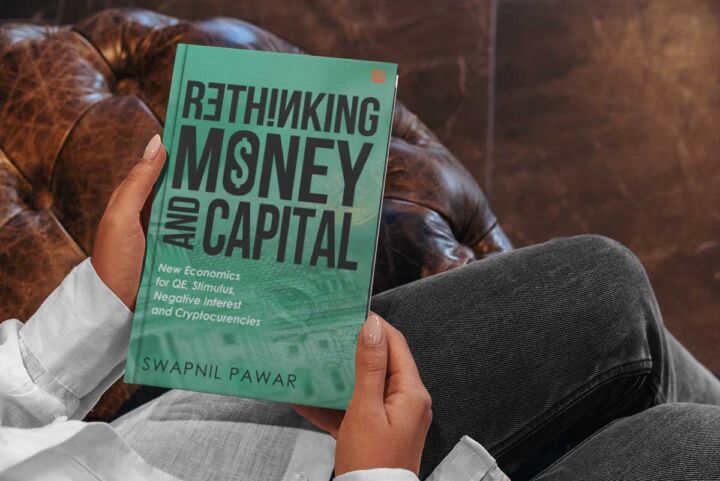
Book Review: Rethinking Money and Capital by Swapnil Pawar
The global economy is in a rut, and there doesn’t seem to be any relief in sight from the painful pattern of periodic financial collapses. In reality, of course, there are a number of approaches that may be adopted to tackle not just the reoccurring fiscal crises but also the continuous social and ecological predicaments that we are facing. Where there were once insurmountable obstacles, there are now viable options for resolution. The changes did not come as a consequence of increased conventional taxation, enlightened self-interest, or programmes run by the government; rather, the improvements came about as a result of individuals simply rethinking the concept of money. Everything will be transformed as a result of this restructuring.
In this pioneering book, Swapnil Pawar traces the development of our present monetary system, which is based on bank debt and scarcity, and reveals the surprising and often shocking ways in which the system’s unconscious constraints give birth to so many critical problems. The author tells anecdotes of ordinary people that have strengthened local economies, created jobs, improved lives, and provided educational opportunities by using new money in conjunction with national currencies.
Money is nothing more than a social construct, which is something that we often overlook. According to the author’s explanation, the modern monetary system is distinguished by the dominance of a single kind of money, which takes the form of scarcity-based, interest-bearing national currencies. In addition, the system has resulted in negative consequences. The creation of scarcity in the economy by banks leads to the development of a society that values competition above collaboration. Money that is driven by debt and interest rates exacerbates inequality since it goes to those who are seen to be “creditworthy.” The author shows why the existing system has not served it well but that we may create new systems that better meet its needs.
Rethinking Money and Capital offers solutions to problems that governments, businesses, nonprofit organisations, local communities, and even financial institutions are now facing. In doing so, it demystifies a subject that is both complex and extremely important, striking a deep connection with readers who are looking for innovative, substantive answers that will do more than just restore prosperity; it will provide the framework for an era of sustainable wealth.
Swapnil Pawar addresses important issues pertaining to the monetary system in his book, Rethinking Money and Capital. He offers a blueprint for a modernised system of money and finance that is both feasible and powerful, and, most importantly, can be achieved through the implementation of incremental changes to the system that the government is currently using. The author adopts both theoretical and practical approaches to explore the key issues and outlines the policy implications for monetary systems and the economy, with reference to negative interest rate policy, quantitative easing, stimulus, and cryptocurrency. This book will serve as a helpful resource for policymakers as well as academics, advanced students, and researchers in the fields of financial economics and international finance.