
Title: The Sign of the Four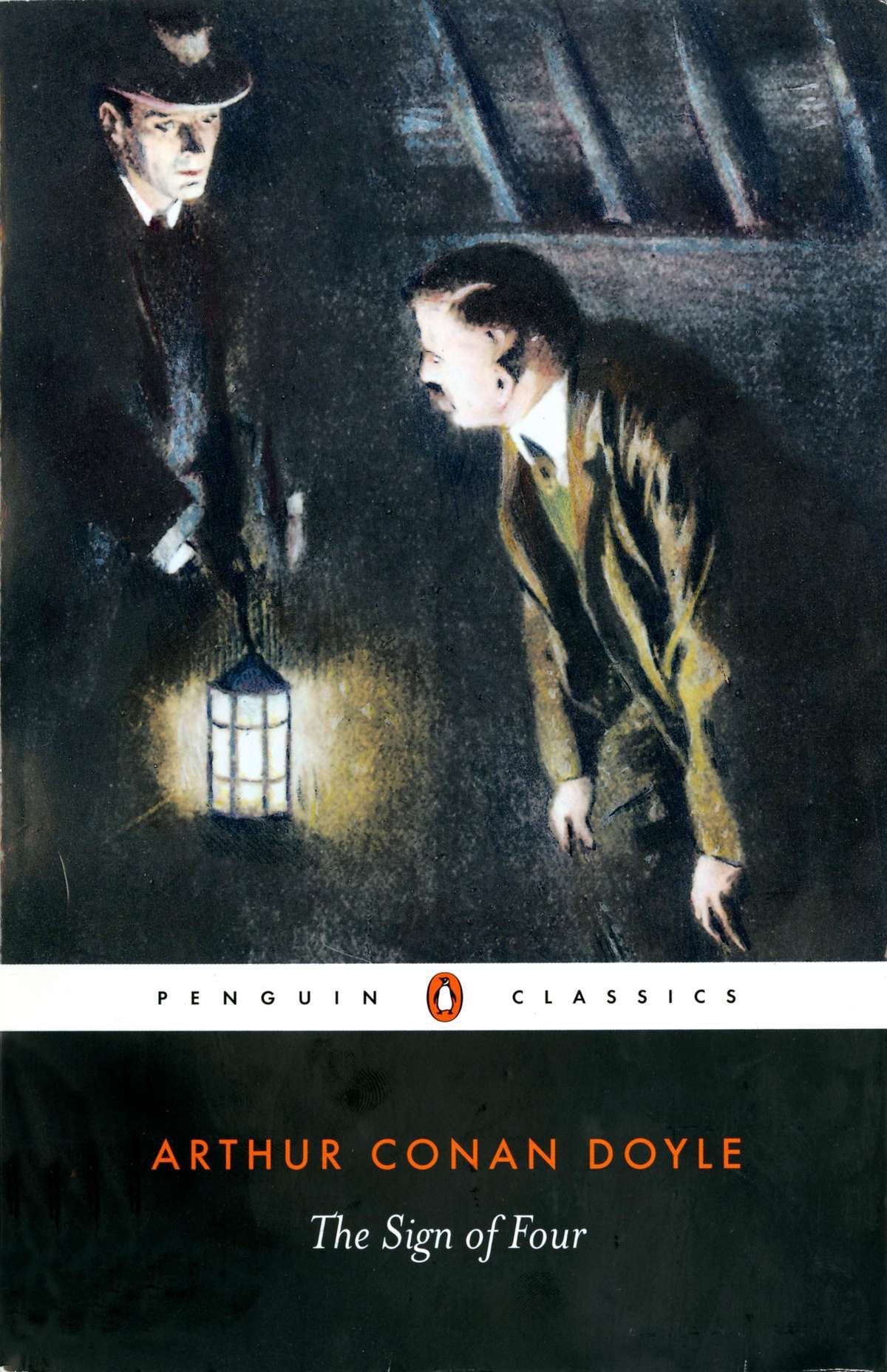
Author: Sir Arthur Conan Doyle
Series: Sherlock Holmes: Book 2
Publisher: Lippincott’s Monthly Magazine
Genre: Crime, Mystery, Detective Fiction
First Publication: 1890
Language: English
Major Characters: Sherlock Holmes, Dr. John Watson, Jonathan Small, Mary Morstan, Thaddeus Sholto
Setting Place: late 19th century London
Narration: First person
Preceded by: A Study in Scarlet
Followed by: The Adventures of Sherlock Holmes
Book Summary: The Sign of the Four
As a dense yellow fog swirls through the streets of London, a deep melancholy has descended on Sherlock Holmes, who sits in a cocaine-induced haze at 221B Baker Street.
His mood is only lifted by a visit from a beautiful but distressed young woman – Mary Morstan, whose father vanished ten years before. Four years later she began to receive an exquisite gift every year: a large, lustrous pearl.
Now she has had an intriguing invitation to meet her unknown benefactor and urges Holmes and Watson to accompany her. And in the ensuing investigation – which involves a wronged woman, a stolen hoard of Indian treasure, a wooden-legged ruffian, a helpful dog and a love affair – even the jaded Holmes is moved to exclaim, ‘Isn’t it gorgeous!’
Book Review: The Sign of the Four
The Sign of Four (1890) was the second volume in the Sherlock Holmes series, written by Arthur Conan Doyle three years after the first. So, one could not say that the demand for a sequel was overwhelming. Curiously enough, at the evening party the offer to publish such a sequel was made to Conan Doyle, the same magazine editor made an offer to Oscar Wilde for The Picture of Dorian Gray. That must have been a fairly interesting periodical.
The Sign of Four opens with the revelation that Holmes was injecting himself three times a day with cocaine or morphine, depending upon the desired effect. Holmes explained he needed the cocaine for mental stimulation when he was not busy with a challenging case.
In addition, it was made clear in A Study in Scarlet that Holmes was what Germans call a Fachidiot , a person who is an expert in their specialty but knows nothing about anything else.
“How often have I said to you that when you have eliminated the impossible, whatever remains, however improbable, must be the truth?”
Now coming to the plot of The Sign of the Four, Mary Morstan has been receiving large pearls in the mail from an unknown source since her father’s death. She contacts Sherlock Holmes and Dr Watson after she receives a letter to meet with an anonymous person to right an injustice done to her. An unusual man, Thaddeus Sholto, tells the trio that Mary is one of the heirs to a treasure. As they go to meet with a Sholto family member, they come upon a murder victim in a locked room.
The plot is complex with elements of the crook’s confession going all the way back to the Indian Rebellion of 1857. Like much literature of the 19th Century when Great Britain was a colonial power, the book does come across as racist toward the native people. However, Indian art objects and clothing are depicted as beautiful and exotic.
“The emotional qualities are antagonistic to clear reasoning.”
Holmes is brilliant and an observer of the smallest details as he solves the murder. Watson is warm and caring as he falls in love with Mary Morstan, and acts as Holmes faithful assistant. Holmes has no use for love and says, “Love is an emotional thing, and whatever is emotional is opposed to that true, cold reason which I place above all things. I should never marry myself, lest I bias my judgment.”
The mystery was entertaining with the wonderful partnership of Holmes and Watson, as well as other interesting characters. The London detective work was great, but the plot got overly convoluted when it worked back to India in the criminal’s confession.
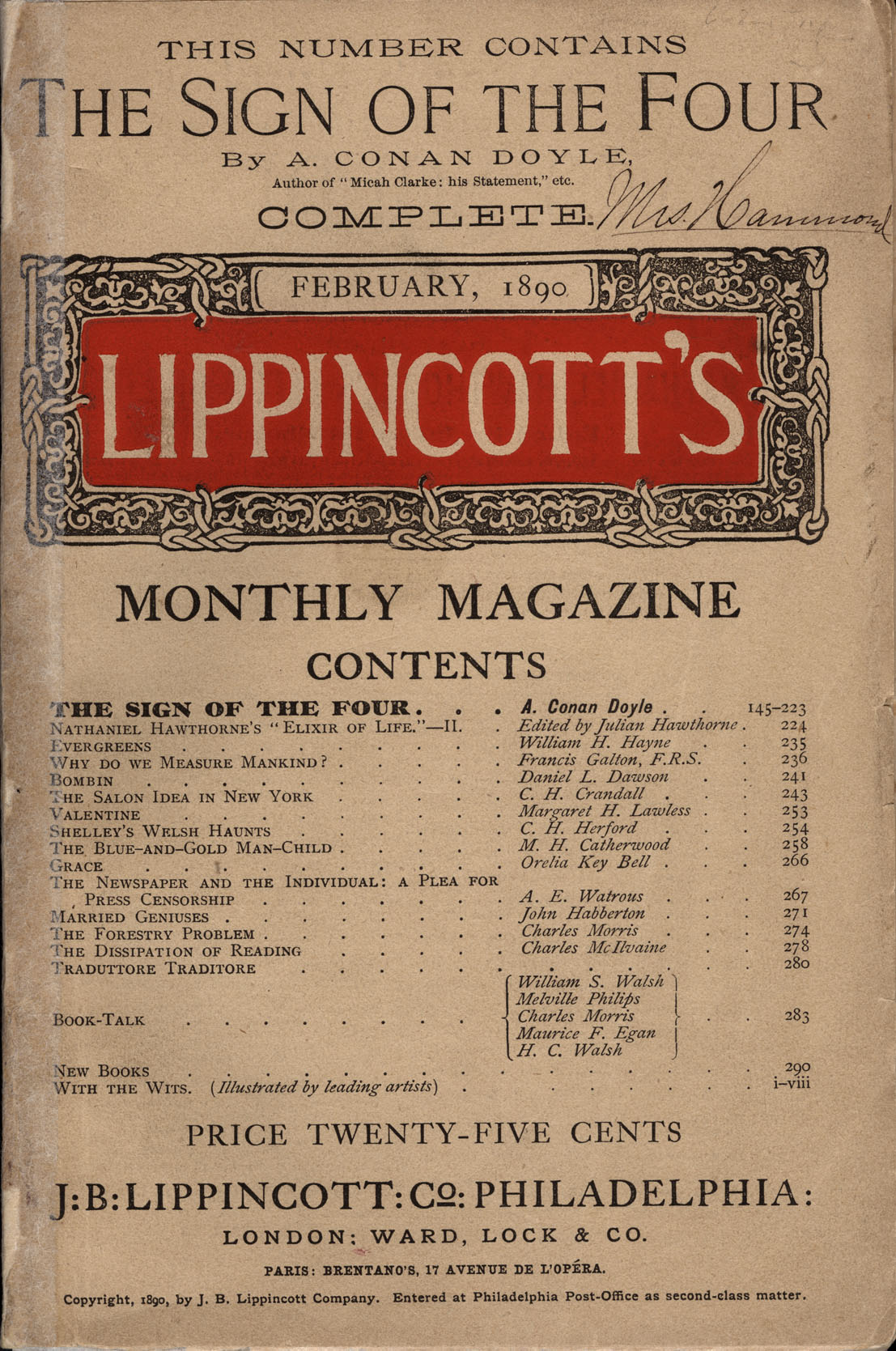
The novel first appeared in the February 1890 edition of Lippincott’s Monthly Magazine as The Sign of the Four; or The Problem of the Sholtos (five-word title), appearing in both London and Philadelphia.
The British edition of the magazine originally sold for a shilling, and the American for 25 cents. Surviving copies are now worth several thousand dollars.
As with the first story, A Study in Scarlet, produced two years previously, The Sign of the Four was not particularly successful to start with.
It was the short stories, published from 1891 onwards in Strand Magazine, that made household names of Sherlock Holmes and his creator.







