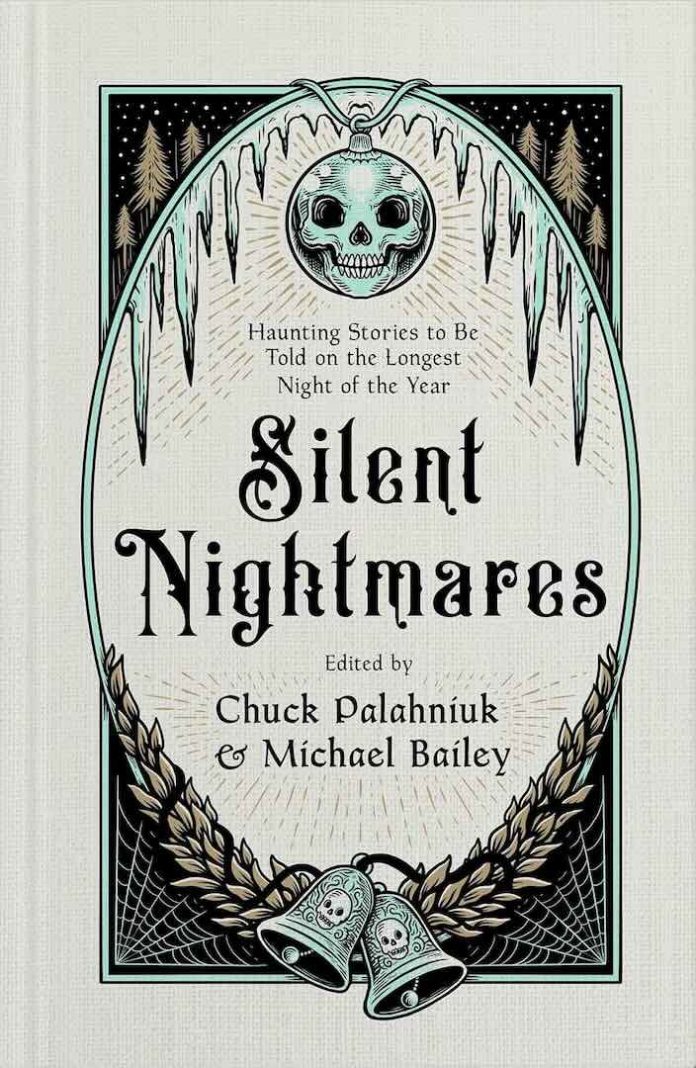
At three in the morning on Christmas Day, in an alley behind a Walmart, a police officer in a Santa hat hands a Breathalyzer to a small man in a faded red robe. The man has drunk nothing but bottled water, there are hundreds of empties around him, and he is surrounded by a multiplying supply of white bread and frozen fish sticks. The device reads 1.45 percent. The officer slaps it against his thigh, resets it, and makes him blow again. It reads 1.45 percent again. That story is called “Rapture”, it is by one of the two editors, and it is the best indication of what Silent Nightmares by Chuck Palahniuk is actually like.
Where Silent Nightmares by Chuck Palahniuk Sits
First, a correction that the cover invites. This is not a Palahniuk collection. It is an anthology of twenty stories by twenty writers, compiled by Michael Bailey and Chuck Palahniuk, who contribute a foreword, an afterword and one story each. Readers coming for four hundred pages of Palahniuk will get about fifteen.
What it is instead is a deliberate revival. The pitch is that the Christmas ghost story was a Victorian industry before it became a curiosity, and that the holiday has worse things underneath it. Bailey’s foreword names them: Krampus with his birch switch, Grýla with her sack, the Yule Cat hunting anyone who got no new clothes, the Wild Hunt, and the Mari Lwyd, a horse skull on a pole that comes to your door and demands a rhyming contest. Against that lineage, Silent Nightmares by Chuck Palahniuk is not a novelty item.
The roster is the real selling point, and it is unusually wide. Ramsey Campbell, Joe R. Lansdale, Alma Katsu, Josh Malerman, Lisa Morton, Gabino Iglesias, Jonathan Maberry and Cynthia Pelayo are all here, alongside writers with far smaller profiles: Mari Ness, Wil Dalton, Krissy Eliot, Annie Neugebauer, Eugen Bacon. The spread matters, because the famous names are not the ones who win.
The Argument the Book Has With Itself
Most anthologies have no thesis. This one has two, and they contradict each other.
Bailey opens in earnest: comfort at midwinter is a lie, the solstice was survival rather than celebration, and this book is a reclamation. Palahniuk closes by taking that apart with cheerful materialism. Why did the Victorians love a Christmas ghost? Three answers, none mystical. Gift-giving is anticipation chemistry and Christmas afternoon is the crash. Cheaper lighting stretched winter evenings, British periodical numbers went from under 150 in 1800 to nearly 5,000 by 1900, and editors kept short ghost stories on hand purely to fill the leftover pages of a folio. And, borrowed from a British Library curator, domestic carbon monoxide peaked on Christmas Eve, and it causes hallucinations.
He turns sincere only at the end, on the observation that belief in a thinning veil at the solstice is prehistoric, and that Dickens used the form for social reform. The stories in Silent Nightmares by Chuck Palahniuk fall on both sides of that split, and a reader who notices the argument gets more out of the running order.
The Best of the Twenty, and What Chuck Palahniuk Adds
Four stories are worth the price on their own, and only one is by a name you will know.
Mari Ness’s “Always Winter” is a time loop in which it is Christmas every day, indefinitely, and the world has quietly reorganised around it: shops shut, supply chains failing, a family counting time in Christmases while eating pancakes they no longer want. Wil Dalton’s “A Season for Reflection” gives an elderly widow a dead husband who appears only in reflective surfaces and takes her body while she sleeps, told in the voice she uses to forgive him. Gabino Iglesias’s “The Singing Children” puts thirty children at a village tree line at night, singing in the faces of the dead, and lets a widowed farmer work out what is wrong by watching dogs that will not approach. And Bailey’s own “Rapture” is the funniest and angriest piece here, a procedural joke about field sobriety tests that turns out to be about waste.
As for the man on the cover: “Kingston” is Palahniuk doing precisely what Palahniuk does, in first-person plural, with a Nebraska cousin who has found God and a laser pointer. It is the most aggressive thing here and the likeliest to make someone close the book, and its closing symmetry does not justify the pages spent on it. His afterword is better than his story.
Where Silent Nightmares by Chuck Palahniuk Gives Ground
- There are no content warnings anywhere in the book. It contains sustained child abuse, a child kept in a cage, rape, a euthanasia in forensic detail and an infant abduction, and it is sold as a seasonal gift. That is an editorial failure rather than a matter of taste.
- The devices cluster. Three stories end with the narrator taken by a cloaked or skeletal figure. Three are set at the bedside of a dying parent. Read in order, the repetition shows.
- Twenty stories in 269 pages means several never get room to land. At sixteen it would be stronger.
- The tonal gear changes are brutal. Two of the heaviest stories about long-term abuse sit a few pages from Jonathan Maberry’s closing comedy, in which four characters score each other’s suicides on splash pattern and duration. Nothing prepares you.
Read It If, Skip It If
Silent Nightmares by Chuck Palahniuk knows which shelf it belongs on.
Read it if:
- You want the Victorian seasonal ghost story taken seriously. Campbell, Pelayo and Morton are each in direct conversation with Dickens or M. R. James.
- You read anthologies for discoveries. Ness, Dalton, Eliot and Iglesias are the reason to buy this.
- You like range. Folk horror, pandemic polemic, pulp crime, prose-poetry and two stories with nothing supernatural in them at all.
Skip it if:
- You need to know what is coming before you read it. This book will not tell you.
- You are buying it for Palahniuk. One story, one afterword, a shared compilation credit.
- You want cosy. There is none here, including in the stories that end warmly.
Content Notes
Across the collection: prolonged abuse of a child by a parent, with confinement; rape, described; the sexual humiliation of a teenager; suicide depicted, including a teenager’s and a parent’s; a dog killed in veterinary detail, and another killed on a neighbour’s complaint; a dying woman smothered; an infant taken; sustained domestic violence and coercive control, forgiven by the victim; serial murder of women, including dismemberment; body horror involving teeth, eyes and skin; mass atrocity invoked through the names of real perpetrators; impalement and public torture; pandemic illness and harassment of disabled people. Several stories end without rescue.
Read These Next
Five of ours for readers who finish Silent Nightmares by Chuck Palahniuk.
- Shock Induction by Chuck Palahniuk is his most recent novel, a fairer test of him than one short story.
- Winter in The City: Edited by R B Wood & Anna Koon is the obvious comparison: another cold-weather anthology, gentler and more uneven.
- Sometimes I Scare Myself by Jeneva Rose for a single-author collection to read against this.
- Bone-Chilling Classic Horror Books to Keep You Up at Night for the Victorian tradition these writers are raiding.
- Unveiling the 10 Best Horror and Mystery Books You Can’t Miss if you would rather return to novels.
The Last Word
The subtitle promises stories to be told on the longest night, and that is worth taking at face value, because the book is unusually easy to read aloud. Most pieces run fifteen to twenty minutes. Several are built on a repeated phrase that works better spoken than silent: Krissy Eliot’s narrator calling her husband a loving, practical man who kept her free of worry, over and over, while the thing in the basement breathes.
What keeps the collection honest is how often it declines the supernatural. Alma Katsu’s has no ghost at all, only a woman on a hospice night shift who recognises a name on a door and decides what she is owed. Dalton’s has a ghost but does not need one. Gary Braunbeck’s reads as a girl’s journey into a glowing snowdrift and then reveals on the last page what she was actually doing. The scariest material in Silent Nightmares by Chuck Palahniuk is domestic, and the editors seem to know it, which is why the vampires come last. Buy it for the writers you have not heard of. Do not give it to anybody without saying what is in it.







