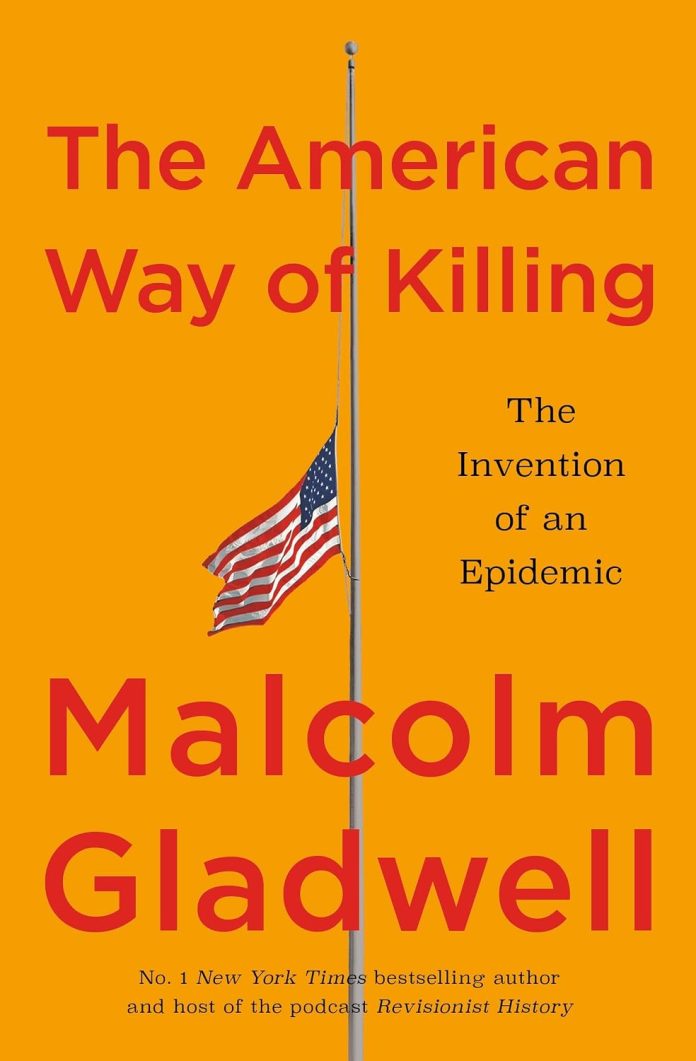
Two numbers from Memphis. In 1935 the city recorded roughly forty homicides per hundred thousand people; by 1985 that figure had halved. Anyone reading the local paper would have concluded Memphis had become safer. Over the same fifty years the rate of serious assaults there nearly doubled. More people were being attacked, and fewer of them were dying. The American Way of Killing by Malcolm Gladwell builds its most interesting chapter on that gap, and the explanation it offers is not that Memphis calmed down. It is that Memphis got better doctors, and everyone else took the credit.
What The American Way of Killing Is Actually Arguing
The American Way of Killing by Malcolm Gladwell opens with an emergency physician on the South Side of Chicago who has buried fifteen close friends and an older brother, all shot, and who went back to practise medicine in the neighbourhood he grew up in.
From there the argument runs through eight chapters in three parts, and it is more disciplined than Gladwell’s reputation suggests. Americans think they have a crime problem; the opening pages show that robbery rates in Paris and London comfortably exceed Chicago’s, and that crime and lethal violence are separate phenomena with separate causes. Americans think most murders are planned; four centuries of records say homicide is mostly an argument that escalates. And Americans think they are heavily policed; Berlin, the same size as Los Angeles, has roughly twice as many officers.
The Chapter That Justifies the Book
The third chapter is the one to read, and it is the most genuinely new idea here. Modern American trauma care is extraordinarily good, for a reason nobody wants to say aloud: American surgeons get more practice with bullet wounds than anyone else on earth. Gladwell gets one Baltimore veteran to walk him through the most remarkable case of a thirty-five-year career, and to estimate that he has personally worked on something like three and a half thousand gunshot patients.
Then comes the turn. If wounds that killed people in 1970 are survivable in 2026, the homicide rate can fall while the violence underneath it rises, and a country can congratulate itself on progress its paramedics manufactured. The American Way of Killing by Malcolm Gladwell names the effect after that Baltimore surgeon and reaches for the economics of moral hazard: a few people absorb the consequences of everyone else’s failure, so nobody else has to act. It is supported rather than asserted, including an estimate that medical improvements alone cut the death rate from wounds by up to four per cent a year.
He sharpens it twice. Nobody in the federal government counts how many Americans are shot and survive; a criminologist needed a Justice Department grant to hand-count four years of cases in four cities, and found three non-fatal shootings for every fatal one. And the neighbourhoods furthest from a Chicago trauma centre are overwhelmingly Black, so the same wound is likelier to be recorded as a murder depending on where the victim was standing.
Killing, Malcolm Gladwell, and the Trouble With the Rifle Chapter
Chapter one is the problem. Gladwell goes to a range in North Carolina with a law professor and competitive shooter, learns to hit a target, and then takes apart what an assault-weapon ban prohibits: pistol grips, forward grips, folding stocks, barrel shrouds, threaded barrels, mounts for grenades nobody may legally own. The 2025 Senate bill names the banned rifles across seven pages, then lists the functionally identical rifles that stay legal across ninety-six. That is fair and damaging, and his statistical point stands: handguns are used in the large majority of mass shootings and in most American gun deaths.
Where The American Way of Killing by Malcolm Gladwell overreaches is the leap from “these bans are cosmetic” to “the rifle is not the problem.” The lethality claim rests on one study of 232 autopsy reports, and magazine capacity, which is the substantive part of the argument, gets handled in a footnote leaning partly on a criminologist whose gun research is heavily contested. A reader who knows the field will notice that the weakest chapter comes first, and will read the rest more warily than it deserves.
Where The American Way of Killing Gives Ground
Four things hold The American Way of Killing by Malcolm Gladwell back.
- Contested scholarship arrives as settled. The argument that the militia clause was a concession to Southern slave patrols rests on one law professor’s thesis and one linguist’s corpus analysis. Both are real work; both are minority positions. No serious originalist reply appears.
- He wants twice as many police and barely argues with the objection. The case that America is under-policed is his best-evidenced, and it includes the finding that the fewer officers a country has the more violent they tend to be. But the question of how you double a force that much of the public distrusts gets a few pages and a shrug.
- The elephant never gets assembled. He promises in the introduction that the separate parts will add up to a whole and that the problem is not intractable. The book ends on a parable. There is no chapter that says what to do, in what order, at what cost.
- The machinery is visible. Every finding gets a coined name, a parable and a reversal. When the evidence is strong this is thrilling; when it is thinner, the shape of the argument does the persuading.
Read It If, Skip It If
The American Way of Killing by Malcolm Gladwell is for a particular reader.
Read it if:
- You want reporting rather than polemic: a gun-rights professor, trauma surgeons and a police chief all talk at length.
- The idea that a falling murder rate can conceal rising violence is new to you.
- You like being told that what everybody agrees on is wrong, and shown the data.
Skip it if:
- You want a policy programme at the end.
- Clinical description of gunshot injuries is something you would rather not read.
- You have no patience for the house style, which is very much intact.
Content Notes
Sustained clinical description of what bullets do to organs. Children taught to treat wounds; an entire class who have each lost a relative to shooting. Individual killings recounted, including intimate-partner homicide. Gun suicide figures and a discussion of access to means. Slavery, a slave rebellion and its suppression, and slave patrols. Racism in ambulance dispatch. Mass shootings described, including Uvalde and Aurora. Police violence. Prison conditions.
Read These Next
Five of ours for readers who finish The American Way of Killing by Malcolm Gladwell and want more.
- Outliers by Malcolm Gladwell for the method in its purest form. Revenge of the Tipping Point is the closer sibling in subject.
- Between the World and Me by Ta-Nehisi Coates for what this material feels like from the inside.
- Home of the Happy by Jordan LaHaye Fontenot for one American killing examined to the bone.
- Supercommunicator by Charles Duhigg if the conversational-failure thread is what caught you.
- The Power of Storytelling in Nonfiction Writing on how books like this are built.
One practical note: the edition reviewed here is an uncorrected galley, with notes and index unfinished, a footnote missing and a date that contradicts the main text. For a book arguing this hard from numbers, not being able to follow the citations is a real limitation, and the finished edition will presumably remove it.
The Verdict
The Second Amendment chapter sends him back to the Stono Rebellion of 1739, when a group of enslaved men on the South Carolina coast killed their way up a road for a day before an armed church congregation stopped them. The men who rode out that Sunday were a slave patrol, drawn from the militia. That, he argues, is the anxiety Madison was answering in Richmond fifty years later, and the sentence the Supreme Court has since read as though its first half were throat-clearing.
Whether or not that chapter convinces you, the closing pages will. The American Way of Killing by Malcolm Gladwell ends in Dodge City, where tourists pay to watch actors shoot each other, and where the real town in the 1870s put up a sign at the bridge prohibiting firearms, ran a gun check like a coat check, and hired six officers for two thousand residents. Homicides fell to fewer than two a year. The most famously lawless town in the American imagination looked at its problem and fixed it in about eighteen months. That is a better ending than a policy chapter, and a more damning one.







