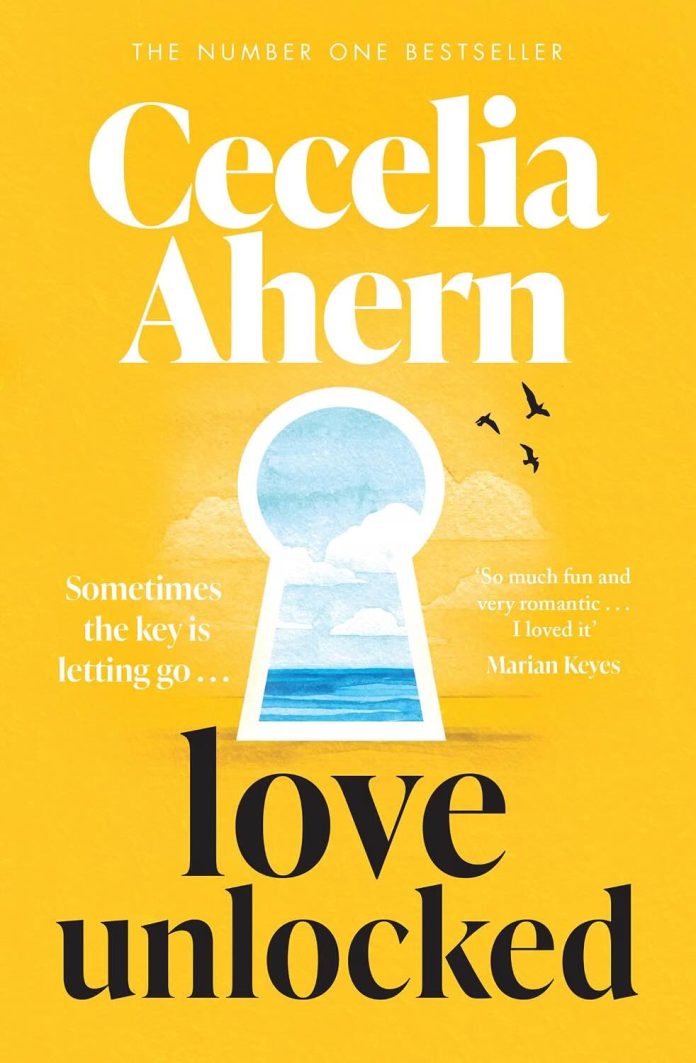
The novel opens with two chapters that are barely a page each. In the first, a woman lying awake in a flat beside a railway line replays the moment she stopped her boyfriend’s hand across a restaurant table before he could ask the question. It is titled with a single word: no. In the second, a man drops to one knee in a Cork hallway strung with Christmas lights, in front of everyone he loves, and recites a proposal stitched together from her favourite film quotes. That one is titled yes. Then the page turns and it says: two years later. Both of those relationships are over. Love Unlocked by Cecelia Ahern spends the next four hundred pages working out why, and it is much more carefully engineered than the premise suggests.
How Love Unlocked Is Built
Thirty-six chapters, alternating strictly between two people who do not meet until roughly a fifth of the way in.
Melody Yates is a well-known Dublin dance DJ, half of a hit podcast in which she argues the anti-love case against a glossy daytime television star who collects meet-cutes. Al Collins is head of bridge maintenance for Leinster, and two weeks before Christmas his fiancée left him for the best friend who lived in their spare room and works four desks away.
Al’s professional judgement is that the Grace Plunkett footbridge cannot carry twenty thousand padlocks. He has them cut off on a wet Thursday in January. Melody, chasing a podcast segment, notices that every couple she knows who broke up that week broke up on the same day, and that all of them had a lock on that bridge.
The Letters Between the Chapters
The best formal decision in the book is the one that has nothing to do with either of them.
Five times, the narrative stops and gives you a real letter from Joseph Plunkett to Grace Gifford, transcribed from the National Library of Ireland. They are not summarised or fictionalised. They are simply printed, in his repetitive, breathless, unembarrassed voice, and each is followed by a line stating how many days remain before he is executed by firing squad in Kilmainham Gaol.
The bridge is named for Grace Gifford, who married him in the prison chapel hours before that happened. Placing those letters against a novel about people who cannot commit to a joint mortgage is a bold move, and Love Unlocked by Cecelia Ahern mostly earns it.
Melody and Al, and Two Kinds of Fear
The two leads have symmetrical damage, which is neat but not glib.
Al is a grand-gesture man, a former competitive rower who bent his whole personality around a woman and a friendship and cannot understand how he missed what was happening in his own house. His grief is written without dignity and is much better for it: the crying in the office toilets, the frozen mice, the buttons cut off shirts, the spare key he had copied.
Melody is the harder character and the more interesting one. She does not fear love. She fears the lift rather than the stairs, the closed door, the thing with no way out. And she also cannot spend a night alone in her own flat without a panic attack, and Love Unlocked by Cecelia Ahern is quietly excellent on how those two things are the same wound viewed from opposite sides.
Al’s Song of the Day
One small device does a surprising amount of work.
Each day Al picks one song and plays it on repeat, at volume, all day, as a mood he has decided to inhabit. Joy Division on the worst day. Simon and Garfunkel on the emptiest. Alanis Morissette when he wants the fury of a wronged woman on his side. The novel takes each one seriously enough to tell you its release year and what he thinks it means.
It is a device that could have been twee and instead becomes the most efficient emotional shorthand in the book. You always know exactly where he is before he says a word.
Where Love Unlocked Strains
Four things stop it being top-tier Ahern.
- The middle sags. There is a long stretch of podcast meetings, office politics and repeated conversations about whether the theory is real.
- The revenge comedy sits oddly. Some of it is genuinely funny; some of it lands as cruelty played for laughs, and the tonal join shows.
- Coincidence carries a lot. People bump into precisely the right person at precisely the right moment more than once.
- The final movement is very fast. After a slow, careful build, the last stretch resolves several large problems in very few pages.
Even so, Love Unlocked by Cecelia Ahern is her most structurally ambitious book in a while, and the ambition pays off far more often than not.
Is Love Unlocked a Standalone?
Yes, completely.
There is no series and nothing you need to have read first. The acknowledgements do reveal that the idea came out of research for Into the Storm, when the author read about the padlocks removed from the Pont des Arts in Paris and wondered what happened to all those couples afterwards. Readers who know her back catalogue will spot the family resemblance to her debut, but Love Unlocked by Cecelia Ahern stands entirely on its own.
Content Notes for Love Unlocked
Infidelity and betrayal by a close friend, sustained across the book. Panic attacks and claustrophobia, described from inside. Explicit sex. An extended sequence of domestic rage in which a man throws his wife’s belongings into the street and breaks glass in a house with children asleep upstairs. Parental abandonment and neglect of a teenager. Historical execution and imprisonment. Drug use in the backstory. Divorce and separation throughout, including of long marriages. Suicidal thinking, briefly and obliquely.
Read it if / Skip it if
Read it if you want a romance with a real idea underneath it; if you like a novel whose shape is doing the arguing; if the phrase “Dublin bridge engineering” makes you curious rather than tired.
Skip it if you need a tight plot; if petty revenge as comedy is not for you; if you would rather the historical material stayed out of the love story.
Read these next
Five for readers who finish Love Unlocked by Cecelia Ahern and want more of it:
- Into the Storm by Cecelia Ahern. The novel whose research produced this one.
- P. S. I Love You by Cecelia Ahern. Her debut, and the obvious companion piece on letters and loss.
- If We Could Turn Back Time by Siân O’Gorman. For more Irish women reassessing what they actually want.
- I Know How This Ends by Holly Smale. For a love story built around a formal conceit.
- Sweet Heat by Bolu Babalola. For heartbreak handled with more heat and just as much heart.
What Stays With You
Go back to those letters. Each one is followed by a flat editorial line telling you how long the writer has left: a hundred and fifty-four days, then ninety-four, then twelve, then five. He does not know. He is complaining that he misses her, asking her to say she loves him, sending her money and a small gun and telling her how to use it. The countdown is entirely for the reader’s benefit, and it is merciless.
That is the argument Love Unlocked by Cecelia Ahern is quietly making underneath the padlocks and the podcast and the frozen mice. Nobody gets told how many days they have. The couples in this novel behave as though a symbol bolted to a footbridge is what holds them together, and the man in the letters had no symbol at all, ninety minutes of marriage, and a love people are still tying metal to a bridge over a century later. The book is funnier than that makes it sound and messier than it needed to be. It is also the only romance this year that made me want to go and stand on a specific bridge.







