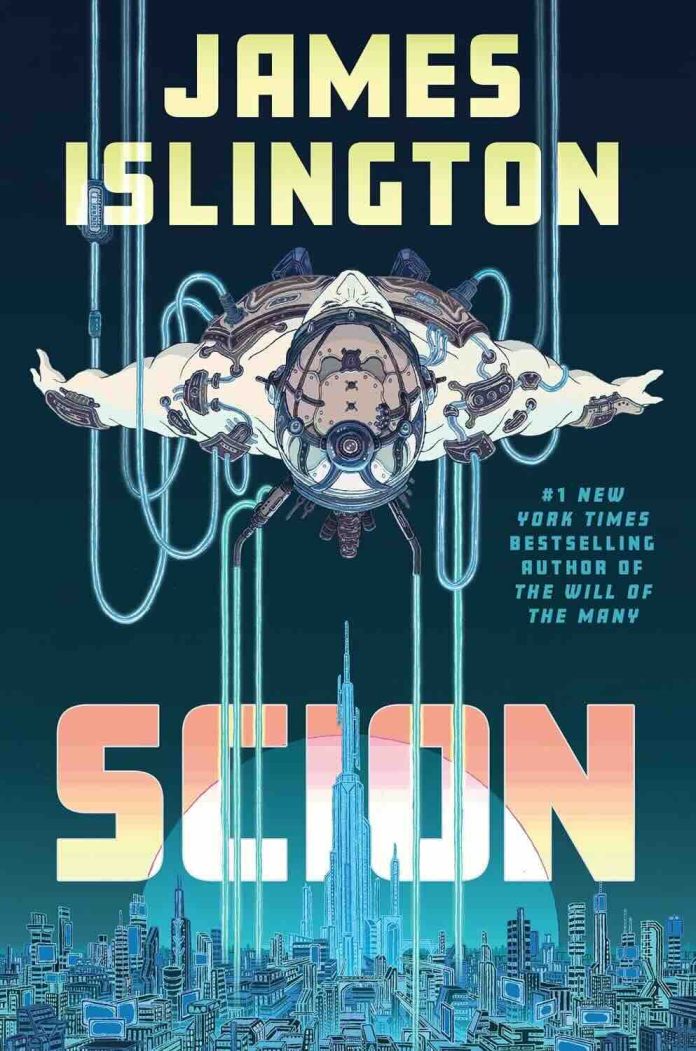
The dedication of Scion by James Islington reads: for everyone still hoping we’ll see more of Adam Jensen one day. If that line means something to you, you already know what kind of book this is, and you are going to have a very good time.
It is a holiday, and the author says so himself in the acknowledgments. He wrote it to take a break from the heavier weather of the Hierarchy novels, purely for his own entertainment, and was not certain it would work for anybody else. It works. What arrives is a short, mean, extremely quick cyberpunk thriller narrated by a contract killer named Azure, who has been genetically built to be very good at his job and structurally incapable of minding it.
A City Where Murder Is a Crowdfunding Campaign
Themis is one of twelve megacities under the Plate, an engineered lid that keeps the weather out and the heat in. Below it, a system called DeGov runs government by continuous public vote and logs every transaction on an open ledger. Citizens draw a Basic income. Designer drugs are sold legally in shops. Engineered animals handle security, from giant owls down to something with six spider legs and four tentacles for arms.
And then there is Resolution Ten-O-Ten, the idea the whole book turns on. Fewer than seven thousand people, in a population numbering well over a billion, have bought biological immortality. Ten-O-Ten made killing them legal and made the contracts crowdfundable. Ordinary citizens pledge their Basic toward having a specific immortal killed, and a tower in the city centre displays the running totals like a charity thermometer. It is a genuinely excellent piece of satire, and Islington plays it almost entirely straight.
Where Scion by James Islington Breaks From Hierarchy
Readers arriving from The Will of the Many and The Strength of the Few should know two things before they start.
The first is that this is a standalone. No shared world, no shared characters, no prior reading required. The second is that it is a fraction of the length. Where those books build slowly across six hundred pages, this one runs roughly two hundred and thirty, chapters often three or four pages, and it never stops moving.
The prose changes accordingly. Islington’s fantasy register is measured and formal. Here he writes fast, flippant and present tense, with a narrator who treats mortal danger as an inconvenience and his own death as a scheduling issue.
A Narrator Who Cannot Feel Very Much
Azure carries genetic modifications called revs, split between somatic ones for strength and speed and cognitive ones for recall, pain dampening and something close to precognition. He cannot run them all at once, and running any of them costs him.
The more interesting modification is the one he did not ask about. Azure does not experience much. He watches a friend die and sheds no tear, notices the absence, and files it. He is funny about this, constantly, and throughout Scion by James Islington the humour is doing structural work as a substitute for the reactions he is missing. His running argument with Atti, the self-aware AI in his earpiece, is the best sustained comedy in the book, and one exchange involving an elevator with no voice modulator is the single funniest page Islington has written.
What Works
- Momentum. The plot moves through an aquarium, a toxic waste container, a sewer, a drug lounge, a warehouse and a corporate tower without a slack chapter. Nothing outstays its welcome.
- Legible action. Fight choreography is unusually clear for a book this fast. You always know where everyone is standing and what it will cost to move.
- The world is invented, not borrowed. Nostrums, Slabs, biosecurity, the Pactum ledger, the Plate. It would have been easy to write generic neon and rain.
- The central conceit is set up fairly. The turn the book is built toward is signposted early enough that a careful reader can get there, and hard enough that most will not.
Where It Stumbles
- The world arrives in clumps. Ten-O-Ten, DeGov, revs, bios, nostrums and lifers all need explaining, and several arrive as paragraphs of explanation rather than through scene.
- The supporting cast is wasted. Verity, Chandra and Manuel are each vivid within a page and then gone. Chandra in particular deserves a book.
- A late conversation does too much work. A long stretch of crucial exposition is delivered by a character on a screen while Azure fights two monsters below it, and the fight loses by it.
- The ending is a fork, not a resolution. Islington sets up a genuine choice, then closes the book without telling you which way it went. It is a defensible decision and it will infuriate some readers.
Ten Minutes of Being Human
There is one passage that lifts the whole thing. Azure takes a rare, expensive drug that does not suppress feeling but amplifies it, and for exactly ten minutes he experiences grief, guilt, fury and shame at full volume. It is quiet, it happens alone in a moving pod, and it recontextualises every joke that came before it.
That scene is where Scion by James Islington earns its title and its ideas. Everything else is machinery, very good machinery, but the ten minutes are the argument. The question underneath is an old one made newly uncomfortable, and readers who want the science behind it can start with the NIH primer on cloning, which is drier than Islington and considerably less bloody.
Who Scion by James Islington Is For
Reach for it if you want a cyberpunk thriller that respects your time, if you like a narrator who is funny about terrible things, or if you have wanted a book that reads like a good immersive sim.
Skip it if you need emotional investment early, if unresolved endings ruin books for you, or if you want the density of Islington’s fantasy. This is a different writer in a different mood.
Read These Next
- Altered Carbon by Richard Morgan. The obvious ancestor: hard-boiled violence, bought immortality, and identity as a transferable asset.
- Never Let Me Go by Kazuo Ishiguro. The same question about who counts as a person, answered as quietly as this book answers it loudly.
- Volatile Memory by Seth Haddon. Nearer-future cyberpunk with a similar interest in what gets done to a body.
- Splinter by D.K. Thorne. For readers who want the paranoia turned up and the pace kept high.
- The Will of the Many by James Islington. If this is your first Islington, his other register is worth knowing.
The Last Word on Scion by James Islington
The book is the sound of a writer enjoying himself, and that enjoyment is infectious enough to carry a novel thinner than his usual work in almost every measurable way. The world is a sketch, the cast is a series of brilliant cameos, and the last page declines to answer the question the whole story asks.
It is also faster, funnier and stranger than most things on the shelf beside it, and the ten minutes at its centre are better than anything in a book this size has any business being. Islington called it a break. He should take more of them.







