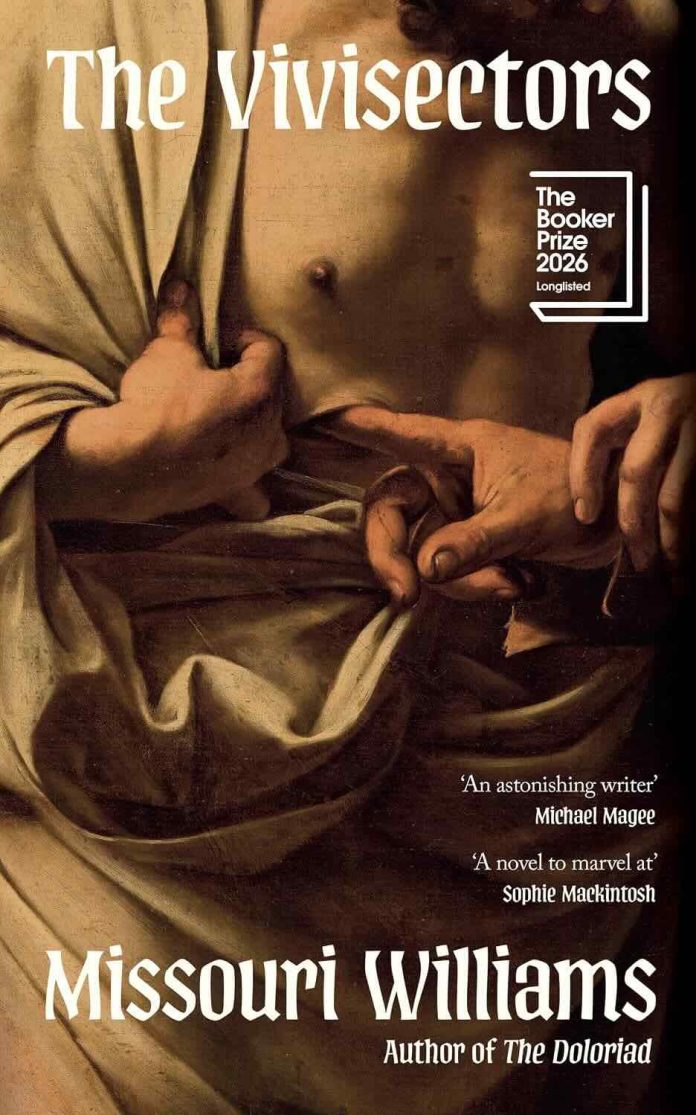
The Vivisectors by Missouri Williams opens with a piece of advice. The narrator's uncle, over breakfast, tells her that if you want to write something terrible about somebody, the first person is the safest form. They will never accept that you were capable of betraying them that utterly, so they will look at anything else instead. Confusing an author with a narrator, he adds, is the most cardinal of literary errors.
Then she writes the book you are holding.
This is Williams's second novel, after The Doloriad, and it announces on page one that it knows exactly what it is doing to you. The judges called it a bracing antidote to the cosy campus novel and to dark academia, which is accurate. It is also considerably stranger than that makes it sound.
What Happens in The Vivisectors
The narrator is called Agathe, though the book withholds that for ninety pages and only releases it when she hands it to a stranger in a library.
She lives with her elderly uncle, a retired literary critic, in a four-storey house at the edge of an enormous park that is slowly eating the city. She is paid an obscene hourly rate by a wealthy foreign woman she refers to only as her boss, and what she is paid for is to be that woman's entire academic career: the thesis, the lectures, the marking, the emails, written in an impersonation of her employer's clumsy second-language idiom, complete with endearing mistakes.
Then a student says something in a seminar. A professor calls it peddling conspiracy theories. The student replies that where he comes from that word is forbidden. The professor complains and has him moved to another class without explanation, and within weeks the faculty has split into camps, the international students who fund the place have found a cause, and the gardeners who hold the vegetation back from the city have gone on strike.
The boss sends Agathe to befriend the student and report back.
The City Is the Best Thing in The Vivisectors
Nothing here is named. Not the city, not the country, not the university, not the boss, not her son, not the gardener's daughter. The husband is named on the final page and it lands like a gunshot.
That could be an affectation. Here it is an argument, because midway through The Vivisectors a sacked philosophy professor delivers a theory about why contemporary novels have no places, no proper nouns and no weather: it is so they can be sold in as many languages as possible, so that any reader can slot themselves into an outline. Williams has written exactly that kind of book on purpose, and then filled it with more specific physical detail than almost anything else on this longlist.
The park is a vast cruciform wilderness that begins in the city centre and pushes into the suburbs in four directions. There is a flooded museum with rows of rotting paintings. A tree has grown through two floors of an abandoned department store. Roots crack through college foundations audibly during summer examinations. Parakeets, released decades ago by a careless zoologist, scream in the birches. The gardeners move in pairs and then in formations and eventually in battalions, hats pulled low, and nobody in the neighbourhood associations dares say a word about it.
What Works
- Agathe. One of the genuinely unpleasant narrators of recent fiction, and impossible to look away from. She grinds her teeth until they are translucent. She walks until her socks are bloody because her step count is the only ambition she has left. She describes the middle of herself as a large dead rock. She is also, frequently, funny, in a register so dry you can miss it.
- The three choruses. Williams stops the novel dead three times to stage something closer to a play. Seven gardeners debating the perfect garden, watched through glass by a narrator who cannot hear them and closes her eyes to listen anyway. Three international students in a common room, one of whom recites a song that the black mould on her dormitory wall sang to her. And a salon of the uncle's elderly friends, where a stranger tells a story about a tower.
- That tower story. A woman who has lived her whole life in a tower watches a prince climb it. She says nothing throughout, because she does not want to distract him, because she is afraid of spoiling the moment, because she thinks love is an exercise in restraint. He reaches the roof. He steps on the glass dome. It is four pages long and I have not stopped thinking about it.
- The whale story, near the end, which I will not describe except to say it concerns an albino whale, a fishing village and a corpse that washes up too conveniently to be believed. It is the best short piece of writing anywhere in this year's longlist.
- The comedy of the boss. A woman who says she loves to garden and watches the gardener through two layers of glass. Who claims she loves to write and has never written a sentence. Whose bookshelves are full of unbroken spines. The portrait is merciless and never quite tips into caricature.
Where It Stumbles
- The argument repeats. Decline, apathy, the emptying of language, the failure of the city to act: this case is made by the boss, the child, the schoolmaster, the students, the gardeners, Adam and Agathe herself, and after the fifth iteration the voices start to blur into one authorial complaint.
- The gardener's daughter never stops being a symbol. Every character in The Vivisectors uses this autistic child to illustrate a theory, including the narrator, who reads her as a historical process made flesh. The novel clearly knows this is an indictment of them. It also never gives the girl a single moment that belongs to her.
- Adam remains a construct. He is written as unreadable and he stays unreadable. Defensible on the theme, thin on the page, and he is asked to carry a great deal.
- One late act goes unexamined. Agathe does something in the last thirty pages that is the largest thing she does in the book, and it is dispatched in a paragraph and never returned to. I understand the coldness as a design decision. I still wanted the novel to look at it.
- The engine is deliberately offstage. We never learn what was actually said in that seminar. That refusal is the point. It also means three hundred pages rest on a hole.
What The Vivisectors Is Actually Doing
The title is the boss's word, delivered mid-rant. We analyse a situation, she says, until we have proved the presence of evil, and nothing escapes our scalpels. We cut people open to find out what they meant.
But the book is not really about a campus row. It is about enclosure. Agathe's founding belief, stated early, is that by enclosing something you create emptiness: a walled field has only two states, full or barren, and once something in it dies nothing replaces it. Everything in the novel is a wall. The park's boundary. The family. The mirrored tower of shared discourse that Agathe describes in a magnificent page-long tirade, built on a mountain crumbling under the weight of everyone climbing it. A student essay imagines a domed city of four layers with all the suffering hidden in the lightless bottom one, and the novel's architect later dreams the same city as paradise and cannot work out how to get rid of the dome.
And glass, over and over. Characters watch each other through windows, partitions, screens and greenhouse panes, seeing perfectly and hearing nothing. The prince falls through a glass roof. The last scene takes place inside a rebuilt orangery that its maker cheerfully admits will crack next summer because the foundations are wrong.
The tower story gives you the moral in one line: she might have thrown him a rope, but it never occurred to her to extend a hand. Where the novel finally goes with that line, in a final section that abandons realism and says so, will decide whether you think this book is a triumph or a dodge.
Somewhere in the middle of all this is a child everyone talks about and nobody talks to. If that thread is the one you take away, the National Autistic Society is a better guide to her than any character in the book.
A Word on Content Warnings
The Vivisectors opens with a suicide attempt that leaves a woman with a catastrophic brain injury, and later depicts her killing by a family member. There is a page and a half of extended ableist theorising, spoken in character. There is a dream of coerced sex and one consensual sex scene. The institutional conflict involves racism and an antisemitism-adjacent dispute handled entirely through allegory. Emotional cruelty within a family runs from the first page to the last.
Who This Is For
Reach for The Vivisectors by Missouri Williams if you want a novel that argues with the form of the novel while being one, if you like your narrators genuinely cold rather than charmingly damaged, if the phrase "campus novel" makes you sigh and you would like to see one dismantled. Skip it if you need someone to root for, if unnamed everything irritates you on principle, or if you want a scandal plot that pays out.
It is not long. It is extremely slow, and that is deliberate.
Read These Next
Five books to go to if The Vivisectors has left you wanting more of this weather.
- The Doloriad by Missouri Williams. Her debut, winner of the Republic of Consciousness Prize, and considerably more brutal. Start here if this one worked on you.
- Milkman by Anna Burns. The other great novel of an unnamed city and unnamed people, where every single thing is euphemism and the euphemism is the violence.
- Waiting for the Barbarians by J. M. Coetzee. An empire narrating its own decline from the inside, with the same interest in what a frontier does to the people who guard it.
- Woodcutters by Thomas Bernhard. For the salon of elderly men performing their positions at each other, and for contempt as a prose style.
- The Secret History by Donna Tartt. The campus novel this book is explicitly the antidote to. Reading them back to back is an education in what the genre assumes.
The Last Word on The Vivisectors
There is a moment when Agathe's father, one of the city's famous novelists, stops a stranger on a lawn and confesses that every book he has written was an attempt to render his daughter, that each contains a different invented version of her, and that all of them failed. He has spent a career placing her in a room of mirrors hoping the reflections would add up to a person.
He is standing in front of her while he says it. He does not address her once.
That is the whole novel in one scene, and in that scene The Vivisectors by Missouri Williams earns its coldness rather than merely performing it. Too much of the rest performs it. The same diagnosis about an exhausted city is delivered by the employer, her son, a sacked professor, three students, seven gardeners and the narrator, and by the fifth telling it has stopped being a chorus and started being a tic. The autistic child every character uses to prove a point is never given a moment of her own, which the book means as an indictment and also commits. And the largest act of the narrator's life is handed a single paragraph and then abandoned.
Whether those final pages are an escape or a very elegant surrender, I genuinely cannot decide, and I am no longer sure the novel can either. Three extraordinary set pieces, an unforgettable narrator, and a long middle that keeps clearing its throat. See where it sits against the rest in our Booker Prize 2026 longlist guide.







