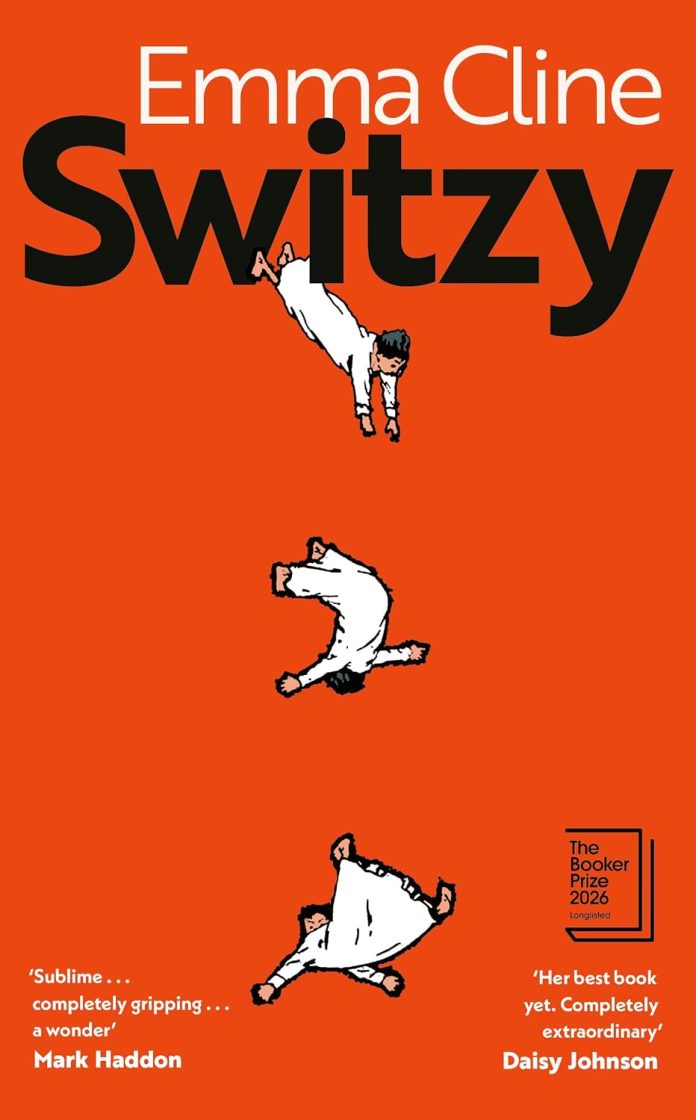
Switzy by Emma Cline opens somewhere over Greenland, on a plane its passenger does not own. A man in his seventies plays solitaire while his assistant sleeps. A flight attendant has made up little kits with hand wipes and lip balm and a sachet of powder that is supposed to make water more wet. He tips it in, shakes the bottle, drinks, and considers the question honestly. Hard to say.
His name is David Hastings. He is a retired chief financial officer with Alzheimer's. He is on his way to a clinic outside Zurich where, in five days, he will be given a bitter drink and will not wake up. Two things stand between him and the appointment: a daughter in London, and a man he has not spoken to in fifty years.
The title is not the country. Switzy is what his old friend Bill Stearns calls the place, and Stearns is the sort of man who has been everywhere and looked at nothing. A whole nation compressed into a chummy diminutive. That is the joke and it is also the thesis, and it makes Switzy by Emma Cline the sharpest book on the Booker Prize 2026 longlist about what money does to attention.
What Happens in Switzy by Emma Cline
Very little, in the sense a plot summary would recognise. A flight. Two dinners with his daughter Rebecca and her family in Marylebone. A hotel bar. A museum. A drive over the French border. A meeting with a clinic liaison whom David calls Ghoul. A last morning in an industrial park with a soccer field outside the window.
What happens instead is a consciousness, rendered continuously for the whole length of the novel, in a mind that is coming apart while it works.
David's notebook has his PIN in it, and the phone number of his lawyer, and his own full name, and three words a doctor once asked him to remember. Every time he touches the leather cover through his jacket he is able to move his legs again. This is the register: an executive brain still running its old routines on a machine that is losing sectors.
Switzy by Emma Cline Has the Best Dementia Writing on This List
I want to be precise about this, because the field is not empty and the claim is not small.
What Cline understands, and what most novelists in this territory miss, is that decline is not a fog. It is a series of specific engineering failures, and a man like David responds to each of them with a workaround.
He cannot follow a conversation, so he has developed a smile that fills the exact shape of a response. He cannot remember why he entered a room, so he comments on an object in it and steers the exchange down a side street. He cannot hold the itinerary, so he lets them hand him a printed copy the way you let a child flap around in his father's necktie. He cannot tie his shoelaces, which is a two-line scene that I have not stopped thinking about, so he now wears slip-ons with thick white soles that catch his own eye all day as an aberrance, a wrongness in the corner of his vision.
None of this is explained by a narrator standing outside him. You are inside the workaround. When a name goes, the sentence goes with it, and Cline simply lets the gap sit on the page.
Switzy by Emma Cline is also, and this matters, frequently very funny. Not warm-hearted funny. Funny the way a sharp man is funny when the only audience left is himself.
What Works
- The specificity of money. The jet is a hundred per cent write-off under bonus depreciation, put into service before the thirty-first of December. There is the Executive Physical in Minnesota, three days of tests for people whose care has been marked urgent because they have been marked valuable. There is the rule that gifts flow only downward through a hierarchy. Cline does the thing very few novelists bother to do with the rich, which is to get the paperwork right.
- The assistant. Cody is thirty-three, has power of attorney and medical power of attorney, and has been quietly taking money from David for years. David worked it out long ago. His entire career was catching exactly this. He has decided it is roughly fair payment for a young man tethering himself to an old man's decline, and he never says a word. The whole relationship is conducted in a silence that neither of them will break.
- The withheld thing. Around the two-thirds mark the novel finally delivers what happened in the last year of boarding school, and it is delivered flatly, in short paragraphs, with no music under it at all. I put the book down.
- The Farewell Symphony. David's nine-year-old grandson is learning a part of Mahler's Ninth. David asks to hear it, lies on the boy's narrow bed with his eyes shut, and finds it lovely and springlike until it turns. He makes the boy switch it off. The whole novel is built on that turn.
- The three words. A doctor asked him to remember Rose, Chair, Apple. He wrote them in his notebook. Very late in the book, in a parked car in France, the third word arrives correctly, and it is not Apple, and he wonders why a doctor would choose a word like that to leave in a person. It is the single best small move in the book.
Where It Stumbles
- The satire of "the young people" wears thin. Four or five times, David launches into a set piece about higher-order thinking, blank eyes, brains in jars, everyone in the world now as addled as he is. The first is bracing. By the fourth it reads like an opinion column parked inside a dementing man's head, and it is the one place where you can hear the author rather than the character.
- Rebecca is underwritten. The daughter has one genuinely startling scene, in which David glimpses something about her life and says nothing to anybody, ever. It lasts four lines. She is otherwise a bundle of supplements, worried emails and a high nervous voice, and the novel is not curious about her.
- The hotel-bar chapter runs long. A much younger woman, a bathtub, a stolen sweater. The point being made is that he no longer desires his desires. That point is fully made in five pages and the sequence runs for twenty.
- The assistant's theft goes nowhere by design. Thematically that is exactly right. As a reading experience it is a loaded gun taken down off the wall and put back in a drawer.
- If you need plot, this will be an ordeal. There is no reversal, no revelation that changes the destination. The man gets on the plane and the man arrives.
What Switzy by Emma Cline Is Actually About
Not dying. Apologising, and the discovery that an apology is a thing you want, not a thing you can give.
The whole journey has one real destination, and it is not Zurich. It is a village an hour and forty-eight minutes away, over a border, where a man called Tom lives with his wife. Tom was David's roommate for four years. Tom taught him chess and the secret language hidden in a deck of cards. Tom's mother fed him burnt bacon and never once asked why he did not want to go home for the holidays. On a rotting dock one August, something happened between them that neither of them ever named.
And in their final year, when the other boys picked their target, David stood among them and said nothing.
He has crossed an ocean and a border to say he is sorry, and the fifteen minutes he gets are conducted in the back of a parked car because they will not have him in the house. What Tom does with the apology is the finest thing in the novel, and I will say only this: he is not cruel about it. He simply declines to be recruited into somebody else's last errand.
If you are living with any of this, Dementia UK staffs a helpline with specialist nurses, which is a more practical form of help than a novel can offer.
A Word on Content Warnings
Switzy by Emma Cline depicts an assisted death in full procedural detail, including the final scene in the room. Alzheimer's disease is rendered without softening: incontinence, soiled clothing, the smell of an ageing body, sustained loss of language and orientation. There is a school assault involving a firearm, and its aftermath. Brief sexual content and heavy drinking throughout.
Who This Is For
Reach for Switzy by Emma Cline if you want to see what prose can do that nothing else can, if you loved the cold competence of The Guest and want to know what Cline does with tenderness, if you have ever sat across from a parent who is still performing the shape of a conversation. Skip it if you need forward motion, if you cannot currently be near a book about dementia, or if a novel that ends where it always said it would strikes you as a waste of two hundred pages.
It is short. It is not quick.
Read These Next
Five books to go to if Switzy by Emma Cline has left you wanting more of this weather.
- The Sense of an Ending by Julian Barnes. An old man, a school friendship, a shameful act, and a memory that has spent decades quietly editing itself. The closest relative in the room.
- The Guest by Emma Cline. Her previous novel, and the other half of her subject: a person moving through enormous wealth on permission that can be withdrawn at any moment.
- The Remains of the Day by Kazuo Ishiguro. A life of service, a late journey undertaken for one conversation, and a narrator who cannot say the sentence he has driven all that way to say.
- Elizabeth Is Missing by Emma Healey. The other major novel written from inside dementia, warmer and far more plotted, and a good entry point if Cline's stillness defeats you.
- The Things We Never Say by Elizabeth Strout. Also on this longlist, and the other book here about a family that has agreed, collectively, not to mention the thing.
For a boarding-school ensemble with money and reputations at stake, try The Thoroughbreds by Elin Hilderbrand and Shelby Cunningham, a senior year at Tiffin Academy in which college admissions are drawn with real teeth.
The Last Word on Switzy by Emma Cline
There is a moment near the end when David is offered forty more minutes. The procedure is built that way: you take one set of pills, you wait, and if you are not ready you take them again and buy yourself another stretch. He takes them again.
That is the closest Switzy by Emma Cline comes to suspense, and it is enough, because by then you understand that this man has spent his entire life trying to get out of time. Sleeping in shifts like Edison. Doing his homework at midnight so he could play after school. Enjoying a trip only on the flight home, when it became real. A career spent making some numbers swell and others recede.
The last three pages abandon third person entirely and address him as you, and list what a body did. A coin his father gave him that he lost. The men and the women. The knees scooped out and replaced. A body that had known for a very long time that it would never die and had been entirely certain of it.
I have read those pages four times. They are the best writing in Switzy by Emma Cline by a distance, which is also the problem: the novel spends a good deal of its middle circling material it has already covered, and the last three pages are doing work the preceding hundred should have shared. It is a very fine book that is not quite the sum of its best twenty pages.







