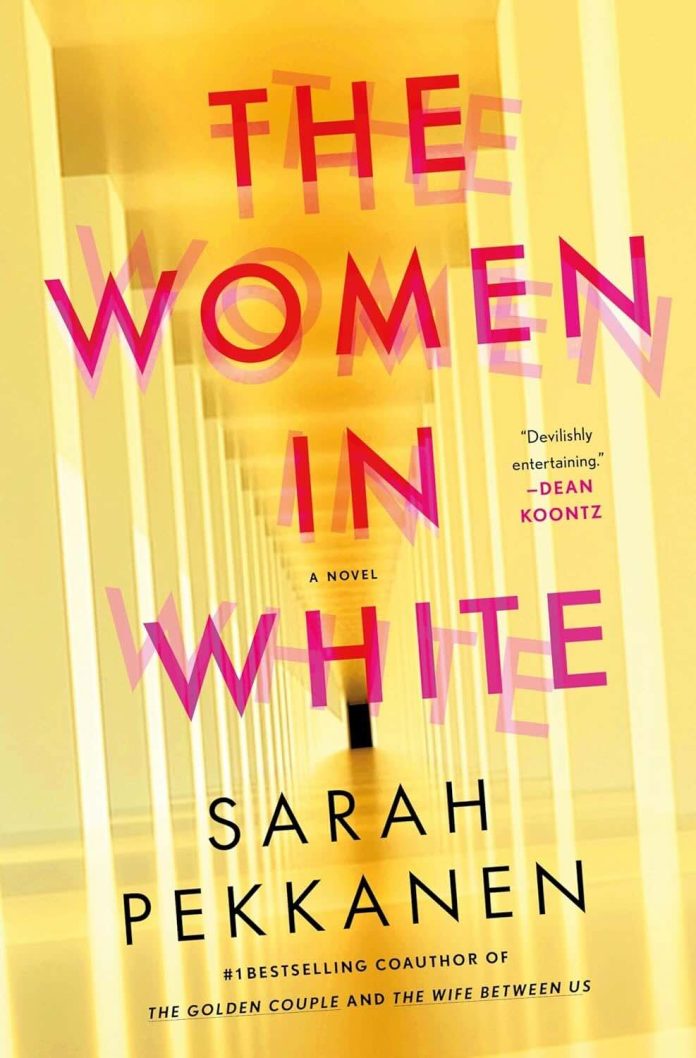
Some thrillers hide a body. This one hides four entire women. In 1964, four young faculty wives at a Virginia university wore identical white dresses into a parapsychology laboratory, and then history swallowed them: no yearbook photos, no archive folders, an obituary that skips a wife entirely. Sixty years later, a broke caretaker starts pulling the thread.
The Women in White by Sarah Pekkanen runs on two clocks. In the present, Riley Bell, newly divorced and quietly sleeping in her car, takes a live-in job caring for Betty Sadler, an eighty-one-year-old widow whose house is a sealed time capsule and who serves Riley her exact tea order without asking. In 1964, nineteen-year-old Betty and three friends are recruited into Dr. Silas Trimble’s institute for “psychical research,” where the tests begin as parlor games and curdle into something much darker. The two timelines hand off chapter by chapter, and the past runs toward a catastrophe the present can only excavate.
A Thriller Built on Declassified Bones
The book’s boldest gambit is its scaffolding. Every one of Betty’s chapters opens with a real, cited epigraph: J.B. Rhine’s Duke laboratory, the CIA’s Stargate remote-viewing program, the Apollo 14 ESP experiment, the Ganzfeld sensory-deprivation protocol whose Ping-Pong-ball blindfolds appear on the page moments later. Pekkanen’s author’s note describes researching at the Rhine archive in Durham, and it shows: the apparatus, the Zener cards, the clinical language of subject files all feel transcribed rather than invented. The result reads like a thriller assembled on declassified bones, and it gives the paranormal premise something most psychic novels never earn: plausibility you can footnote.
What elevates the material is that the science is the horror. Trimble never brandishes a weapon. He brandishes consent forms, schedules, uniforms, and the husbands’ careers, and The Women in White by Sarah Pekkanen is smart enough to know that a man who parks the car to take notes while a test subject suffers is more chilling than any specter.
From the Hendricks Duets to Solo Flight
Readers who know Pekkanen as half of the duo behind The Wife Between Us and The Golden Couple will find her solo era running deeper and stranger: Gone Tonight, House of Glass, and most recently The Locked Ward have each pushed further into institutional menace. This is the furthest push yet, trading domestic suspense’s marital lies for a sixty-year conspiracy of erasure, and it suits her.
Two Timelines, One Locked House
The structure is disciplined: seventy-six short chapters, nearly all ending on a hook, alternating Riley’s anxious present-tense voice with lushly furnished 1964 close-third. The period work doubles as argument. These women are listed under their husbands’ names, paid half wages, prescribed patience, and that is precisely why they can be erased; when Riley’s searches fail, it is because the world indexed the women as Mrs. Somebody Else.
And then there is Betty, the book’s quiet triumph: an eighty-one-year-old wheelchair user who has not left her house in sixteen years and who turns out to be the sharpest strategist on the page. Thrillers almost never hand the action-hero role to an elderly disabled woman. This one does, repeatedly, and earns it.
Riley makes a worthy counterweight. Pekkanen writes her as a professional doubter of her own instincts, a woman trained by a con-man marriage to distrust every alarm bell she hears, and the novel’s sharpest structural rhyme is that her investigation and her recovery turn out to be the same skill: deciding which signals deserve belief. By the final chapters, the mystery plot and the character arc are answering each other.
What Works
- The dual-timeline dread. We learn early that something ended these friendships in a single terrible day; every warm 1964 scene afterward ticks like a bomb.
- The documentary texture. Real epigraphs, a cited appendix, and lab procedure rendered with archival precision.
- The hospital scene. A modern medical test accidentally recreates the 1964 apparatus, bridging the timelines through Betty’s own body. Best set piece in the book.
- Fair-play plotting. The answers are clued on the page, physically and verifiably, and the misdirection is honest.
Where It Stumbles
An honest reading of The Women in White by Sarah Pekkanen has to note where the machinery shows.
- The final-act villain runs conventional. After three hundred pages of patient dread, the resolution leans on a monologue and a motive the genre has worn smooth.
- One endgame scheme is thin. A plan involving the experiments’ commercial value asks for more shrug than scrutiny.
- The origin chapters ease the throttle. Backstories for the four women deepen sympathy but briefly slow the thriller clock.
- The coda is long for a thriller. The final chapters trade suspense for elegy. I found them the point of the book; readers wanting a hard snap of an ending may find them leisurely.
How Dark Does It Get
Darker than the premise suggests, and almost entirely without on-page violence. The dread is institutional, psychological, and cumulative.
A Word on Content Warnings
Readers should know the book includes suicide, a postpartum mental health collapse, implied childhood sexual abuse, involuntary psychiatric commitment, captivity and sensory-deprivation experimentation, and reproductive coercion. There is no explicit sex, and violence is brief and non-graphic, but the themes are heavy and handled seriously.
Who This Is For
Reach for The Women in White by Sarah Pekkanen if you want a thriller with genuine historical teeth, dual timelines that actually converse, and a mystery whose deepest question is not whodunit but who gets remembered. Skip it if you need relentless body-count momentum or a skeptic-proof ending, because this book answers its is-it-real question with a deliberate, graceful wink.
Read These Next
For readers who finish and want to stay unsettled:
- The Locked Ward by Sarah Pekkanen. Her previous solo thriller, another institution with locked doors and unreliable diagnoses.
- The Unknown by Riley Sager. A century-old island mystery restaged for the present, with the same past-won’t-stay-buried engine.
- House of Splinters by Laura Purcell. Gothic dread where the haunting might be grief, might be worse.
- Locked In a Box by Sheila Sharpe. Buried memory, a locked room, and a therapist-heroine written by a real one.
- Hidden Pictures by Jason Rekulak. The modern touchstone for thrillers that let the supernatural stay genuinely possible.
Interwoven 3: The Unraveling by T Atkins is another paranormal on our shelves, if this one lands for you.
For another 2026 novel that hides an ugly secret inside a well-run community of women, try Big Little Truths by Liane Moriarty.
The Last Word
The Women in White by Sarah Pekkanen is a slow-burn thriller wearing white gloves: polite, meticulous, and hiding bruises. Its villainy runs a little conventional at the close and its coda lingers past the genre’s usual curfew, but the book beneath those quibbles is Pekkanen’s most ambitious solo work, a story about four erased women that ends by writing them back into the record. The scariest thing in it is not a ghost. It is a filing cabinet with four empty folders.
Check the archives. Someone you have never heard of is missing from them.







