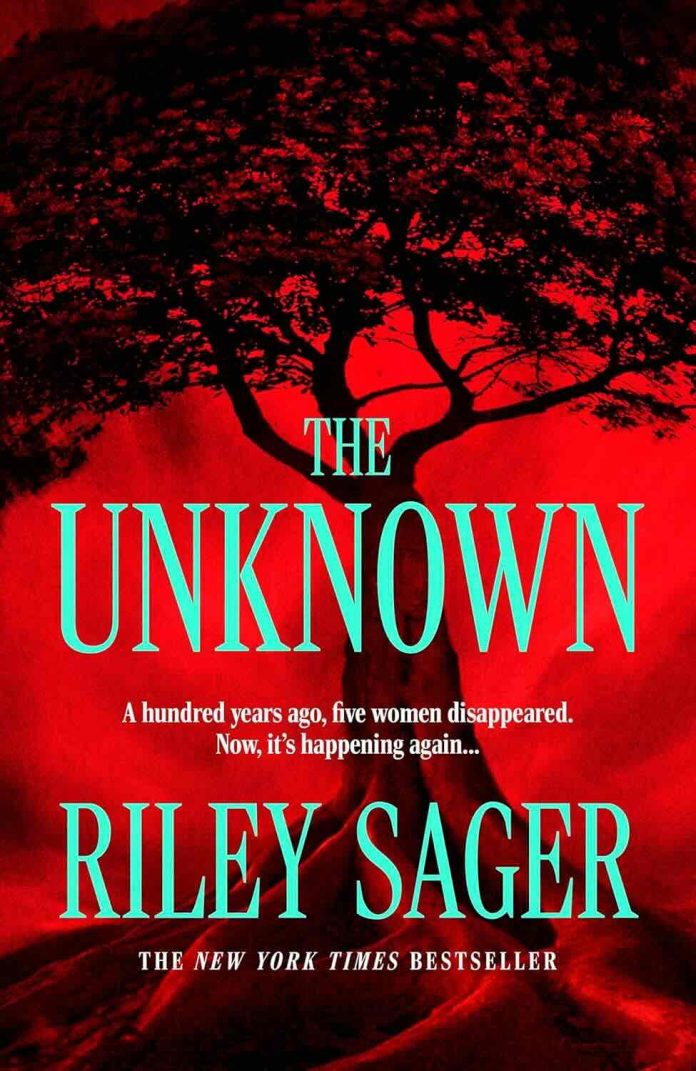
There is a particular kind of dread that arrives when your gut tells you to leave a place and you stay anyway. Riley Sager has built an entire career around that feeling. In The Unknown by Riley Sager, the dread comes courtesy of New Avalon, a fictional speck of an island on Vermont’s Lake Faraday, where five women evaporated in 1926 and a film crew has just arrived, one hundred years later, to recreate the mystery. What could possibly go wrong?
Quite a lot, as it turns out.
The Premise in a Single Breath
Struggling actress Marin Keane lands the role of her life: the lead in a movie directed by Hollywood wunderkind Ronan Peters and co-starring screen legend Violet Wright. The catch is a mandatory week of method-style research on the same island where the disappearances happened. Within days, things start sliding sideways. Strange noises at the tree line. Symbols scratched into wood. Then people begin to vanish. Again.
It is a Sager premise through and through. Isolated setting. Closed circle of suspects. A protagonist with a wound she has not finished bleeding from. And a diary, because with Sager there is always a diary.
What Works in This Book
The Unknown by Riley Sager is not a quiet read. It moves, and it knows you are tired and wants to keep you turning pages anyway. The split structure (Marin’s present-day chapters threaded with the 1926 diary entries of a young medium named Daisy Rue) does a lot of heavy lifting. The diary sections have a different cadence and vocabulary, and to my ear they land. Sager has been doing dual timelines for a while now, and you can feel the muscle memory in every transition.
A few things he gets right:
- The island itself feels real. From the wrought iron archway at the top of the stone steps to the cliff with its boulder teeth, New Avalon has the kind of off-kilter geography that lingers after you close the book.
- The Hollywood satire has teeth. Ronan’s faux-Method seriousness, Loretta’s producer-speak, Susie’s TikTok-bred ego, and the small humiliations of a table read are observed with genuine sharpness.
- Marin is a great point-of-view character. Self-deprecating, anxious, sneakily brave when she needs to be. The running joke about her Bridesmaid with Eczema commercial does more for her interiority than a full chapter of backstory would.
- The pacing in the back third is ferocious. Once the disappearances begin, Sager throws his usual handful of red herrings, then a curveball, then a final pitch that lands somewhere unexpected.
The 1926 sections deserve special attention. Daisy’s voice is youthful, hopeful, and steadily darkening, and the way her belief in her “Gift” curdles into something far stranger gives the historical thread real weight. I would happily read a whole novel about her.
The Side That Doesn’t Quite Land
This is a four-star novel for a reason. The Unknown by Riley Sager is propulsive and clever, but it is also working with some very familiar parts.
A handful of things to flag without spoiling:
- The explanation pulls in two directions. Sager has a long-standing habit of presenting supernatural surfaces and then handing you a rational underside. Some readers love that double act. Others will find one of the two resolutions here a little tidy and the other a little heavy.
- The mental health framing in the 1926 thread. Without saying which way it cuts, the historical plot leans on a representational choice that has aged unevenly in thriller fiction. Readers sensitive to how dissociative conditions get written into horror should know that going in.
- Cast bloat in the middle. There are seven adults on the island at once, plus a remembered eighth woman whose story matters enormously. The middle stretch keeps all of them in motion, and one or two feel underdrawn as a result.
- A particular thematic thread is timely but blunt. Sager wants to talk about Hollywood power dynamics and predatory men, and good on him for wanting that. The execution sometimes states what the scene was already showing.
None of these are book-ruiners. They are the friction you might feel around the edges of an otherwise smooth ride.
A Word on the Style
Sager writes the way he has always written: clipped first-person present tense, short paragraphs, the occasional one-line sentence dropped like a stone in a pond. He drops Indiana Jones and Hitchcock references and lets his characters speak in the bitten-off rhythms of people who are tired of pretending. If you have read his earlier books, you will recognize the tempo within five pages. If you have not, this is a decent entry point, though not his strongest.
The horror beats are more suggestive than graphic. Whispers in candlelit parlors. Wet footprints on porches. Faces at windows that should not be there. Readers who want gore will be disappointed. Readers who want unease will be well fed.
If You Like Riley Sager, Read These Too
The author has been on a steady run for nearly a decade, and The Unknown by Riley Sager sits comfortably in the middle of his catalogue rather than at the top. His earlier novels worth picking up include:
- Final Girls, his breakout
- The Last Time I Lied, which shares some isolated-setting DNA with this one
- Lock Every Door
- Home Before Dark, often named by his readers as a personal favorite
- The House Across the Lake
- The Only One Left
- Middle of the Night
- With a Vengeance
Books to Read Alongside It
If you finish this one and want to stay in roughly the same weather, try:
- Mexican Gothic by Silvia Moreno-Garcia for creeping-house dread
- The Sun Down Motel by Simone St. James for diary-and-present-day construction
- The Hunting Party and The Guest List by Lucy Foley for trapped-on-an-island ensembles
- The Death of Mrs. Westaway by Ruth Ware for a heroine in over her head
- The Whistling by Rebecca Netley for vintage séance energy
- The Woman in the Library by Sulari Gentill for layered storytelling
Final Verdict
The Unknown by Riley Sager is a confident, sometimes ingenious thriller that will satisfy his regulars and likely earn him a few new ones. It does not reinvent the wheel he has been polishing since Final Girls, and a couple of its choices will divide his audience. But the island lingers. The diary lingers. Marin lingers. And when the last page turns, you may find yourself, like me, sitting with the lamp on a little longer than the room actually needs.
That is the Sager promise. He keeps it here.







