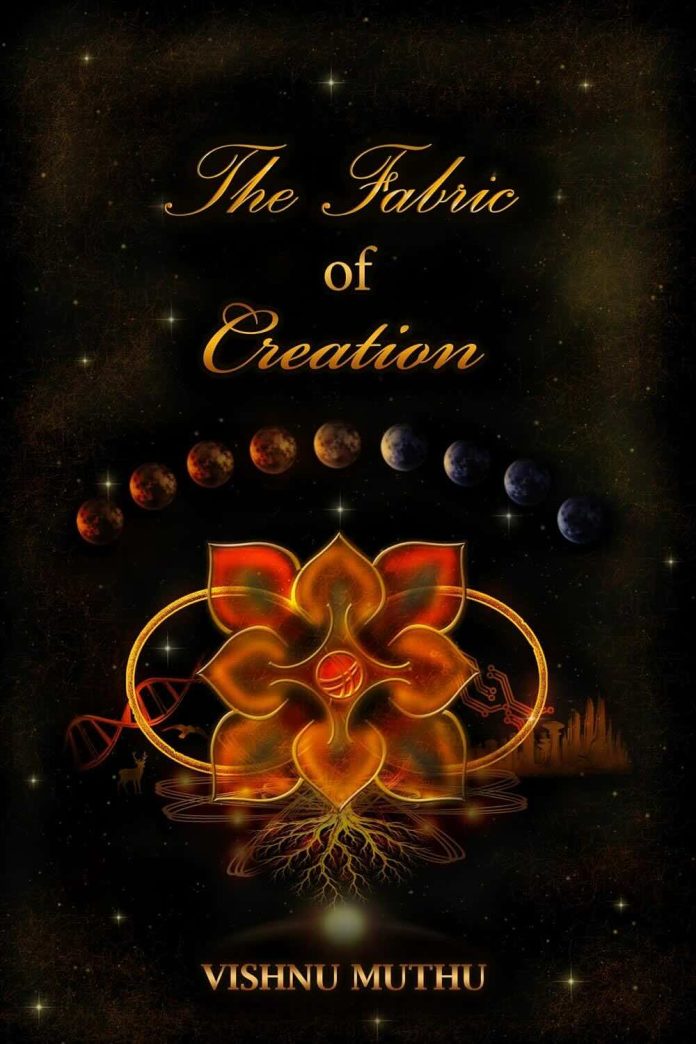
Some books argue. Others build a lens, hand it over, and let you look through it yourself. In Fabric of Creation, Vishnu Muthu has written the second kind.
His debut opens with a claim so plainly stated that it is easy to underestimate: everything is connected, and the proof is not sentiment but repetition. The same structures keep surfacing in places we usually keep in separate rooms. A temple story and a control system. The growth of a family and the behaviour of a wave. The lifecycle of a lotus and the lifecycle of a business. Having made the claim, the author spends the rest of the book quietly earning it.
What holds the whole thing steady is a decision made in the first chapter and never once abandoned.
Nine chapters, five lenses, one architecture
Every chapter in The Fabric of Creation by Vishnu Muthu examines its subject through the same five viewpoints, always in the same sequence. This is the book’s spine, and readers who notice it early will get considerably more from the experience.
The five lenses, always in order
- Myth. Ancient stories, drawn largely from Hindu and Tamil tradition, treated as compressed observation rather than decoration.
- Origin. The intuitive or historical beginning of the thing, and the question of why it began at all.
- Mathematics. The abstract shape underneath, described in words rather than equations.
- Science. The physical mechanism, explained for a general reader.
- Commercialization. How the same pattern behaves once money, trust, and organisations enter the picture.
The nine subjects, and the question each one circles
- The One and the Infinite. How a single point becomes countless possibilities
- Causality. Why every force in nature arrives paired with its opposite
- Reality. The triad of creation, preservation, and ending
- Lifestyle. The balance between memory and passion
- Environmental Science. The five elements as a working system
- Motion. Change as the only reliable constant
- Acoustics and Optics. Sound and light as the body’s two channels to the world
- Materials Science. How matter has shaped both bodies and civilisations
- Space. Pattern recognition as the root of intelligence
Each chapter closes with a short summing-up that reads less like an academic wrap-up and more like something an older relative might say at the end of a long conversation.
This repeating structure is the book’s most confident choice. By the third chapter you stop reading each section as a fresh idea and start reading it as a variation, which is exactly the effect intended. The form teaches the thesis.
Myth handled as evidence
The mythological sections are where ” Fabric of Creation” is most likely to change how a reader thinks, and they are handled with real care.
Ten avatars, read against a first year of life
Consider the treatment of the Dashavatara. Muthu walks through the ten forms in order and shows how the sequence tracks the movement of life from water to land to higher intelligence, then turns the same sequence sideways and lays it against the first years of a human infant: the swimming reflex, the lifted head, the crawl, the grasp, the first steps. The reading is elegant and stays on the right side of the line, offered as a way of seeing rather than a claim about what the original tellers intended.
Eight siddhis, held to the light twice
The same restraint shows in the chapter on Materials Science, where the eight siddhis associated with Hanuman are read twice over. Once as a vocabulary of metalworking, where reduction to the smallest part, expansion by alloying, lightening by removal of impurities, and increase of density all find their counterpart. Then again as a programme of character formation, where the same eight become ways of managing ego, ambition, patience, and self-command. Neither reading cancels the other. Muthu lets both stand, which is a more generous move than picking a winner.
Readers who already know the Trimurti, the Panchabhootam, the Navagrahas, and the churning of the ocean will meet familiar material from an unfamiliar angle. Newcomers will find the retellings clear and unhurried, with enough Tamil and Sanskrit terminology to send the curious looking further.
An engineer’s fingerprints on a philosophical book
This is Muthu’s first book, drawn from close to ten years of travel, observation, and notes, and his professional life shows through the prose in ways that give it much of its texture. He works in computer vision, robotics, geographic information systems, and artificial intelligence, and his instinct is to reach for engineering vocabulary when he needs to explain something human.
A few of the transfers he makes:
- Decision-making described as an interplay of control before the cause and correction after the effect
- Private and public conversation sorted into closed and open loops, each holding a different kind of value
- Memory treated as an irreversible imprint, a system needing a fixed reference before it can register change
- Family dynamics governed by a one-third rule of shared time and responsibility
- Streets, households, and supply chains read through network topology, nodes and edges alike
- Emotional pressure plotted as two curves that either hold their distance or cross
Some of the most quietly interesting passages sit in the science sections: the layered comparison between the Earth’s structure and the human body, the treatment of sound and light as two grammars of the same wave behaviour, and the extended account of how material value multiplies as raw iron becomes a rod, then a surgical needle, then a watch. That last example is the whole book in miniature. One substance, one continuous chain, and value appearing only through transformation.
Prose with a steady pulse
The writing style is measured and even-tempered, closer to the voice of a patient teacher than that of a polemicist. Sentences run long and are built from clauses that stack rather than sprint. Metaphors are drawn from ordinary life and reused with discipline: the pot that determines how much a mind can hold, the rock and the river moving in harmony or in obstruction, the bridge that collects its toll in flood and in drought alike.
There is also a real feel for the well-placed story. A king who cannot find happiness meets a labourer who divides five coins into five purposes. These arrive without fanfare and land cleanly. Eighteen figures support the text, several of them genuinely clarifying, and the closing pages hold a short verse naming all nine chapters against the emotions they govern.
What a reader takes away
- A working vocabulary for reading Hindu myth as structured observation rather than as fable
- A cross-disciplinary habit of mind, and practice in transferring a pattern from one field to another
- Practical material on planning, resource distribution, career stages, and organisational design, folded in without ever feeling like a separate self-help book
- A vivid sense of the Indian intellectual tradition as continuous with, rather than opposed to, modern science
Who this book will find
The Fabric of Creation by Vishnu Muthu will suit the reader who keeps three unrelated books open at once and suspects they are secretly about the same thing. It rewards the puzzle-minded, the systems thinker, the student of Indian philosophy who wants a contemporary framing, and the professional who finds that ideas about management keep echoing ideas about nature.
How best to read it
It works well in single chapters. This is a book to keep near a chair and return to rather than one to finish in a weekend.
If this one speaks to you
- The Tao of Physics by Fritjof Capra
- Myth = Mithya and Business Sutra by Devdutt Pattanaik
- A Beginner’s Guide to Constructing the Universe by Michael S. Schneider
- The Dancing Wu Li Masters by Gary Zukav
- Seven Brief Lessons on Physics by Carlo Rovelli
- The Book: On the Taboo Against Knowing Who You Are by Alan Watts
A closing observation
As a first book, The Fabric of Creation by Vishnu Muthu carries the marks of a decade of collecting: the travel, the noticing, the questions kept in a pocket for years. The closing pages make a case that experience is the only teacher that finally counts, and that the difference between the network you are born into and the one you leave behind is the truest measure of a life.
Approached slowly, The Fabric of Creation by Vishnu Muthu has the pleasant effect of making the world look less like a collection of unrelated departments and rather more like a single, patient, ongoing piece of work.







