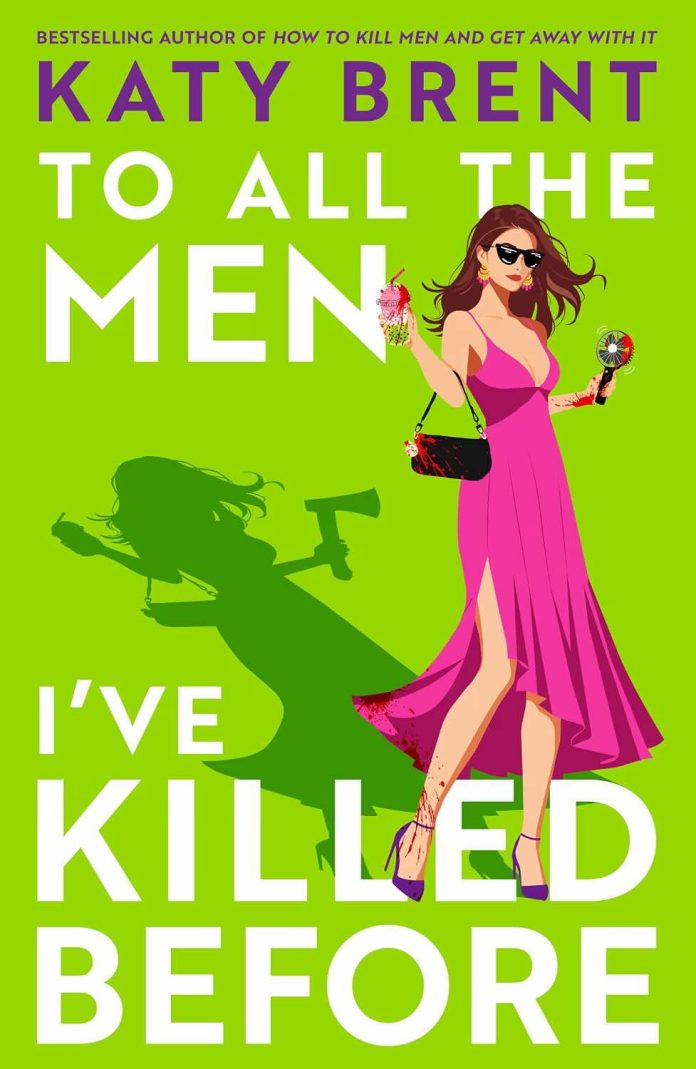
Three books ago, Kitty Collins killed a man who followed her out of a nightclub and discovered she had a taste for it. She has been operating alone ever since, to a private code, in a city where her family’s abattoirs solve the awkward question of what to do with the leftovers. To All the Men I’ve Killed Before by Katy Brent takes all of that away from her. It puts her in Los Angeles with no equipment, no infrastructure and no jurisdiction, on a mission to find and kill one specific British therapist who beat her best friend into a coma and then boarded a plane. And it gives her a sister.
Where To All the Men I’ve Killed Before Sits in the Series
This is the third Kitty Collins novel, and it reads as a deliberate closing of the loop.
Antoinette Pemberton is twenty years old, obscenely rich, and turned out a few books ago to be Kitty’s half-sister by their shared father. She has known Kitty her whole life and been related to her for about five minutes. She has also inherited the family aptitude.
Everything that makes this book work comes from that pairing. Kitty at thirty is now the cautious one, the one who talks about research and planning and tarpaulin. Antoinette is what Kitty used to be, with better technology and no brakes at all.
Kitty and Antoinette, and the Argument Between Them
The novel’s real engine is a disagreement about scale.
Antoinette wants to kill the man who wolf-whistles at them outside the arrivals hall. She has a coherent case: catcalling is not a compliment, everyday harassment is the foundation the serious stuff is built on, and letting the small things go is how the large things become possible. Kitty’s counter-argument is that there are not enough hours in a lifetime and she has only one pair of hands.
Brent gives both of them real ground to stand on, which is more than this subgenre usually manages. To All the Men I’ve Killed Before by Katy Brent is at its sharpest when the two women are simply arguing about where the line is, in a car, on a hiking trail, over cocktails they are not drinking.
Hollywood as a Body-Disposal Problem
The setting is not decorative. It is a logistical crisis.
Kitty’s method has always depended on infrastructure she no longer has, and the book takes genuine pleasure in the fact that Los Angeles is the worst city on earth for this. Every hiking trail is full of people filming content. Every reservoir has cameras. And every stranger is their own main character and none of them are looking at you, which cuts both ways.
Each chapter is headed with a precise real location, from a Sunset Strip rooftop to a bungalow at the Chateau Marmont, and the effect is a very funny travel guide organised entirely around where you could and could not hide a corpse.
What To All the Men I’ve Killed Before Does With Its Villains
The men here are types, and that is a choice rather than a failure.
There is an ageing star whose historical allegations were dropped for lack of evidence, after which the women who made them were doxxed and moved states while his career recovered completely. There is a producer who takes meetings at home. And there is a podcaster with a man bun whose show is a feminist podcast for men, who has done shadow work and rage circles, and who cannot stop talking over the women in the room.
That last one is the best thing in To All the Men I’ve Killed Before by Katy Brent. He is the only male character written with any real observational cruelty, and every one of his lines lands.
The Comedy, and Who It Is Aimed At
The tone of To All the Men I’ve Killed Before by Katy Brent is very specific, and you will know within ten pages whether it is yours.
The narration is first-person, present tense, and relentlessly chatty, with the designer labels itemised and the murders described in the same register as a lost suitcase. Someone’s remains are used as a footstool. A body-disposal brainstorm gets interrupted because nobody brought a pen. It is played broad and it is genuinely funny.
Underneath it, the argument is entirely sincere, and the book never once treats the violence against women as material for a joke. Only the men are the joke.
Where To All the Men I’ve Killed Before Strains
Four things keep it off the top shelf.
- The interruptions become a tic. Kitty is prevented from finishing a kill so many times that the running gag starts to read as padding.
- One long subplot goes nowhere on purpose, and the reveal is amusing rather than satisfying.
- The politics are stated more than they are dramatised. Characters explain the argument to each other in paragraphs.
- The last act resolves very fast. A well-planted twist gets about eight pages of aftermath.
Even so, To All the Men I’ve Killed Before by Katy Brent is the most propulsive book in the series and the only one with a genuine emotional spine.
Do You Need to Read the Others First?
Ideally, yes.
Kitty’s code, her mother, the two kills she regrets and the reason her ex-boyfriend left her are all carried over into To All the Men I’ve Killed Before by Katy Brent, and while each is explained in passing, the explanations land as summary rather than history. Start with book one. The reading order is How to Kill Men and Get Away With It, then I Bet You’d Look Good in a Coffin, then this.
The acknowledgements confirm this is Kitty’s third outing, and the praise pages call it the conclusion of the series.
Content Notes for To All the Men I’ve Killed Before
Graphic dismemberment, described at length and often comically. Extended torture of a bound captive. Strangulation. Drink spiking. Sexual assault of a young woman by a producer, recounted in detail. Historical child sexual assault, recounted by the survivor. Domestic violence and its injuries, described clinically. Misogynistic online abuse reproduced verbatim, including sustained slurs about murdered women. Coerced sex work discourse. Animal remains. An unplanned pregnancy.
Read it if / Skip it if
Read it if you want a revenge comedy with an actual thesis; if you like a double act more than a plot; if the phrase “vegan serial killer” makes you grin rather than sigh.
Skip it if you need tight construction; if broad comic narration grates on you; if you would rather the argument were left implicit.
Read these next
Five for readers who finish To All the Men I’ve Killed Before by Katy Brent and want more:
- How to Kill Men and Get Away With It by Katy Brent. Where Kitty starts, and still the sharpest of the three.
- I Bet You’d Look Good in a Coffin by Katy Brent. The middle book, and essential for the family history.
- How to Kill Your Family by Bella Mackie. The obvious companion, colder and more controlled.
- L.A. Women by Ella Berman. For the same city and the same industry, played entirely straight.
- The Women of Wild Hill by Kirsten Miller. For women taking care of a problem the law will not.
The Verdict
Go back to the first chapter. Two women walk out of arrivals at LAX. A man whistles at them. Antoinette does not shout back. She takes his photograph, so she can reverse-image-search him later and find out where he lives, and when Kitty asks why, she explains it perfectly reasonably: so we can find him and kill him.
That exchange is the whole novel, and it is why the series needed a second woman in it. Kitty has spent three books insisting on proportion, on codes and rules and evidence, on being the reasonable one. Then a twenty-year-old arrives who agrees with every word of her politics and simply refuses the proportion, and Kitty has to work out whether she is the grown-up in the room or just the tired one. To All the Men I’ve Killed Before by Katy Brent is baggier than it needed to be and funnier than it had any obligation to be, and it ends the series in the only place it could: with the older woman deciding what she is prepared to hand on.







