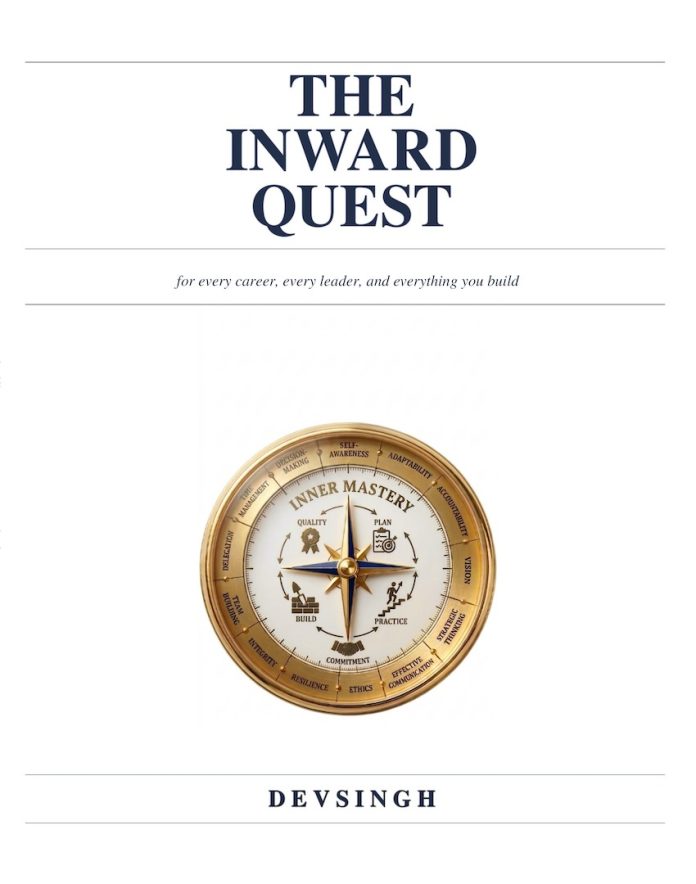
Most leadership books begin with an organisation. This one begins with a body. The prologue makes an argument that sounds almost biological before it sounds professional: the human nervous system carries hundreds of millions of years of survival information, while the office, the org chart, and the career are inventions only a few generations old. The equipment is ancient. The environment is new. Everything that goes wrong in between is where The Inward Quest by Devsingh Balan decides to set up camp.
That framing does real work. It reclassifies a whole category of professional failure. The freeze in the senior briefing, the escalation delayed for three weeks, the conversation deferred under cover of a busy calendar, the sudden narrowing of judgement when a peer attacks your numbers in front of the chief executive: Balan does not treat these as character flaws or skill gaps. He treats them as old code running under new conditions, and he insists the first professional discipline is noticing that it is running at all.
Architecture
Seven parts, arranged as a working instrument
The book runs to roughly fifty-seven thousand words, and its shape is unusually deliberate. Parts One through Five are sequential by design. Parts Six and Seven are not meant to be read straight through at all, and the author says so plainly in the front matter.
- Part One, Inner Self, covers inherited and constructed identity, the two-speed mind, fear at the podium, the standard that keeps moving, equanimity, hidden depletion, and how learning actually accelerates.
- Part Two, Building Something, moves outward into purpose, founding, hiring, product cycles, systems and bottlenecks, growth, artificial intelligence, and endurance across a long horizon.
- Part Three, Leading People, is the operational core: the promotion that changes what output means, crisis escalation, teams that quietly stop telling the truth, selection, feedback, and focus.
- Part Four, Navigating the World, is the longest and most worldly stretch, running from the unwritten influence map through governance, financial fluency, decision discipline, and two sections on customers.
- Part Five, Integrated Self, pulls back to the arc of a whole career.
- Part Six is a reference library of fifty leader profiles.
- Part Seven changes mode entirely and asks a different question.
The appendices are not filler. There is an index that routes a reader from a feeling to a section, a one-page self-audit worksheet, and a toolkit of thirteen structured thinking frameworks with notes on when each earns its keep.
The Three Devices
What the author actually invented here
Balan is candid that the book introduces no new research. The original contribution is the selection, the sequencing, and three recurring instruments that hold the whole structure together.
- The Integrity Bridge. Integrity not as honesty but in its older sense of wholeness. The convergence between the version of yourself that performs and the version that shows up under pressure. This is the book’s spine.
- The Mirror Check. Every later section is tethered back to the inner work of Part One, then closed with a diagnostic question sharp enough to be uncomfortable. One asks about the ratio of problems you solved yourself to problems you created the conditions for someone else to solve.
- The Shadow Check. The device that raises this book above its shelf. Each virtue is handed its shadow. Frank speech curdles into challenge for its own sake. Decisiveness becomes impatience wearing a better suit. Partnership language becomes a more sophisticated version of the transaction it replaced.
That third device is the signature of a writer who has watched good practices go wrong in real rooms. Most books in this category sell the virtue and stop. The Inward Quest by Devsingh Balan follows the virtue into its second decade and reports what it becomes.
Voice and Method
Scenario first, thinking second
Every section opens the same way: a professional inside one specific moment, described in flat, unhurried detail. A dashboard with seventy-five indicators. A retirement dinner in a grand atrium. A woman standing still in the street eleven minutes into an escalation call. Only then does the analysis arrive, which means it lands as recognition rather than instruction. Readers will recognise themselves before they are told anything.
The prose itself is disciplined and cool. Long setup sentences resolve into short declaratives that carry the weight. The philosophical scaffolding is unfashionable in the best sense, drawing on Aristotle, Marcus Aurelius, Epictetus, Xenophon, Francis Bacon, and William James rather than the usual rotation of recent behavioural studies. Balan also breaks the fourth wall sparingly and to good effect, admitting where he spent years inside the noise of a dashboard rather than above it. Those small admissions buy enormous credibility.
The Evidence Section
Fifty practitioners, chosen for structure rather than fame
Part Six is where the book earns its authority. Fifty condensed profiles, each following the same five-beat pattern: origins, core purpose, hardest challenge, how it was met, what was left behind. The selection is genuinely global and refreshingly unobvious. Soichiro Honda and Akio Morita appear, but so do Ela Bhatt, Alonzo Herndon, Elinor Ostrom, Rose Blumkin, Verghese Kurien, Emily Roebling, and Olive Dennis. These are people who built under colonial constraint, capital drought, systemic racism, war, and institutional hostility. The author is explicit that this is not a ranking, and the humility of that note is characteristic.
Part Seven then does something few business books attempt. It abandons instruction entirely and offers a set of observational parables drawn from the natural world, aimed at building perception rather than execution. Whether a reader takes to it will depend on temperament. Read slowly and away from the pressure of the day, as instructed, it works.
Who Will Get the Most From It
- First-time managers who have just discovered that the skills which earned the promotion now work against them.
- Founders carrying uncertainty they cannot say aloud to a board or a team.
- Senior leaders who suspect their information channel has been quietly sanitised on its way up.
- Professionals in mid-career who have optimised every step and never audited the direction.
- Anyone who arrived in organisational life without a mentor who had crossed the terrain first.
If You Liked This, Read These Next
The author’s earlier book, Journey to Infinity Within, covers the inner arc that this volume deliberately leaves behind. The two were once a single manuscript, and reading them in sequence is rewarding, though The Inward Quest by Devsingh Balan stands entirely on its own. Beyond that, the closest neighbours are:
- The Obstacle Is the Way by Ryan Holiday, for the applied Stoic register.
- Meditations by Marcus Aurelius, which Balan returns to repeatedly.
- Turn the Ship Around! by L. David Marquet, for the practical mechanics of pushing authority downward.
- The Fifth Discipline by Peter Senge, cited directly in the toolkit.
- Leadership Is Language by L. David Marquet, for the signal-reading work of Part Three.
- An Everyone Culture by Robert Kegan and Lisa Laskow Lahey, for the identity work underneath professional behaviour.
Final Assessment
A book designed to be returned to
Read once, The Inward Quest by Devsingh Balan gives you the shape of the terrain. Its real value arrives later, when a specific situation turns difficult and the State of Mind Index sends you to the two sections that name exactly what you are carrying. That design choice, more than any single framework, is what separates this from the many titles it will sit beside.
It is a demanding book in a quiet way. It asks readers to accept that the inner instrument is not a side project running parallel to the career but the thing producing the career. For anyone willing to sit with that premise, The Inward Quest by Devsingh Balan is one of the most usefully constructed leadership handbooks published this year.







