Near the middle of East of Eden, three men sit in a kitchen arguing about sixteen verses of Genesis. Lee, the Trask household’s Chinese cook, reports that four elderly scholars of his acquaintance, the youngest past ninety, hired a rabbi and spent two years learning Hebrew in order to settle one word. The word is timshel. Lee’s own verdict on it is that no single word in any language may matter more.
Steinbeck believed it. He carved it into the wooden box in which he handed the finished manuscript to his editor, Pascal Covici. He also got the spelling wrong, and the translation he builds the novel on is disputed by people who read Hebrew for a living.
The argument is worth having properly, because the usual versions of it are both too simple.
What the Verse Actually Says
Genesis 4:7 is God speaking to Cain, after Cain’s offering has been refused and before he kills his brother. Sin is described as crouching at the door, and then comes the clause everything turns on.
Three English versions of that clause are set directly against each other in the novel, and Lee lays them out in order.
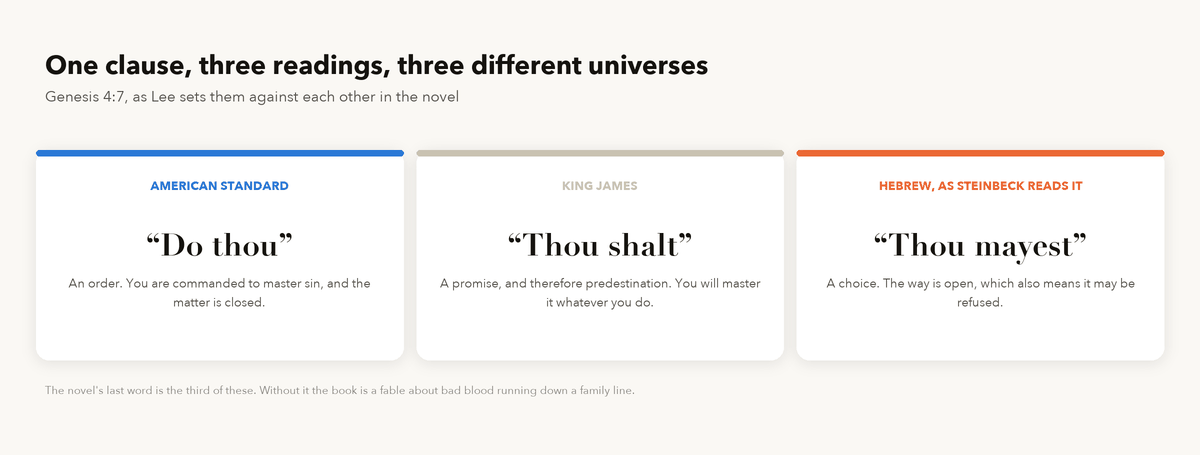
The American Standard Version has “do thou rule over him”, which is an instruction. The King James has “thou shalt rule over him”, which is a promise, and a promise amounts to predestination. Lee’s scholars arrive at a third reading, “thou mayest”, which is neither an order nor a guarantee but a choice, and therefore carries the possibility of refusal.
That third reading, timshel, is the hinge. Take it away and what remains is a story about a taint passed from father to son, which would make the Trask men spectators at their own lives. Keep it and each time the Cain pattern comes round, somebody has decided something.
The Spelling of Timshel Is Wrong
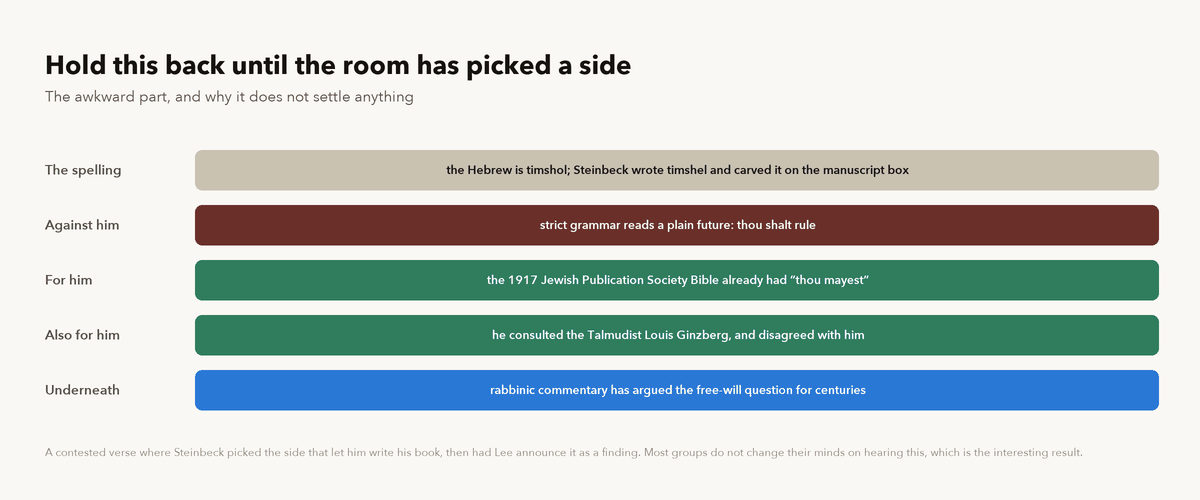
Start with the part that is not really in dispute. The Hebrew word in Genesis 4:7 is timshol. Steinbeck wrote timshel throughout, and carved that spelling on the manuscript box.
His son Thom offered an explanation: his father’s hand slipped while carving, turning the “o” sound into an “e”. Whether that accounts for the spelling in the printed book as well is another matter, and scholars have never fully agreed on why he settled on the altered form.
It is a small error with an outsized afterlife, because the misspelling is now the version everybody knows. Search for the word and you will find Steinbeck’s spelling, not the one in the Hebrew Bible.
The Grammatical Objection to Timshel
The serious challenge is not the spelling but the sense.
Writing in the Jewish Review of Books, Sheila Tuller Keiter sets out the strict grammatical reading. The tav at the front of the word marks the second person masculine singular in the future tense: you will. The letters that follow are the root meaning to rule, to govern, to have mastery over. Put together, the natural rendering is “thou shalt rule” or “thou wilt rule”.
On that reading, Steinbeck has taken a plain future indicative and converted it into a permission. The verse would be telling Cain what is going to happen, not offering him a choice about it.
This is the objection that matters, and anyone who loves the novel should be able to state it without flinching. By the strictest grammatical standard, timshel does not mean “thou mayest”.
Why Steinbeck Is Not Simply Wrong
Here is where the easy version of the argument falls apart.
The 1917 translation published by the Jewish Publication Society renders the clause as “thou mayest rule over it”. That is not Steinbeck’s invention, it is not a novelist’s convenient misreading, and it predates East of Eden by thirty-five years. A major Jewish translation reached the same reading he did, independently and in print, before he was writing.
Steinbeck also did the work. He consulted Professor Louis Ginzberg, a formidable Talmudic scholar, and disagreed with him afterwards. His own account is blunt: the scholars he spoke to did not treat the word as a pure future tense, and they translated it as “thou mayest”.
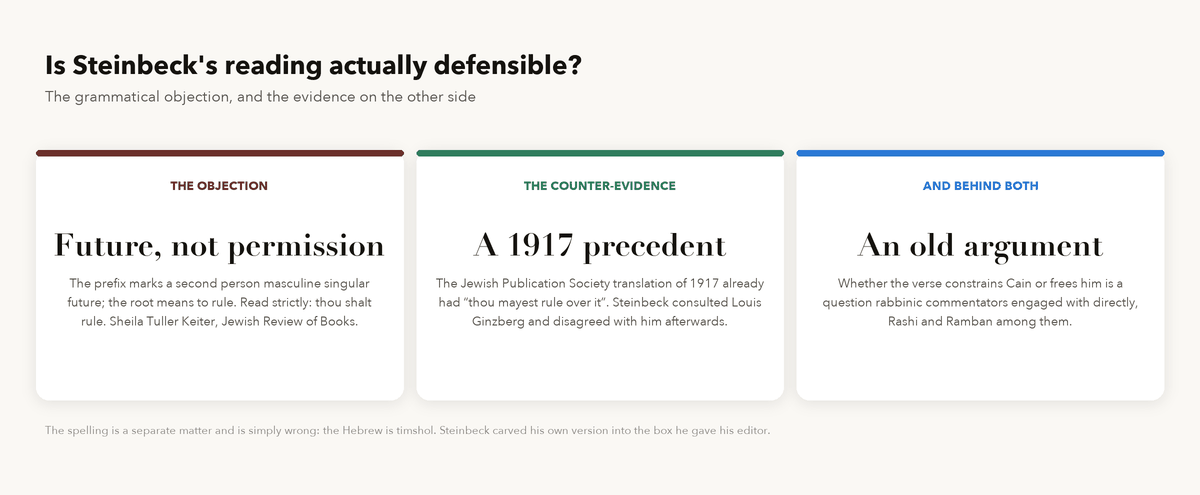
There is a deeper tradition behind that. The question of whether this verse constrains Cain or leaves him free is old, and rabbinic commentators including Rashi and Ramban engaged with it directly, with free will very much on the table. The idea that Genesis 4:7 is about human choice is not a twentieth-century American novelist’s imposition on the text. It is one of the readings the tradition itself produced.
Timshel: So Who Is Right?
Both, in the way that translation arguments usually resolve.
If you ask what the morphology of the word indicates in isolation, the grammarians have it: the form is a future, and “thou shalt rule” is the literal rendering. If you ask what the clause is doing in a passage where God is warning a man about something he is about to do, the permissive reading has real support, a published precedent, and a long interpretive tradition behind it.
What Steinbeck did was choose the second and present it as a discovery rather than a choice. That is the fair criticism: not that his reading is indefensible, but that Lee announces it in the novel as though two years of Hebrew had settled a matter that remains open.
Why Timshel Matters Beyond the Novel
Strip the Hebrew out of the timshel dispute and it is about something most readers have a position on without knowing it.
If the verse is a promise, people are going to be fine, and what they do in the meantime is detail. If it is an order, people are obliged to be good and failure is disobedience. And if it is permission, nothing is settled, and every person has to keep choosing, repeatedly, without a guarantee.
Steinbeck wanted the third because it was the only one that made the novel he was writing possible. A book arguing that a son is not condemned by his father needs a universe in which the choice is real. The entire architecture of East of Eden, the doubled Genesis pattern, the two families, the fifty-five chapters, exists so that one dying man can say one word to one son and have it mean something.
What Lee Actually Claims, and What He Does Not
It is worth going back to the scene itself, because Steinbeck is more careful there than his reputation suggests.
Lee does not say the rabbis settled the Hebrew. He says four elderly men took up the language from exercise books and grammars, worked at it for two years with a rabbi and then a second scholar, and came out convinced. He describes the whole thing as a story he would not dare tell most people. The framing is of an enthusiasm, not a finding.
What he then argues is not linguistic at all. His case for timshel is that any text which has shaped the lives of millions of people is important, and that the three readings produce three different kinds of human being: those who feel commanded, those who feel predestined, and those who are left with a choice. He prefers the third because of what it makes of a person, and he says so openly.
That is an honest position, and it is a different thing from a translation claim. Lee is arguing that the permissive reading is the one worth living by, not that the other two are grammatically impossible.
Adam asks him directly whether he believes it. Lee says yes twice, and then undercuts any suggestion of piety: he has no bent toward gods, he says, only a new regard for the human soul as an instrument. It is an argument from what the word does rather than from what it strictly means, and readers who treat the kitchen scene as Steinbeck’s Hebrew lesson have the emphasis backwards.
Where to Hear It Now
Netflix released its seven-part adaptation on 1 October 2026, created by Zoe Kazan and starring Florence Pugh, and the final episode is titled “Timshel”. Whatever else the series changes, and it changes a great deal, it has not dropped the word.
Readers who enjoy this kind of argument should look at which translation of the Odyssey to read, where one disputed line changes a whole book, and at our guide to reading classics without feeling intimidated.
Which is the correct instinct. You can cut the Hamiltons and reorder the opening and rewrite Cathy’s childhood, and the book survives it. Take out timshel and there is no reason for any of the rest.
Sources: Sheila Tuller Keiter in the Jewish Review of Books on the grammar; the Jewish Publication Society translation of 1917; Steinbeck’s correspondence regarding Professor Louis Ginzberg. Novel text from Penguin Books, 1979 printing, first published 1952 by The Viking Press.







