Netflix released all seven episodes of its East of Eden series on 1 October 2026, and within days it was the platform’s most-watched show worldwide. Created by Zoe Kazan, whose grandfather Elia Kazan directed the 1955 film with James Dean, it arrives with Florence Pugh as Cathy Ames and a Rotten Tomatoes score in the high eighties.
It is also a substantially different shape from the book. This piece sets out what changed, working from the published episode synopses and the critical coverage rather than from a claim to have watched all seven hours, and explains why each change follows from one decision made at the start.
This discusses the plot of the 1952 novel throughout and the broad shape of the series. Specific events in the final two episodes are not covered, because no detailed synopsis of them has been published yet.
The One Decision Everything Else Follows From
Steinbeck’s novel is a double family saga. Two clans, the invented Trasks and the author’s own Hamiltons, run in parallel across sixty years, and the Genesis pattern of a favoured brother and a rejected one repeats across two generations.
Kazan’s East of Eden Netflix series is not that. It is the story of Cathy Ames, with the Trask men arranged around her.
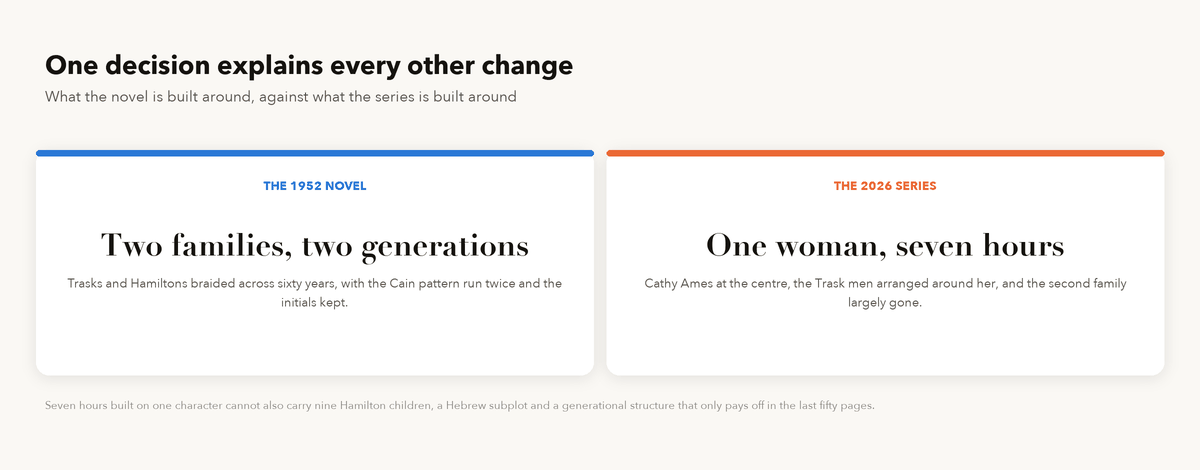
Once you accept that, every other change on the list stops looking arbitrary. A seven-hour series centred on one woman cannot also carry a second family with nine children, a philosophical subplot about Hebrew, and a generational structure that only pays off in the last fifty pages.
How the East of Eden Netflix Series Reorders the Opening
The novel begins with a valley, moves to Cyrus Trask and his two sons, and keeps strict chronological order for hundreds of pages. Cathy does not appear until chapter eight, and she is introduced by a narrator announcing his belief that some people are born malformed in the soul.
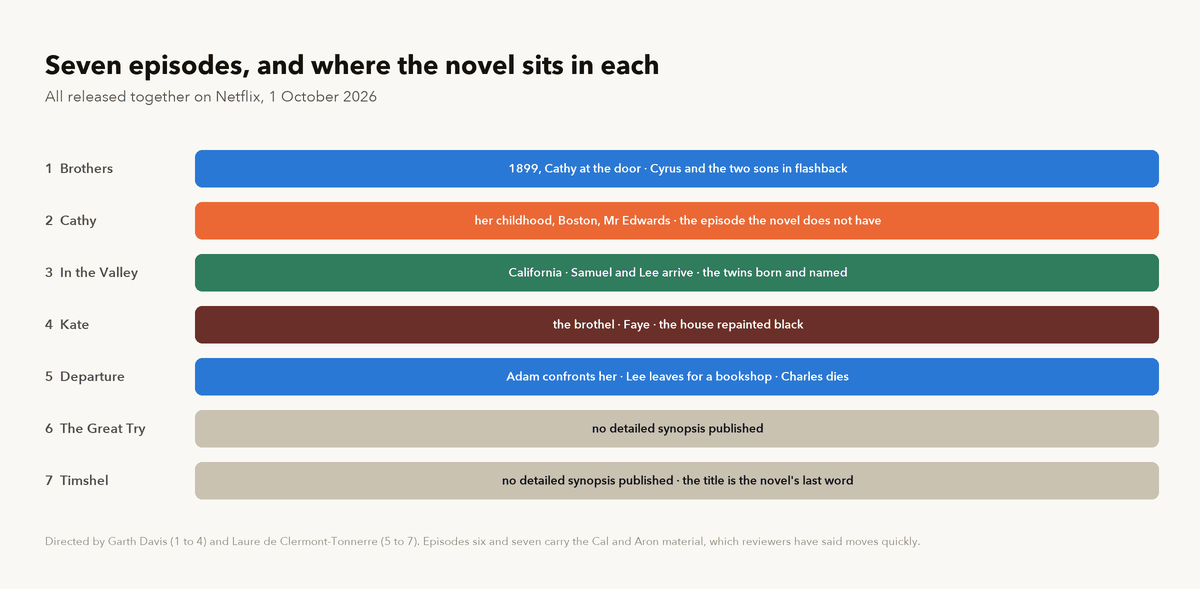
Episode one opens in 1899 with Cathy, bloodied and close to death, outside the Trask farmhouse. The brothers’ upbringing under Cyrus arrives as flashback around her arrival.
That is a conventional television move and a defensible one. It puts the series’ actual protagonist in the first shot. The cost is that Steinbeck’s opening geography goes, and with it the moral scheme the novel sets up before anyone speaks: the light mountains to the east, the dark ones to the west, and the narrator’s admitted dread of one and love of the other.
Cathy Gets an Hour and an Explanation
Episode two is titled “Cathy” and is given over to her past: how she learned to manipulate people as a girl, her time in Boston, and the pimp Mr Edwards who takes her to Connecticut, beats her savagely and leaves her for dead on the road where the Trasks find her.
All of that is in the novel, but it is delivered in summary by a narrator who has already told you what conclusion to draw. The series instead dramatises it and declines to supply the conclusion.
This is the change critics have concentrated on, and Kazan has been open about intending it. Where Steinbeck uses Cathy’s childhood as evidence that she was always like this, the East of Eden Netflix series uses the same events to show cruelty taking shape in response to what was done to her.
Readers of the novel will recognise that the show is doing something the book seems to want to do and cannot. Steinbeck asserts in chapter eight that Cathy was born without conscience, and then spends four hundred pages writing a woman who is frightened of the dark, rattled by blackmail, and keeps morphine within reach. The East of Eden series simply backs the behaviour over the assertion.
The Hamiltons Are Mostly Gone From the East of Eden Series
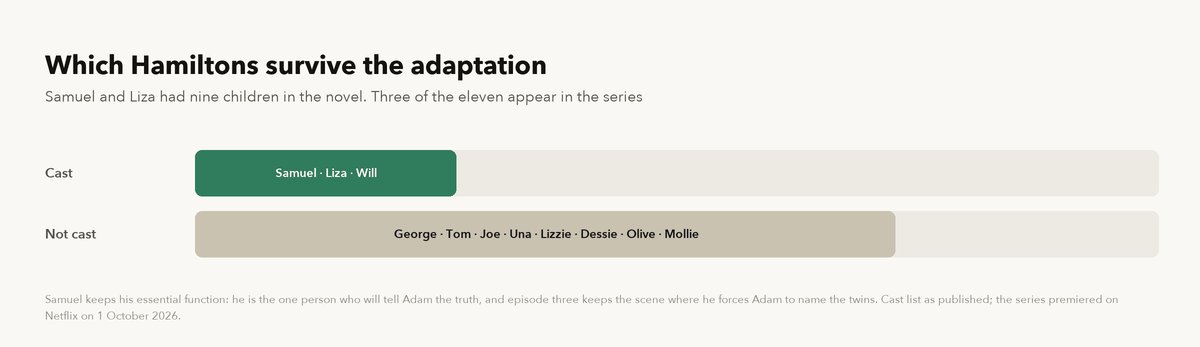
Samuel Hamilton survives into the East of Eden Netflix series, played by Ciarán Hinds. Liza appears, and Will. The rest of the family that occupies a third of the novel does not.
For a reader this is the biggest loss, and it is worth being clear about what goes with them. In the book the Hamiltons are the control group: a family with no money, no inheritance, no Genesis plot and a great deal of life, set against a Trask family with a fortune built on fraud. Remove them and the novel’s argument that its scale of value is not material has to be made some other way.
What survives is Samuel’s specific function, which is to be the only person who will tell Adam the truth. The third episode keeps the scene where he forces Adam to name the twins, more than a year after their birth, and that is the right scene to keep.
Lee Is Expanded, Not Reduced
The one piece of universally positive critical comment on the East of Eden series, alongside Pugh, concerns Hoon Lee’s Lee. The series keeps the detail that matters most: that he code-switches around his white employers, using pidgin because it is expected of him and dropping it when he is treated as a person.
Episode five gives him something the novel also gives him, a departure for San Francisco to open a bookshop, and an argument with Adam about the lie the boys are being told about their mother. In the book Lee leaves, discovers within a week that he does not want the bookshop, and comes back. Whether the series does the same is not clear from what has been published.
Smaller Changes a Reader Will Notice
Three inventions in the East of Eden Netflix series stand out in the published synopses.
- Abra becomes Abra Bacon, daughter of an abusive brothel customer. In the novel her father is a county supervisor who turns out to be an embezzler, and Abra’s connection to Cathy’s world is thematic rather than literal. The series makes it literal.
- James Grew becomes Cathy’s Latin teacher. In the book he is a young man who kills himself after an entanglement with her, and the schoolroom link is not spelled out.
- Adam sends Cathy the wedding photograph, and she imagines speaking to Charles’s ghost. This is not in the novel at all. It is also the clearest signal of the series’ intentions: it gives Cathy an interior life and someone to address, which Steinbeck never does.
Should You Read the Book First
If you have not read it, watch first. The East of Eden series is a coherent thing on its own terms, and the novel is six hundred pages that will keep.
If you already know the book, expect to spend the first two episodes adjusting. The pleasure on offer is not fidelity. It is watching an adaptation argue with its source about the one thing the source got wrong, and having the better of the argument.
If you want the novel afterwards, go in knowing that the Hamilton chapters are the part the series could not use and the part many readers love most, and that the Hebrew argument in the middle of the book is the thing the whole structure is built to support. The finale is titled “Timshel”, so the series has not abandoned it.
Our pieces on adaptation anxiety and using film adaptations to rekindle reading cover the broader question of what to do when a book you love is filmed.
What the East of Eden Series Cannot Do
One structural thing is simply unavailable to it.
The novel runs the Cain and Abel pattern twice, deliberately, with the initials preserved: Cyrus fathers Adam and Charles, and Adam fathers Aron and Caleb. The second run matters because the people inside it know the story of the first. That is a long game, and it needs both generations given comparable weight.
A seven-episode series built around Cathy reaches the second generation late, and reviewers have noted that the closing episodes move quickly. The pattern that takes Steinbeck fifty-five chapters to lay down has perhaps ninety minutes to pay off.
That is not a failure of adaptation so much as a consequence of choosing a protagonist. Kazan picked the character the novel mishandles and built a series that handles her properly. The price is the architecture.
Sources: Netflix, released 1 October 2026, seven episodes, created by Zoe Kazan with Jeb Stuart as co-showrunner; episode titles and synopses as published. Novel quotations and plot from Penguin Books, 1979 printing, first published by The Viking Press in 1952.







