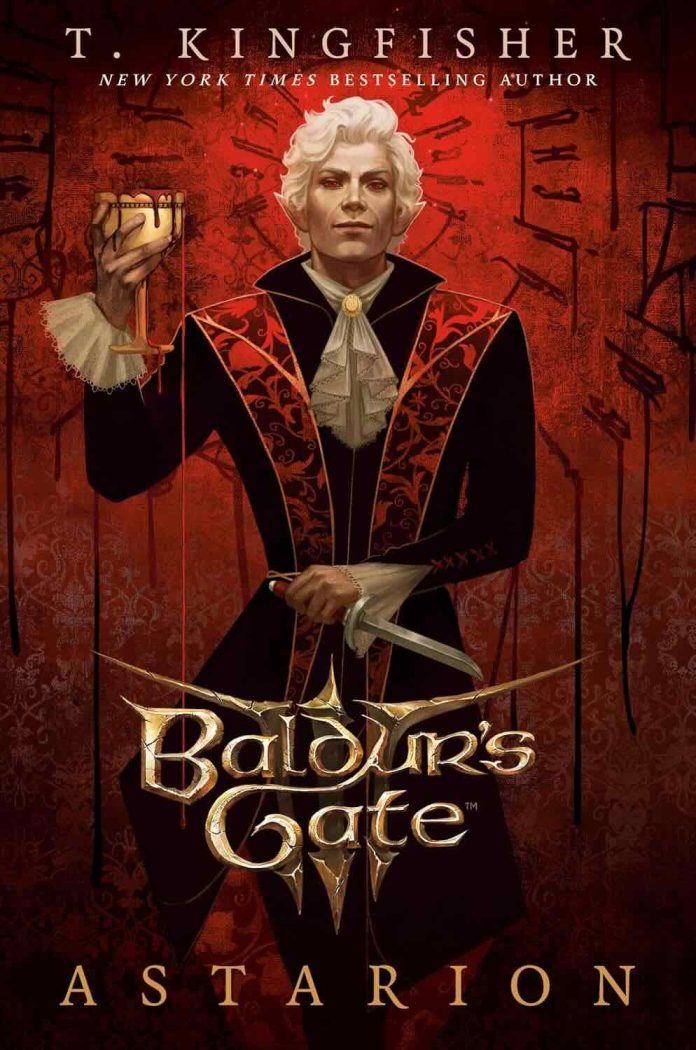
The first page of Astarion: Baldur’s Gate 3 by T. Kingfisher has a man bleeding to death in an alley and thinking about tailoring. He notes the shade of pink his blood has turned a discarded turnip, considers it as an accent colour, decides against, and settles on silver embroidery with a flicker of warmth in the waistcoat. Then he tries to reach his writing case and discovers that his arm is broken in several places. That is the whole character in one page, and the book spends four hundred more proving the page was not a joke.
How Astarion: Baldur’s Gate 3 Is Built
Two strands, separated by nothing but a row of asterisks. The present runs about a week, roughly a century and a half into his servitude to the vampire lord Cazador Szarr. The past runs a whole life in order: a childhood on a vineyard in the north, a summons from an ancient noblewoman he has never heard of, ten years apprenticed to a lawyer in Silverymoon, and a flight south that ends exactly where page one began.
The braid is not causal. It is argumentative. Almost every chapter set in the past concerns a rule and how to get around it: a father’s instruction to pull the weeds, obeyed to the letter by pulling five; a locked chest; a city contract; a clause in an agricultural statute that can be turned against a man who bought powdered troll as fertiliser. Almost every chapter set in the present concerns the one rule he cannot get around, which is that his master can make him want to do anything at all.
A Mind Like a Lockpick
This is the strongest idea in the book, and it is Kingfisher’s, not the game’s. Astarion was a magistrate. He thinks the way a picklock works, feeling along a rule for the point where it will give. When Astarion: Baldur’s Gate 3 by T. Kingfisher finally puts him in a cell with someone dangerous, he does not fight. He negotiates a promise of protection, in specific language, and then spends the rest of the novel living inside the gap he has opened.
The someone dangerous is Hahn den Suriel, an aasimar paladin of the Argent Badger, an order of undead-hunters that nobody has heard of, including everyone he tells. He is six and a half feet of metallic gold, faintly luminous, a hundred and three years old, sworn to destroy exactly what Astarion is, and unable to stop being kind. He is also funny, which is the surprise. Kingfisher has written paladins before and knows the trick: the earnestness is not stupidity, it is a decision made daily at some cost.
What Baldur’s Gate 3 Owes the Paladin
Their scenes are the reason to read this. Two men who are very tired, one of whom has decided to keep going out of spite and one of whom has outlived his entire family and most of his order, flirting across a stalemate that can only end badly. Den Suriel casts a truth spell and discovers that it works on him too, which produces the funniest exchange in the novel and then, forty pages later, its cruellest.
The other thing Astarion: Baldur’s Gate 3 by T. Kingfisher does well is the household. Cazador is not written as a monster so much as an administration. Comfort is doled out in portions too small to be relied on. The oldest spawn teaches the newest that the way to survive is to be boring. Kindness between siblings can never be acknowledged afterward, because anything you admit to wanting is a handle somebody can pick you up by. One spawn hates another purely for having once helped her. That is an unusually precise account of how abuse organises a house, and it is doing real work under the jokes.
And the jokes are good. A vampire who cannot see his own reflection plans to keep a tame doppelganger on staff. A burglary goes wrong because a magical harp starts performing a filthy sea shanty. There is an ivory figurine that summons an elephant, on the condition that a clear elephant-sized space is available, which is a detail only this author would think to include and then use as a plot resolution.
Where Astarion: Baldur’s Gate 3 Gives Ground
Four things hold Astarion: Baldur’s Gate 3 by T. Kingfisher back.
- The heist is thin beside the character work. Cazador hands each of his six spawn an enchanted vial and five days to fill it with the rarest blood they can find. What follows is a fetch quest through an undead cult that is mostly a corridor with a great many bones in it, and the cult’s leader is dealt with by a joke item.
- The ending is not allowed to be an ending. The novel has to stop before the game starts, so every gain of the previous four hundred pages gets dismantled in the last forty. Kingfisher says outright in her afterword that she could not give this one a happy ending. It is honest, and it is still deflating.
- The romance outruns its page count. Cellmates to bed in about three scenes. The final chapters ask for a bond the book has not fully paid for.
- The quipping is relentless. When genuine horror arrives, and it does, the narrative reflex to make a joke about it occasionally flattens the page instead of sharpening it.
Read It If, Skip It If
Astarion: Baldur’s Gate 3 by T. Kingfisher knows who it is for, and players are not the whole of that audience.
Read it if:
- You want a tie-in that takes its character more seriously than its franchise.
- A doomed flirtation between a thief and a paladin is enough of a plot.
- You like Kingfisher’s particular register, where the funniest line in a scene is also the saddest.
Skip it if:
- You need the plot, rather than the person, to be the point.
- You want your protagonist to escape, improve, or win.
- Depictions of coerced sex and prolonged torture are a hard no. This one does not flinch.
Content Notes
Astarion: Baldur’s Gate 3 by T. Kingfisher carries a heavy load. Sustained torture on the page: bones crushed, fingers severed, a poem cut into skin with a silver knife. A year of solitary confinement in a sealed crypt, with starvation and self-injury described closely. Sexual servitude, including a scene in which the narrator is ordered to service a guest and used at a dinner table. Magically compelled obedience and compelled desire. A fatal beating. Predatory killing of people. Explicit consensual sex between men. Animal deaths. Corpse-wax body horror. Suicidal ideation and the inability to act on it. Frequent profanity.
Read These Next
Five of ours for anyone who finishes Astarion: Baldur’s Gate 3 by T. Kingfisher wanting more.
- Daggerbound by T. Kingfisher for paladins written by someone who takes them seriously.
- Snake-Eater by T. Kingfisher if the voice is what you came for.
- The Lion and the Deathless Dark by Carissa Broadbent for the doomed-bargain register.
- The Good Vampire’s Guide to Blood and Boyfriends by Jamie D’Amato for a lighter take on the same appetites.
- Exploring the Rise of Grimdark Fantasy if this is the shelf you want to stay on.
One more note for the curious: the cult’s guards are mummies made by adipocere, the real process by which body fat in cold water turns to a soap-like wax. Kingfisher has a character explain it at length and then complain about how they look, which is roughly the book’s whole comic method.
The Last Word
The past strand ends with a young lawyer on a bluff above Baldur’s Gate, throwing a childhood keepsake into the river and swearing that nothing will be taken from him again. We have already read the alley. We know how long the vow lasts.
Astarion: Baldur’s Gate 3 by T. Kingfisher is a prologue, which means it is structurally forbidden from rescuing anybody, and it spends its last pages carefully returning its hero to the exact condition the game finds him in. What it manages anyway is a portrait of a man who has turned charm into armour so completely that he no longer knows where the armour stops, and a paladin who breaks himself on the discovery that not everyone can be saved. The heist is filler. The two of them in that cell are not.