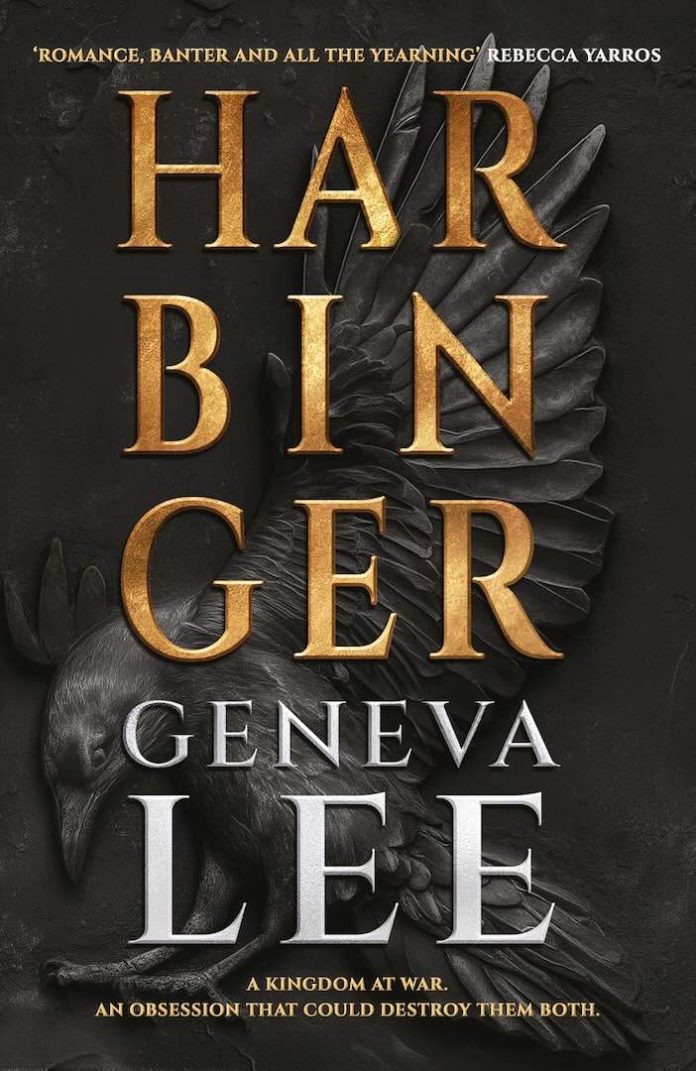
About a third of the way into Harbinger by Geneva Lee, a man who has just been stabbed through the throat, died in a woman’s arms, and then walked back into her bedroom alive sets out the terms on which he will explain himself. One question a day, paid after training, and anything she asks out of turn is docked from the account. It is a good scene. It is also the novel’s architecture printed on the page, because this is a book that has decided in advance precisely when you will be allowed to know each thing, and it makes its heroine work for every early delivery.
How Harbinger by Geneva Lee Pays You in Answers
Arden Icaros is twenty-five, the daughter of a patron house that farms, and she has dirt under her fingernails in a genre that usually prefers courtiers. At her Petition she refuses to kill the sacrificial raven and lets it go instead. At her Kindling the stars mark her with the sigil of Ravenell, the sixth house that was destroyed five centuries ago and blamed for everything since, and the room calls her a harbinger. The king is assassinated the same night, his heart cut out of his chest.
What follows is not a quest. Bishop Marius, patron of the military order and a bishop besides, removes her to his failing estate on the coast and then declines to tell her anything, which turns the first four hundred pages into a slow audit of one man’s secrets. A locked wing. A forbidden book he stole from a bookshop. A travel log that puts him at three of the heart-collector murders. The structure is confident enough to let the reader draw the obvious conclusion and sit with it for a very long time.
Thirty-Eight Chapters and Two Epilogues
The shape of Harbinger by Geneva Lee tells you what kind of series this is. Thirty-eight numbered chapters in Arden’s first-person present tense, and then two epilogues, the second of which hands the narration to Bishop for the first and only time. The switch arrives exactly when the book needs an interior it has spent five hundred pages refusing to open, and it works, though it also reads a little like the sequel’s opening chapter arriving early.
Between those poles the novel is built on two reversals, and both of them are real. The first lands before the midpoint and rewrites every suspicion the reader has been carefully handed. The second lands on the final pages and reorganises the entire book behind it. Neither is a cheat. Both are set up in plain sight, which is the harder way to do it.
The Man Who Will Not Use What He Has
Bishop’s real name is Endymion, which is the single best decision in the novel. The shepherd of the myth was granted endless sleep and endless youth, loved by a goddess who could only watch him not change, and Lee gives that name to a man who cannot age, cannot father children, and buttons his uniform to the jaw to hide what he is.
He is an immortal who refuses to fight like one. His skin carries the marks of every other immortal he has killed, hundreds of them, taken during years he does not defend and will not excuse. His religious vow is not piety; it is a cage he built after the fact, and he tells Arden plainly that if it ever comes off he will not be able to rebuild it. So he runs a military academy on footwork and discipline, trains the conscripts himself, and shelters the immortals who turn up at his gate knowing perfectly well that one of them may eventually kill him and that this would be fair. Harbinger by Geneva Lee is far more interested in what he declines to do than in what he can.
Where Harbinger by Geneva Lee Loses Its Shape
- The middle runs the same circuit three times. He withdraws for her safety, she calls him a coward, they collide, and the cycle resets. The first round is excellent. The second and third are the same argument with the furniture moved.
- The lore arrives in conversation. A five-hundred-year-old librarian delivers the immortality rules across two long scenes, and the central riddle is quoted back at the reader more than once because the plot needs it held in mind.
- The magic is promised rather than spent. Arden manifests twice in a very long book, once by accident and once under extreme duress. Readers who came for a system will wait the whole way.
- The best villain gets one monologue. Her motive is genuinely good, and it arrives about four pages before she leaves.
- A brother’s collapse is reported, not dramatised. He is warm in the opening chapters and a snob by the final act, and the change is attributed to a fiancée offstage.
- Nothing resolves. The last page is a cliff, deliberately, and the series decision is defensible. It will still enrage a portion of the audience.
What Harbinger by Geneva Lee Is Actually Building
The middle act is where the book quietly becomes good. Arden buries her best friend, observes the mourning rites, gives his belongings away to strangers, and then takes on physical work she is not remotely equipped for because it is the only thing that quiets her head. The training sequences are unusually legible for the genre: terrain, footwork, a recovery drilled into her that she later uses on someone trying to kill her. The acknowledgments thank a sword instructor, and it shows.
What holds it together is the bargain at the centre. He asks her, eventually, to promise that if he loses control she will end him, and hands her the one word that will bring him to his knees. She agrees and then refuses the part where he faces it alone. That exchange is the whole novel: two people who have each decided the other is the greater danger, negotiating terms.
Content Notes
Harbinger by Geneva Lee opens with a publisher warning page, and it is warranted. Bird sacrifice. A stabbing witnessed at close range. A woman bound to a tree and set alight, with burns treated over weeks. A mercy killing performed by the narrator at the victim’s request. Serial murders in which hearts are cut from living bodies, described after the fact. Two poisonings, one at a table that includes a child. A slow death by seizure. An animal killed defending the narrator, with her orphaned cub on the page. The massacre of an entire household, parents and staff included. A mob assault. Sustained grief, survivor guilt, and a narrator who describes having offered herself up rather than fight. Self-loathing about a body marked without consent. Coercive control inside an engagement. Three explicit consensual sex scenes.
Read These Next
- Fallen Court by Geneva Lee. Her nearest comparison for court politics and withheld information.
- Filthy Rich Fae by Geneva Lee. Lighter, funnier, the same instinct for a slow reveal.
- The Lion and the Deathless Dark by Carissa Broadbent. For readers who want immortality treated as a wound.
- Onyx Storm by Rebecca Yarros. The military-academy romantasy this will be shelved beside.
- Romantasy and the Emotional Turn in Modern Fiction. Useful for seeing which conventions Lee is using and which she is refusing.
Worth Your Shelf
The dedication carries a Latin tag about the stars inclining without binding, and the novel spends five hundred pages testing it. Everyone here has been handed a fate by something enormous and indifferent: a mark, a resurrection, an omen. Every one of them spends the book arguing with the delivery. The heroine is told she will bring war and plants bulbs instead. The immortal is told he is built to fight for a throne and teaches teenagers how not to drift left on a recovery.
Harbinger by Geneva Lee is a first book doing first-book things, and some of them are irritating: a saggy middle, a magic system kept in its box, an ending that stops rather than lands. What it does well is rarer. It builds a romance out of two people negotiating the terms of each other’s destruction and makes that feel like tenderness. It gives a grieving woman a job instead of a speech. And it withholds the truth long enough that when the last thirty pages arrive, the reader has to go back and reread the whole thing in a new light. That is a harder trick than a magic system, and Lee lands it.







