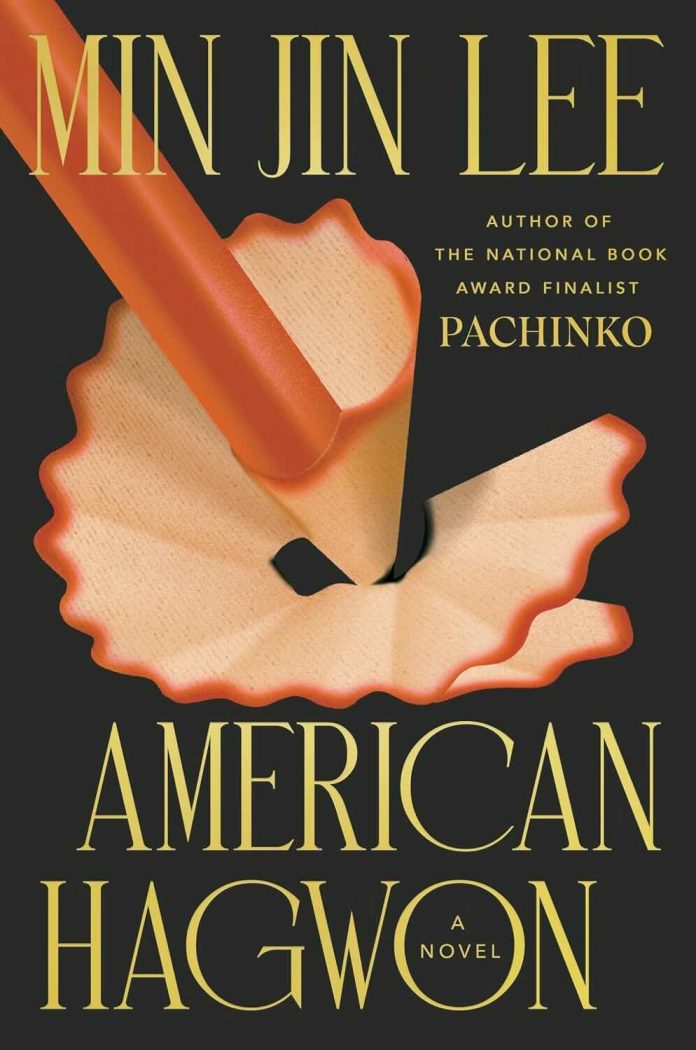
Three days into her new school in Seoul, a thirteen-year-old is called to the chalkboard, gets the problem wrong, and starts to rub it out. Her teacher stops her. Erasing a mistake, he explains, is cowardice, because nobody can learn from what has been hidden. Then he takes a brass ruler from his pencil cup and strikes her open palms three times, once for each attempt at the third question. She does not make a sound. American Hagwon by Min Jin Lee opens on that scene, and everything the novel goes on to argue about education, shame and who pays for a child’s future is already sitting in it.
Min Jin Lee and the Girl Who Does Not Speak
Mido Koh is the youngest of three children born in New Jersey to Korean parents whose work has moved them between Paramus, Seoul and Sydney. She reads at a college level and says almost nothing outside her own home. Teachers in three countries have flagged it; a doctor in Sydney taught her to breathe through the fear. Her mother Helen, an Ewha graduate who works retail, keeps a spiral notebook for each child with a manila envelope of cash pasted inside the back cover for school fees. Her father John, third in his class in mathematics at Seoul National University, is a manager at a trading conglomerate and a man so scrupulous that refusing bribes has become a reflex.
The thread Lee follows for fifteen years is what happens to that silent child. Mido finds a friend, loses her to a family bankruptcy and a flight to California, and finds her way into a drama society in Sydney mostly to learn how to talk. When a play she wrote is staged and she reads a speech aloud at rehearsal, the room stops. She discovers something she cannot quite explain to anyone: speaking gets easier when the words are hers first. It is the most precise thing American Hagwon by Min Jin Lee does, and Lee refuses to make it a triumph. What Mido does with that discovery is teach, at a strip-mall tutoring centre, other people’s anxious children.
The hagwon of the title is not a metaphor. It is private tutoring, an institution the novel takes seriously enough to argue with itself about. One teacher defends it as a haven, a place where a child can look foolish in front of someone paid to be patient. Another calls the whole industry a machine for turning young people into products. Both of them are in the same room, and Lee does not settle it.
What an Education Actually Costs
Running under the family story is a ledger, and Lee keeps it in plain sight. An envelope handed to a teacher during a home visit. A cup of tea and a biscuit a mother has been saving for her husband. A tutoring bill that would consume a mother’s entire salary for three children. A 500-won coin given for luck before an exam. A spaghetti marinara ordered at $14.99 because the boy has been taught to pick the cheapest thing on someone else’s bill.
This is the second thread, and it is the one that gives the novel its weight. When the family’s fortunes collapse, the fall is rendered with pitiless specificity: which job is taken, what it pays in cash, how much is left after the lawyer, whose name is embroidered on the borrowed uniform. A man who managed twenty-one people ends up in a fryer kitchen in a Garden Grove strip mall. His wife negotiates commission at a shop selling Swiss watches to Koreans who will not walk into an American department store. Nobody makes a speech about it. They go to work.
American Hagwon by Min Jin Lee is written in a gliding omniscience that steps into almost any consciousness for as long as it needs, including people we will never meet again: a receptionist at a tax office, a mart manager whose framed degree made his dead parents proud, a lonely widow buying diamond studs for her son’s bride. It is the Middlemarch move, and she has the control for it. The novel is extremely long and largely uneventful in the conventional sense, and it is nearly always absorbing, because Lee understands that work is where most people’s inner lives actually happen.
The counterweight to all this is a subplot at the trading company, where a director’s obsession with a junior colleague drags John into a scheme he knows is wrong. It supplies the novel with its engine and its one real villain.
Where Min Jin Lee Gives Ground
- The antagonist is the only person American Hagwon by Min Jin Lee keeps outside. Everyone else in the book, down to a one-scene housekeeper, gets interiority and the benefit of the doubt. She gets appetite, calculation and an unbroken run of sexual conquests, and the writing about her tips into something closer to melodrama than the rest of the novel earns.
- The sex is repetitive and oddly clinical. Several strands rely on it to carry information, and the scenes accumulate past the point of telling us anything new.
- The last act thins out. A late institutional storyline resolves through summary and reported news rather than through the characters, and it arrives with a tidiness the preceding six hundred pages never needed.
- The length asks for genuine patience. At well over two hundred thousand words, the novel has stretches where the ledger does the work and the story waits.
Content Notes
American Hagwon by Min Jin Lee earns a full list. Corporal punishment of a child; a false accusation of sexual assault; a parent striking a teenage daughter; terminal illness and end-of-life care described at length; grief; suicide; adultery and coercive sexual dynamics, including a wealthy man’s relationship with a much younger employee; sex work; financial crime; and an extended thread on the mental health of students under academic pressure, including a suicide referred to in passing.
Read These Next
Four for readers who finish American Hagwon by Min Jin Lee and want the same register:
- Flashlight by Susan Choi. Another Korean family across decades and continents, built around a disappearance and what a household refuses to say aloud.
- Happiness Falls by Angie Kim. A Korean American family, a missing father, and a child whose silence the world keeps misreading.
- I Leave It Up to You by Jinwoo Chong. Sharper and funnier, about a son pulled back into the family business he ran from.
- The Family Chao by Lan Samantha Chang. Immigrant parents, three grown sons and a restaurant, with the money always in the frame.
Lee’s previous novels are Free Food for Millionaires and Pachinko, and readers of the latter will recognise the method here: a long view, a moral seriousness about work, and a refusal to let anyone be only one thing.
The Last Word
Late in the book, a hagwon owner addresses five hundred parents in a church hall and tells them their children cannot be superheroes, that no exam result will protect anyone from harm. The parents listen closely. Lee lets us watch their faces, and what she shows is not stupidity or greed. It is people who understand him perfectly and cannot afford to believe him.
American Hagwon by Min Jin Lee is too long, and its villain belongs to a smaller, louder novel. It is also the most clear-eyed book I have read about what families spend, in money and in silence, to give a child a chance. It ends without triumph, on an ordinary evening, and that restraint is the whole argument.







