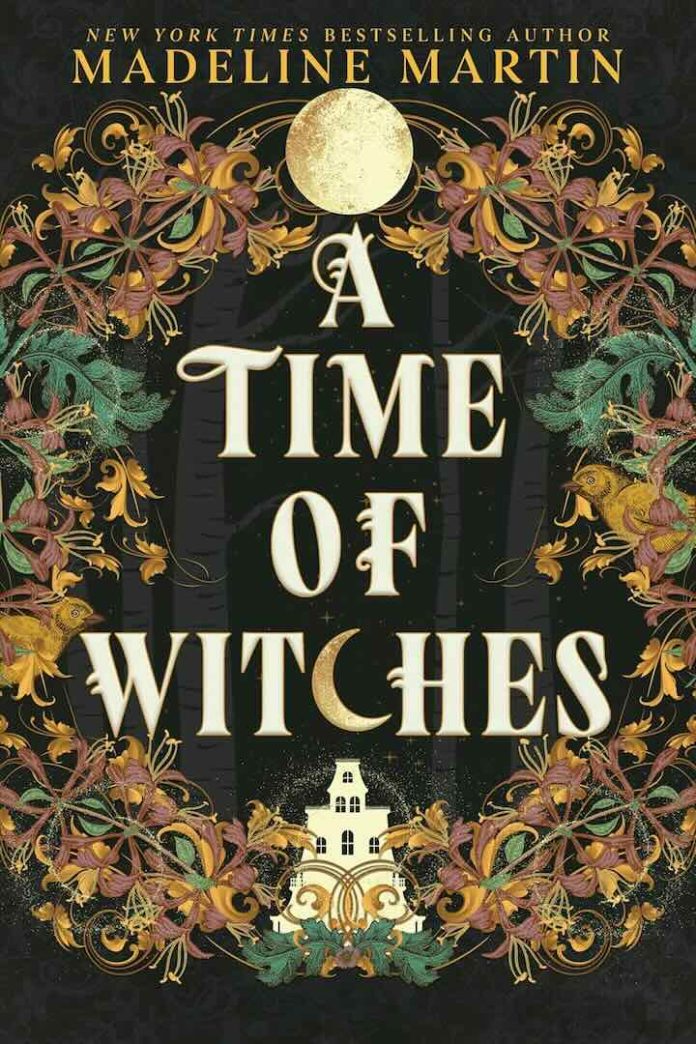
Three candles go out at once in a bedchamber at Brackenmere Manor, with no wind in the room and no window open. Four hundred years later, a woman in Savannah watches the photographs on her phone delete themselves one by one. A Time of Witches by Madeline Martin runs those two clocks side by side and points them at the same date, and the date is real: 27 August 1645, when eighteen people were hanged on Thingoe Hill outside Bury St Edmunds after Matthew Hopkins declared them witches.
Martin is best known for her wartime bibliophile novels, and readers arriving from those will find this a genuine departure. The bookshop warmth is still here. So is a prison chapter that will sit in your chest for a week.
How A Time of Witches Works
A Time of Witches by Madeline Martin runs two strands, alternating in short chapters. In the present, Lilith Legare is twenty-six, newly motherless, and has started noticing that plants lean toward her and the weather answers her moods. A fortune teller who turns out not to work at the shop she was found in tells her that she is tied to a woman named Sybil, that she must help her, and that failing means she will cease to exist.
In 1645, Sybil Brantham is a wealthy widow in Suffolk with a dead husband, a herb garden, a sixteen-year-old in her care whose power she is frightened of, and a magistrate who has been refused too many times. When Hopkins arrives in town, all of that becomes evidence.
The connecting device is a spell that binds Sybil to a descendant born under a full moon, which is why Lilith has dreamed of a burning since childhood and why she is now dissolving. The rules are laid out plainly and the countdown is honest. Lilith has three days, and the reader can feel each one go.
What Madeline Martin Does With the Prison
The seventeenth-century chapters are the reason to read this. Martin travelled to Bury St Edmunds and worked with the guides and with Moyse’s Hall, and the research does not sit on the surface as decoration. It arrives as procedure.
There is a cell where women are separated by whether they have confessed, so that the ones who have not can be starved in front of the ones who have. There is the walking test, which is simply being made to run between two chairs for a day and a night while a man asks the same questions until exhaustion turns a denial into an admission. And there is a woman brought in to shave a prisoner’s entire body and prick her with a bodkin whose point retracts into the handle, so that the absence of blood proves what the town has already decided. And there is a detail Martin found in a pub basement: the accused had their nails and hair clipped into jars before execution, so they could not be buried whole and could not enter heaven.
Martin also names real victims and lets them keep their names. Mary Bacon, John Lowes, the Everards, Margery Spearham. That choice gives A Time of Witches by Madeline Martin a spine that its supernatural plot alone would not have supplied.
What works
The strengths of A Time of Witches by Madeline Martin are almost all in the past, and they are specific rather than atmospheric.
- Edith. An old woman covered in warts who feeds everyone the town forgot, and whose only complaint about her life is that she has never been beautiful. What her friend does about that, days before the swimming test, is the finest sequence in the novel.
- Kat. Seven children, a sharp tongue, a seamstress with a genius for using people’s own consciences against them. Her speech to the crowd is the best-constructed scene in the book.
- The erasure. Lilith’s photo count ticking downward, a reflection that stops arriving, and a best friend who texts back asking who this is. That last one lands hard.
- The animals. A rescued racehorse, a kestrel, a woodlark, a squirrel and a black cat named Dragon, all treated as companions rather than props. Martin’s afterword on why she wrote a black cat is worth reading.
- The appendix. Seven usable tea, balm and bath recipes closing the book, which is a lovely idea and executed without whimsy.
Where it gives ground
Five things keep A Time of Witches by Madeline Martin from being the novel its prison chapters promise.
- The two halves are not weighted equally. One timeline contains starvation, forced stripping and eighteen hangings. The other contains lasagna, two bottles of wine and a skunk called Lord Wimbleton the third. Both are enjoyable. They do not belong to the same book, and the novel never resolves the gap.
- Asher is thin. His secret is signposted for two hundred pages and dissolved in a single conversation with no real friction. The romance is pleasant and carries no risk.
- Essie exists by text message. She is the warmest, funniest character in the present-day strand and appears in person on roughly three pages.
- Aunt Jacqueline solves too much. She knows everything, supplies every ingredient, and can perform the one spell the plot requires. Charm is not the same as opposition.
- The investigation is short. Lilith watches one day loop, follows the wrong servant once, then overhears the entire answer in a single unguarded conversation.
Content notes for A Time of Witches
Eighteen on-page hangings, described. An attempted burning at the stake. A death by drowning during a swimming test. Starvation, thirst and sleep deprivation used as torture. A woman stripped, shorn and searched by other women, at length. Sexual assault and coercion, referenced repeatedly. An unwanted pregnancy used to force a betrayal. A man beaten to death in a cell. A mute child imprisoned and starved. Plague deaths, parental death, maternal emotional abuse, and a deliberate blood offering. The English witch trials are the subject rather than the backdrop, and the book does not soften them. Romance is closed door. No heat rating needed.
Read it if / Skip it if
Read it if you want witch-trial fiction that treats the procedure as the horror rather than the magic; if you liked Weyward and wanted the historical strand to run longer; if you read author’s notes and want a good one.
Skip it if you need both halves of A Time of Witches by Madeline Martin of a dual timeline to hold equal weight; if a love interest with no obstacle bores you; if the mechanics of a countdown spell feel like homework.
Read these next
For readers who finish this and want to stay in the same weather:
- Weyward by Emilia Hart. Three women, three centuries, one family and the natural world taking their side. The closest match on the shelf.
- The Moonlight Healers by Elizabeth Becker. Inherited healing passed down a female line, with the same interest in what a mother declines to explain.
- The Amalfi Curse by Sarah Penner. From the author of The Lost Apothecary, and built on the same dual-timeline frame.
- The Booklover’s Library by Madeline Martin. Her own backlist, for readers who want the wartime novels this one departs from.
- The Manningtree Witches by A.K. Blakemore. The same Matthew Hopkins, told from inside the accusations, and considerably harder going.
The Pirate Queen by Ariel Lawhon is another novel about a woman punished for holding power, following Grace O’Malley from a marriage arranged at sixteen to a fleet of her own.
The Verdict
A Time of Witches by Madeline Martin is two novels sharing a spine. One is a cosy contemporary about a woman inheriting her power, a bed and breakfast, a grumpy vet and a rescued black cat, and it is pleasant company. The other is a furious, exact account of what a paid witchfinder actually did to a hundred and twelve people between 1645 and 1647, and it is not pleasant at all. The second one is why the book matters. Martin has spent twenty-five years wanting to write this, and it shows most in the pages where nothing supernatural happens: a woman running between two chairs until her feet break, a jar of clipped fingernails in a cellar, a friend sewing a silk gown so that someone can feel beautiful on the last morning of her life. The magic is the frame. The record is the point.