Mention a novel you loved and, sooner or later, someone asks whether you read it or listened to it. The question sounds neutral. It rarely is. Whether audiobooks count as reading has turned into one of the most persistent arguments in book culture, and it keeps going because most people on both sides are arguing from instinct rather than from the evidence.
The evidence is now substantial. There is a 46-study meta-analysis on comprehension, brain-imaging work showing what happens when the same story arrives through the eyes or the ears, new 2026 research on children, and a full year of fresh market data from Pew, the Audio Publishers Association and the Association of American Publishers. This guide puts all of it in one place, with dates and sample sizes, so you can decide for yourself whether audiobooks count as reading.
Key takeaways
- Across 46 studies and 4,687 participants, reading and listening produced no reliable difference in comprehension overall.
- Print keeps a small edge when you control the pace, and for inference and dense or technical material, mainly because you can go back.
- Listening invites more mind wandering, so attention, not the ear, is the weak point.
- For the meaning of a story, the brain builds nearly the same semantic map whether you hear it or see it.
- In 2025, 26% of US adults listened to an audiobook, up from 11% in 2011, and digital audio out-earned e-books for American publishers.
A word on where this is written from. We publish book reviews every day, more than 4,000 of them on this site alone, and the question of format comes up constantly with readers and with the publicists who send us books in print, as e-books and as audio. We have no stake in which format wins. Every figure below links to its source, with each study’s limits stated alongside its findings.
The Short Answer: Do Audiobooks Count as Reading?
For most books and most purposes, yes. If you have taken in the story or the argument and can think and talk about it afterwards, you have done what reading is for. The research on comprehension backs that up for narrative fiction and for most narrative non-fiction.
There are two honest qualifications. Listening is not the same skill as decoding print, so it does not build reading fluency in a child who is still learning to read. And for dense, technical or heavily structured text, print gives you control that audio does not. Neither point turns a finished audiobook into an unread book.
How Many People Listen to Audiobooks in 2026
The format stopped being a niche some time ago. The 2026 figures show how far it has travelled.
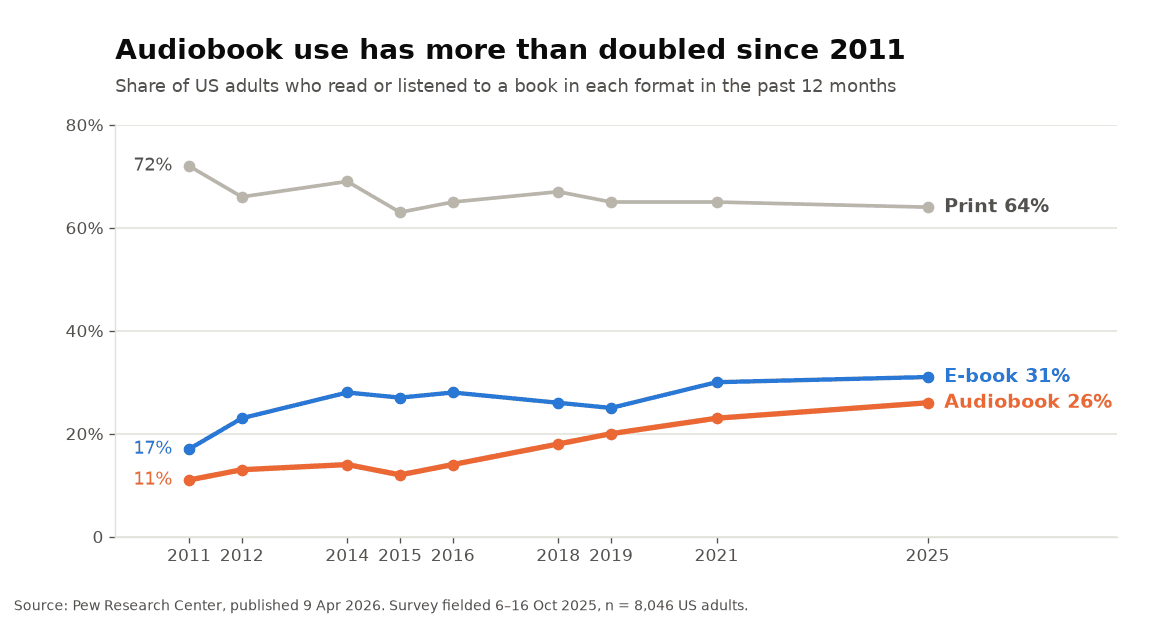
The Pew Research Center surveyed 8,046 American adults between 6 and 16 October 2025 and published the results on 9 April 2026. Twenty-six percent had listened to an audiobook in the previous twelve months. In Pew’s first survey in 2011 the figure was 11%. Print remains the most common format at 64%, and e-books sit at 31%.
Money tells a similar story. The Audio Publishers Association released its annual survey on 5 June 2026: US audiobook sales reached $2.43 billion in 2025, up 9%, with more than 750,000 active titles, a 43% jump in a year. General fiction was the biggest category at 27% of revenue, which disposes of the idea that audio is mainly for business and self-help books.
The Association of American Publishers measures a different slice of the market, its member publishers, and its annual StatShot for 2025 found digital audio revenue of $2.5 billion against $2.2 billion for e-books. Over five years, digital audio grew 61.4% and e-books 11.0%. More people still read e-books than listen to audiobooks, but listeners now spend more. Sales alone cannot say whether audiobooks count as reading, but they show the question now concerns a large share of readers.
According to Edison Research figures released with the APA survey, 58% of American adults, about 157 million people, have listened to an audiobook at least once. Listeners finished an average of 3.8 titles last year, and the most cited benefits were being able to multitask (86%), listening on the go (84%) and having an alternative to screen time (70%).
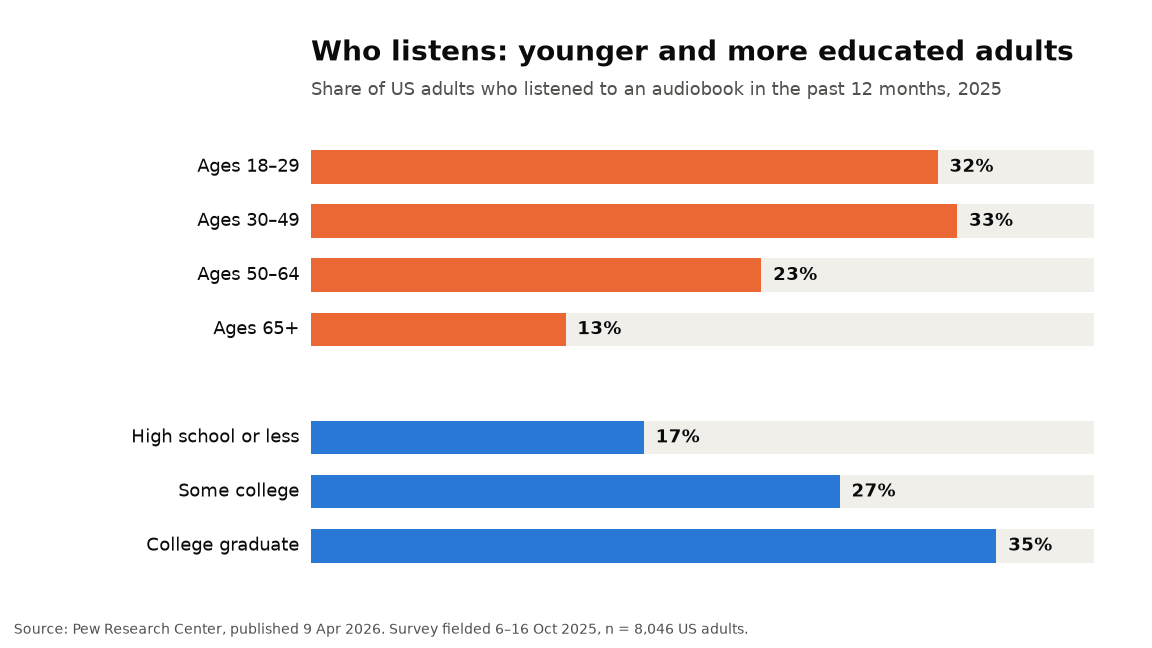
The profile of who listens matters for the argument. Pew found audiobook use highest among adults under 50 and among college graduates, at 35%. The people listening most are not avoiding books; they are among the most educated readers in the country.
Do Audiobooks Count as Reading? The Comprehension Research
The largest piece of evidence is Virginia Clinton-Lisell’s meta-analysis in Review of Educational Research, which pooled 46 studies with 4,687 children and adults, run between 1955 and 2020. The overall difference between reading and listening comprehension was not statistically reliable (g = 0.07). The detail is more interesting than the headline. Reading came out ahead when people read at their own pace, and its advantage showed up in inferential and general comprehension rather than in remembering literal facts.
A smaller controlled study points the same way. Beth Rogowsky, Barbara Calhoun and Paula Tallal randomly assigned 91 adults to an audiobook, an e-text, or both at once, using sections of Laura Hillenbrand’s non-fiction book Unbroken. In their 2016 paper in SAGE Open they found no significant differences in comprehension, either immediately or two weeks later. One caveat: the comparison was with reading on a screen, not on paper.
The brain-imaging work explains why the results are so close. Fatma Deniz and colleagues in Jack Gallant’s lab at Berkeley scanned volunteers while they listened to stories from The Moth Radio Hour and then read the same stories. Their 2019 study in the Journal of Neuroscience found that the maps of meaning across the cortex were almost identical in the two conditions. Once the ear and the eye have done their sensory work, the brain processes the story’s meaning in much the same way.
| Study | Who and how many | What it found |
|---|---|---|
| Clinton-Lisell meta-analysis, Review of Educational Research | 46 studies, 4,687 children and adults | No reliable overall difference; reading ahead when self-paced and for inference |
| Rogowsky, Calhoun and Tallal, SAGE Open, 2016 | 91 adults, non-fiction text | No significant difference immediately or after two weeks |
| Deniz et al., Journal of Neuroscience, 2019 | Adults in an fMRI scanner, spoken and written stories | Semantic brain maps nearly identical for listening and reading |
| Varao Sousa, Carriere and Smilek, Frontiers in Psychology, 2013 | University students, three reading modes | Most mind wandering and weakest memory when listening |
| Ozernov-Palchik, Olson, Gabrieli et al., Developmental Science, 2026 | US third and fourth graders, eight-week trial | Audio alone gave poor readers no vocabulary gain; audio plus tutoring did |
So when someone asks whether audiobooks count as reading in terms of understanding a book, the most accurate answer is that the gap is small, it depends on the material, and it is mostly about control and attention rather than about the format itself.
Where Audiobooks Fall Short of Reading in Print
Two weak points are real, and knowing them makes you a better listener. Neither means audiobooks count as reading only in a lesser sense; both can be managed.
The first is attention. In a 2013 study in Frontiers in Psychology, Trish Varao Sousa, Jonathan Carriere and Daniel Smilek had the same participants read a passage aloud, read one silently and listen to one. Minds wandered most while listening, and listening also produced the weakest memory for the text and the lowest interest ratings. Reading aloud produced the least mind wandering. Listening while driving or cooking makes it worse.
The second is control. With print, your eyes slip back half a line without your noticing. With audio, rereading means a deliberate jump back. That matches the meta-analysis finding that reading wins when it is self-paced. For a long sentence that needs unpacking, a dense argument, or anything you need to analyse rather than follow, that control matters.
Some books also lose structure in audio. Footnotes, maps, family trees and diagrams vanish or arrive as an awkward reading of something meant to be seen, so a print or e-book copy suits those better.
Where Audiobooks Beat Reading on the Page
There are cases where listening is not a compromise at all.
- Anything written to be heard. Poetry, drama, oral history and much nineteenth-century fiction, which was read aloud at home.
- Strong first-person narration. A good performance does interpretive work that a silent reader has to supply alone.
- Dialect and unfamiliar names. Often easier to follow by ear than to decode on the page.
- Long non-fiction you would never otherwise start. The realistic choice is often not audio against print. It is audio against not reading the book at all.
- Readers with dyslexia or low vision. Talking books were created for blind readers in the 1930s. For many readers today, audio is the difference between having access to a book and not having it.
Do Audiobooks Count as Reading for Children?
The National Literacy Trust’s report Children and young people’s audio listening in 2026, published in July and based on more than 110,000 UK children aged 8 to 18, found that 57.8% enjoy listening to audio, against 36.1% who enjoy reading. More than a quarter (28.4%) said listening had made them interested in reading books, and 22.4% use audiobooks to get to stories when reading is hard. A third (34.2%) said that listening to an audiobook feels like reading.
The MIT study adds a caution. Researchers in John Gabrieli’s lab at the McGovern Institute ran an eight-week randomised trial with third and fourth graders across the US. Audiobooks with highlighted text, on their own, did not help poor readers learn new vocabulary. Paired with one-to-one tutoring twice a week, they did. For children, audiobooks count as reading for enjoyment and access to stories, but they do not replace being taught to read.
Why the Argument Never Ends
If the dispute were really about comprehension, the research would have settled it by now. It has not, which tells you the dispute is about something else.
Print carries an aura of effort and full attention. Listening is associated with convenience, and in a culture that treats books as self-improvement, convenience can look like cheating. That is why the question is rarely raised about a thriller and often about a classic: the anxiety attaches to books that work as cultural credentials.
Once you see that, it becomes easier to answer. Asking whether audiobooks count as reading is often a way of asking whether you are allowed to enjoy a book without having struggled for it. You are.
How to Get More From an Audiobook
The research points to a few habits that close most of the gap.
- Match the book to the moment. Save plot-driven fiction and memoir for driving or chores, and listen to dense non-fiction when you can give it your full attention.
- Use the rewind button without guilt. A 15 or 30 second skip back is the listener’s version of rereading a line, and it targets the weakness the meta-analysis found.
- Read along for hard books. Many apps sync the e-book and the audio, which gives you the narrator’s performance and the page’s control at once.
- Pause and recap. At each chapter’s end, say what happened; it catches wandering attention.
These habits are what make audiobooks count as reading in practice as well as in principle. For more on fitting listening into a busy week, see our guides to multitasking reading, turning your commute into reading time and the best apps for reading books, which covers audiobook and library apps.
Do Audiobooks Count as Reading for Challenges, Book Clubs and School?
Reading challenges. Goodreads sets no rule that excludes audiobooks, and you can log them like any other book; StoryGraph lets you record the format too. If you are working through reading challenge ideas this year, count your audiobooks. If the trackers agree that audiobooks count as reading, there is no reason to hold yourself to a stricter rule.
Book clubs. Someone who listened has as much standing in the discussion as someone who read. For quoting passages, keep a print or e-book copy to hand.
School and study. This one depends on the purpose. If the aim is to know the story and discuss its ideas, an audiobook does the job. If the aim is to build reading fluency, or to analyse language closely for an exam, the teacher’s instructions come first, and print is the better tool.
Frequently Asked Questions
Is listening to an audiobook as good as reading?
For understanding a story, very nearly. The 46-study meta-analysis found no reliable overall difference, with a small advantage for print when readers set their own pace and for inferential questions.
Do audiobooks count as reading on Goodreads?
Yes. Goodreads does not exclude them, and you mark an audiobook as read in the same way as a print book.
Is it cheating to listen instead of read?
No. Listening to the whole text is taking it in.
Do you remember less from audiobooks?
You can, mainly because listening invites more mind wandering. Choosing the right moment, rewinding when you drift and pausing to recap all help.
Are audiobooks good for children?
They help with enjoyment and access, and the National Literacy Trust links them to interest in reading. They do not replace reading instruction; the 2026 MIT trial found struggling readers needed tutoring as well.
Do audiobooks count as reading for school?
For knowing a set text and discussing its ideas, yes. For building fluency or close language analysis, follow the teacher’s instructions; print is the better tool.
The Bottom Line
The market has made up its mind, with $2.43 billion in US audiobook sales and digital audio now out-earning e-books for publishers. The science has largely settled the comprehension question too. Listening and reading lead to the same understanding of a story, with print keeping a modest edge for dense material and close analysis.
So do audiobooks count as reading? In every sense that matters to a reader, yes. Choose the format that suits the book and the moment, and spend the energy you save on the next book.
Sources
- Pew Research Center, “Americans still opt for print books over digital or audio versions; few are in book clubs”, published 9 April 2026; survey of 8,046 US adults, 6 to 16 October 2025.
- Audio Publishers Association, annual sales and consumer survey, released 5 June 2026; consumer data from Edison Research.
- Association of American Publishers, StatShot Annual Report for calendar year 2025, released August 2026.
- Clinton-Lisell, V., meta-analysis of reading and listening comprehension, Review of Educational Research (46 studies, N = 4,687).
- Rogowsky, B. A., Calhoun, B. M. and Tallal, P. (2016), “Does Modality Matter? The Effects of Reading, Listening, and Dual Modality on Comprehension”, SAGE Open.
- Deniz, F. et al. (2019), Journal of Neuroscience 39(39).
- Varao Sousa, T. L., Carriere, J. S. A. and Smilek, D. (2013), “The way we encounter reading material influences how frequently we mind wander”, Frontiers in Psychology.
- Ozernov-Palchik, O., Olson, H., Gabrieli, J. et al. (2026), Developmental Science; MIT News, 9 April 2026.
- Arif, A., Clark, C. and Picton, I. (2026), “Children and young people’s audio listening in 2026”, National Literacy Trust.
Last updated 23 October 2026 with the latest survey, sales and research data.