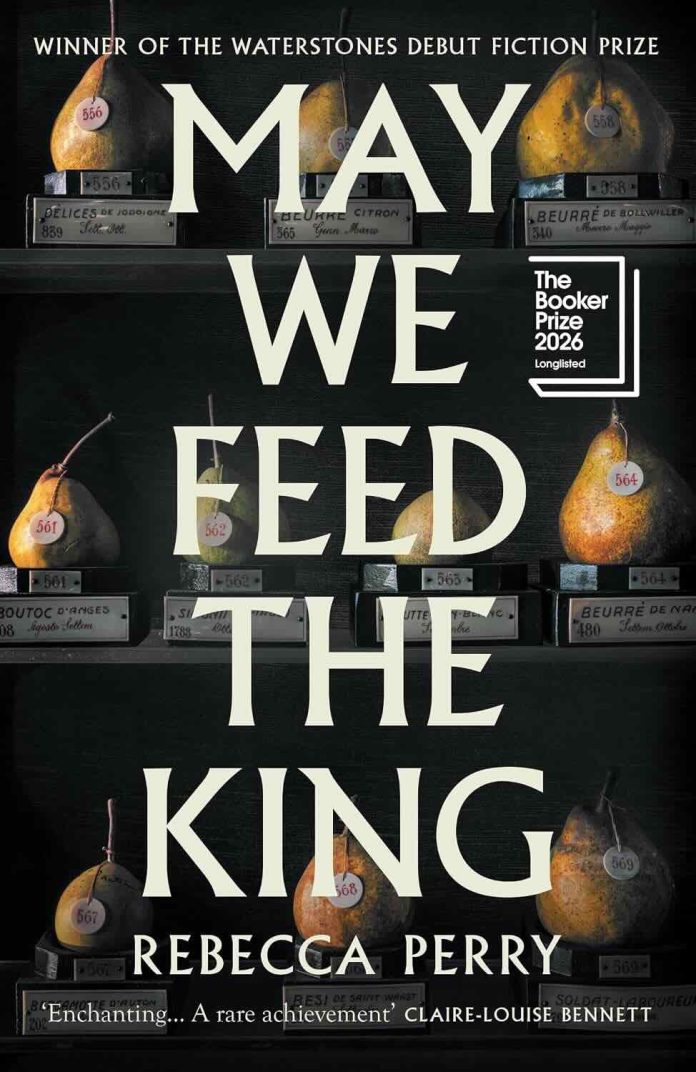
May We Feed the King opens on a website that sells plastic food to museums, and the narrator of this novel knows it the way other people know their own street. She can tell you that the gherkins are filed under celebration food rather than vegetables. That a single parma ham slice costs fourteen pounds and a whole cooked leg of venison costs fifty-five, and that these discrepancies are baffling but presumably justified, because we should never presume to know the intricacies of another person's craft.
She will tell you the beef tomato is a joke. She will tell you the whole cooked chicken leg is one of the few items she considers flawless.
May We Feed the King by Rebecca Perry spends its opening pages on this catalogue, and by the end of them you would follow this woman anywhere.
What May We Feed the King Is About
She is unnamed. For twenty-two years she has built scenes in historic houses: the feast in the great hall, the monk's cell, the room behind the rope where a book lies open and the bread has been picked hollow. Her one rule is that a room must look as though the people have just walked out of it. Anything less and the scene is dead.
A palace hires her for its 750th anniversary, a date nobody can actually account for. Six scenes, plus a public talk. The site has archives almost nobody has read, and an archivist who takes their white gloves off one finger at a time.
Digging through the ledgers, she finds a king. One page, defaced by centuries of marginalia from people who despised him, reduced to a nickname and a humiliation. She weeps when she sees it, and then she decides to build his world back around him.
The second part of May We Feed the King by Rebecca Perry is that world: a court in an unnamed country, a third brother who never expected the throne and does not want it, and the people who feed him.
The Grief May We Feed the King Never Names
Something has happened to her. We are told this in exactly these terms and no others: certain things had happened in my life. My past life. After my life as I knew it had ceased to exist. The table where we used to sit.
Perry never once states it plainly, and the restraint is the most impressive thing here. The loss is present in every chapter as an absence of information, which is precisely how the whole book works: she is a woman who reads rooms for what has been left out, written by an author who has left out the one fact that would explain her.
There is a recurring dream about a stranger eating oysters to honour a dead friend, asking whether it counts as a gesture. The narrator tells them their friend will not know either way, and then hears the cruelty in what she had meant as comfort. That is the novel in a paragraph.
What Works
- The catalogue chapters. May We Feed the King spends several early pages assessing fake food as though it were sculpture. Funny, obsessive, and doing enormous quiet work about how we substitute a representation for a thing we cannot have.
- The court is genuinely alive. A lady-in-waiting climbs the stairs every single day to ask a version of the same question about a dying man's appetite, and both she and the attendant know it is a charade that must play out.
- The framing device. Court scenes open again and again with a hypothetical observer at a window, or at a keyhole, or hidden in a trunk, catching only a sliver. That is precisely the fixed viewing angle the curator designs for. The two halves are the same act, and Perry never once points at it.
- Objects carry the plot. In the final section, the six finished scenes are described as objects only, and every object is evidence: a medicine bottle missing from a line, a warrant to execute burned in a grate with the name gone, a fruit bowl with one space in it.
- The last page. She takes the props home, rebuilds a version of the scene on her own dining table, and leaves one apple to the side for somebody else to place. I put the book down and sat still for a while.
Where It Stumbles
- The court is deliberately unplaced. No country, no date, no names, only titles. It gives the medieval half a fable-like clarity and it also means you never get your feet under you. Some readers will find it airless.
- The chapters are very short. Many run under a page, and May We Feed the King asks real patience for it. Perry is a poet and it shows in the best way at the sentence level, but the accumulation can read like a notebook rather than a novel for the first fifty pages.
- The romance is almost too quiet. The attraction between the narrator and the archivist is conducted almost entirely through hands, and while I found it lovely, readers wanting the book to commit will be left waiting a long time.
- One strand is stronger. The king's chapters are so good that the present-day sections in the middle third can feel like an interruption, until the structure justifies them.
What the Records Leave Out of May We Feed the King
The argument underneath all of it arrives in the public lecture near the end. She describes a nineteenth-century modelmaker who rendered every one of the 286 apple varieties then grown in Italy, in resin and wax, and points out that this catalogue is now the only proof those apples ever existed. Then she asks the room what such a record cannot preserve.
Flavour. Which is the entire purpose of an apple.
That is what she is doing for her king, and what May We Feed the King is doing for its narrator: building the most faithful possible replica of a thing that cannot be recovered, and being honest that a replica is what it is. The novel is set in the tradition of the museum period room, and it understands exactly what those rooms are: an argument about the past dressed up as a fact.
Who This Is For
Reach for May We Feed the King by Rebecca Perry if you like novels built out of objects, if you have ever stood behind a rope in an old house and wanted to climb over it, if you can be patient for eighty pages while a structure assembles itself. Skip it if you need a named setting, a stated plot, or a narrator who will tell you what is wrong with her.
It is the most quietly ambitious debut I have read in years, and the only book on this longlist that made me want to reread it immediately to see how it was done.
Read These Next
- The Pretender by Jo Harkin. Also about a boy manoeuvred toward a throne he did not ask for, funnier and more raucous, and a good corrective if Perry's court feels too hushed.
- The Glutton by A.K. Blakemore. Historical fiction organised entirely around appetite and the body, by a writer Perry thanks in her acknowledgements.
- Written on the Dark by Guy Gavriel Kay. For the same trick of an invented, unplaced medieval Europe that feels more solid than the real one.
- Small Things Like These by Claire Keegan. The other contemporary novel that does this much with this little, and withholds with the same discipline.
- The Palm House by Gwendoline Riley. Also on this year's list, and the useful contrast: two novels about unspoken loss, one built from talk and one built from things.
If you want another historical fiction, we have also reviewed The Famine Orphans by Patricia Falvey.
The Last Word on May We Feed the King
Rebecca Perry has written a book about the ethics of representing people who cannot answer back. Her narrator's whole profession is deciding what a dead stranger had for dinner, and she takes that responsibility more seriously than most historians take theirs. When she refuses to give the reader the king's ledger entry in full, it is not coyness. It is the entire moral position of the novel.
I said in our Booker Prize 2026 longlist guide that "delicacy of touch" is not the language of a panel wanting dynamite, and that Perry would struggle on those grounds. Having read it, I was wrong about the book if not about the odds. This is not a delicate novel. It is a very controlled one, which is a different thing, and the control is holding down something enormous.
The cost is the opening. For the first fifty pages the chapters are so short, and the court strand so deliberately unmoored from any named country or date, that the book reads as a beautiful notebook rather than something with a shape. It does acquire a shape, and a very fine one, and a reader who gives up before it arrives will not have been unreasonable.
A woman arranges fruit in a bowl and leaves a gap. Somebody has to come and fill it.