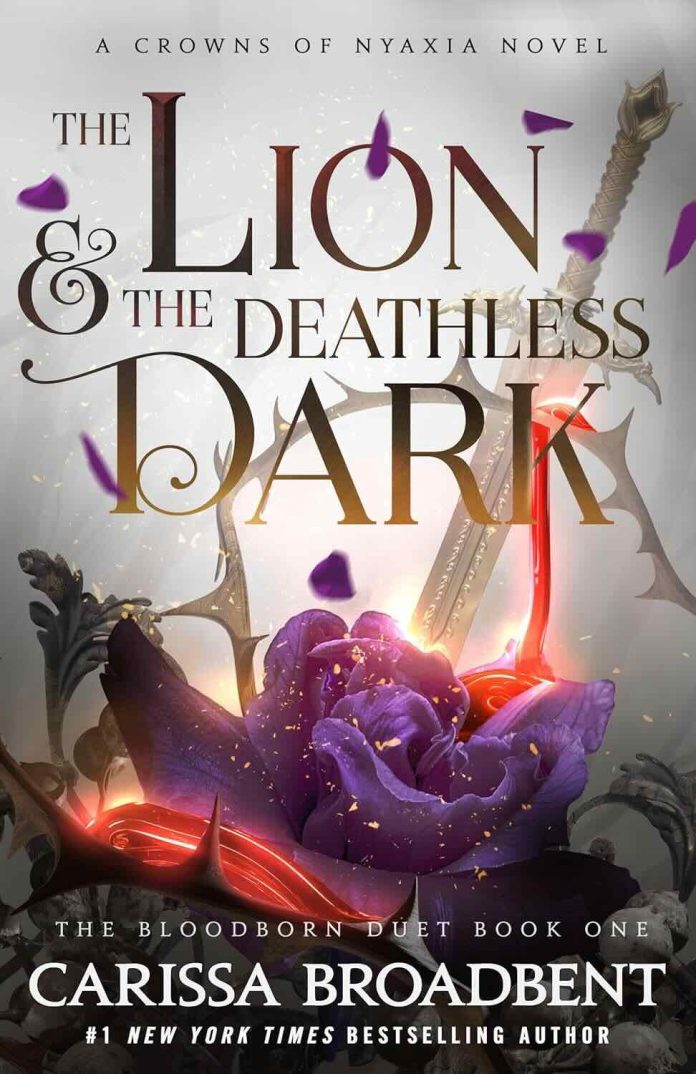
Most fantasy hands you a hero and asks you to cheer. “The Lion and the Deathless Dark” hands you a bounty hunter with a dead friend’s blood under her fingernails and dares you to keep reading anyway.
Ten years ago the sun shattered and never came back. Vampires poured into the human kingdoms. Since then, Kyrene has hauled severed heads to shepherds for coin, worn a divine title she wears like a costume, and carried a golden sword that talks back and disapproves of nearly everything she does. The Lion and the Deathless Dark by Carissa Broadbent opens the Bloodborn Duet, and it is the angriest, ugliest, most emotionally exposed entry in this series so far.
A World That Has Already Lost
The setup is grim and specific. No flowers grow. Food comes in shades of brown and grey. Medicine costs more than most people will ever hold. Humans cage other humans for meat, and everyone has learned to call it survival. Broadbent commits to that bleakness in small, awful details rather than sweeping declarations, which is why it lands.
Into this walks Septimus, a Bloodborn prince in an immaculate white suit who smokes vanilla cigarillos and reads paperback romances by firelight. He offers Kyrene a job: hunt the gods themselves. What follows is a road novel wrapped around a heist wrapped around a grief spiral, and it moves fast enough that you rarely notice the gearwork underneath.
Where This Sits in the Crowns of Nyaxia Series
New readers can start here, though the emotional payoffs deepen enormously with context. The full running order:
- The Serpent and the Wings of Night (Book 1)
- Six Scorched Roses (Book 1.5)
- The Ashes & the Star-Cursed King (Book 2)
- Slaying the Vampire Conqueror (Book 2.5)
- The Songbird & the Heart of Stone (Book 3)
- The Fallen & the Kiss of Dusk (Book 4)
- The Lion and the Deathless Dark (Book 5)
Familiar faces appear, and their arrivals carry real weight if you know the history. A glossary sits at the back for anyone coming in cold. It helps. It does not fully replace four books of accumulated feeling. Marketing has positioned The Lion and the Deathless Dark by Carissa Broadbent as a clean entry point, and that is roughly seventy percent true.
The Sword Steals the Show
Zefiah, the Blade of Retribution, is the finest character Broadbent has written. She speaks inside Kyrene’s skull in curled brackets, five thousand years old, sarcastic, possessive, and quietly maternal in a way neither of them will name. Their bickering carries the book’s humor. Their silences carry its heartbreak.
Kyrene herself is a harder sell, and deliberately so. She is petty, reckless, vain, and honest about all three. She drinks too much. And she makes catastrophic choices at speed and calls it decisiveness. Broadbent refuses to soften her, and readers who need a likeable protagonist should know that going in.
Septimus is the surprise. A manipulator who spent a decade arranging catastrophes, he is also the most tender presence in the book, and the gap between those two facts is where the novel does its best work. His running joke about who pulls the trigger becomes something genuinely painful by the final chapters.
What Works
- The four interludes. Short character studies dropped between sections, told in third person, reaching backward in time. They are the structural highlight, and one of them reframes everything before it.
- Prose that stays sensory. Broadbent writes bodies, weather, and hunger with real precision. Nothing floats.
- Thematic discipline. One phrase recurs throughout the book, spoken by people convinced of their own kindness, and every repetition cuts deeper.
- Worldbuilding through economics. Medicine, bounties, trade markups, and who can afford what. This is a war story told through invoices.
- A genuinely unsettling set of gods. Petty, bored, and lethal, they read as recognizable rather than mythic.
Where It Stumbles
An honest reading has to name the friction, and there is a fair amount of it in The Lion and the Deathless Dark by Carissa Broadbent.
- The middle sags. A training stretch and an extended overland journey slow the momentum considerably. Roughly a hundred pages could tighten without losing anything essential.
- Repeated structure. Several confrontations follow near-identical beats: provoke, get overwhelmed, produce a divine object at the last possible second. By the third instance, the shape is predictable even when the outcome is not.
- Kyrene’s guilt loops. Her self-condemnation is affecting early and repetitive by the final third. The same realization arrives four or five times in slightly different words.
- Zefiah’s absence. A late-book development sidelines the sword’s voice for a long stretch. It is thematically earned and narratively costly, removing the book’s sharpest instrument precisely when tension peaks.
- The ending. Broadbent all but apologizes for it in her author’s note. It is a hard, deliberate cliffhanger that dismantles a great deal of what the characters achieve. Some readers will find it devastating in the best sense. Others will find it withholding.
That last point is the fault line. Whether the finale reads as brave or as punitive depends almost entirely on your tolerance for narrative cruelty.
Romance, Heat, and Content
The romance is slow, adversarial, and built on shared damage rather than shared virtue. Two open-door scenes arrive late, and they are explicit. Before that, the tension runs on eye contact and restraint, which Broadbent handles beautifully.
Heat Level at a Glance
Roughly three chilies out of five. Explicit but not frequent, and never decorative: both scenes carry plot and character weight rather than pausing the story for spectacle.
A Word on Content Warnings
Prospective readers should note the front-matter warnings, which are extensive and accurate. They cover violence against children, body horror, cannibalism, pregnancy loss, and suicidal ideation. Take them seriously. This is a considerably darker book than its cover suggests.
Who This Is For
Reach for The Lion and the Deathless Dark by Carissa Broadbent if you want morally compromised leads, sardonic first-person narration, and vampire politics with teeth. Skip it if you need heroes who deserve their titles, tidy conclusions, or a romance that arrives early. Fans of the earlier books will find the lore payoffs richest here, though the emotional core stands on its own.
Read These Next
For readers who finish and need something in the same bloodstream:
- Empire of the Vampire by Jay Kristoff. A sunless world, a vampire war, and a first-person narrator who hates everyone including himself.
- Godkiller by Hannah Kaner. Deity-slaying as a working-class profession, with a similar allergy to grand heroism.
- The Poppy War by R.F. Kuang. Rage as an engine, and divine power that bills you for every use.
- A Dowry of Blood by S.T. Gibson. Lyrical, intimate vampire fiction about power and consent.
- Blood Over Bright Haven by M.L. Wang. For anyone drawn to the theme of comfortable people discovering what their comfort costs.
- From Blood and Ash by Jennifer L. Armentrout. Closest match on the romantasy shelf for chosen-one machinery and slow-burn heat.
- House of Earth and Blood by Sarah J. Maas. Grief-forged heroine, found family, and a mystery structure.
Readers new to the author should also try her earlier War of Lost Hearts trilogy, which begins with Daughter of No Worlds and shares this book’s interest in survivors who make ugly choices.
Readers who want another heroine bargaining with something immortal because the alternative is dying on schedule should try The Dark in Her Veins by M.K. Lobb.
A Note on the Ledger
Kyrene never pretends she works for free. She takes the coin, names the price, and lets you decide what her word is worth. So, in that spirit: this copy arrived from the publisher at no cost to me, in exchange for nothing but an honest accounting. The praise above was not part of the arrangement. Neither were the complaints.
The Last Word
The Lion and the Deathless Dark by Carissa Broadbent is uneven, overlong in its middle stretch, and structurally repetitive in its set pieces. It is also the most interesting thing she has written: a chosen-one story with the chosen one scraped out of it, carried by a talking sword and two people who are honest about being monsters. When it works, which is often, it works better than almost anything else on the shelf.
Bring the anger. You will need it for the wait.







