International gambling platforms operate across borders, serve customers in different jurisdictions, and may hold licences issued by authorities in different countries. When a dispute arises over a delayed withdrawal, a suspended account, a disputed bet, or the handling of personal information, knowing where to complain can make a significant difference.
For players researching their options, understanding the role of a regulator is just as important as understanding an operator’s terms and conditions. A platform such as Winshark Casino can serve as a reference point when considering the broader landscape of online casino services, but the appropriate complaint route depends on the operator’s licensing arrangements, the player’s location, and the nature of the dispute.
Why Complaints Against International Gambling Platforms Can Be Complicated
International gambling platforms may accept customers from multiple countries while operating under a licence issued by a single jurisdiction. However, an operator’s international reach does not automatically mean its licence authorises it to offer gambling services in every country where its website is accessible.
This distinction matters because gambling regulation is not governed by one universal licensing system. National laws differ in their requirements for advertising, customer verification, responsible gambling measures, payment processing, and dispute resolution. Some jurisdictions restrict access to foreign-licensed gambling services, while others permit particular forms of cross-border activity under specific conditions.
As a result, the first step in a complaint is often identifying the legal entity that operates the service and determining which authority, if any, has jurisdiction over it. The brand name displayed on a website may not be the same as the legal company named in its terms and conditions.
What Regulators of International Gambling Platforms Actually Do
Regulators supervise licensed operators and assess whether they comply with applicable laws, licence conditions, and industry standards. Depending on their legal powers, they may investigate suspected misconduct, request records, require corrective measures, impose financial penalties, or suspend or revoke a licence.
Complaints help regulators identify possible violations that might not otherwise be visible through routine supervision. For example, multiple reports about unexplained account restrictions, misleading bonus terms, or failures to meet responsible gambling obligations may point to a wider compliance problem.
However, a regulator is not necessarily a service that resolves individual customer disputes or orders refunds. The UK Gambling Commission explicitly distinguishes its regulatory role from the work of an ombudsman or individual dispute-resolution service. It records complaints and may use information about suspected breaches when considering regulatory action, but it does not resolve individual disputes about gambling transactions or recover customers’ money on their behalf.
That distinction is essential: reporting a problem to a regulator may contribute to oversight of international gambling platforms without guaranteeing a personal remedy.
The Typical Complaint Process
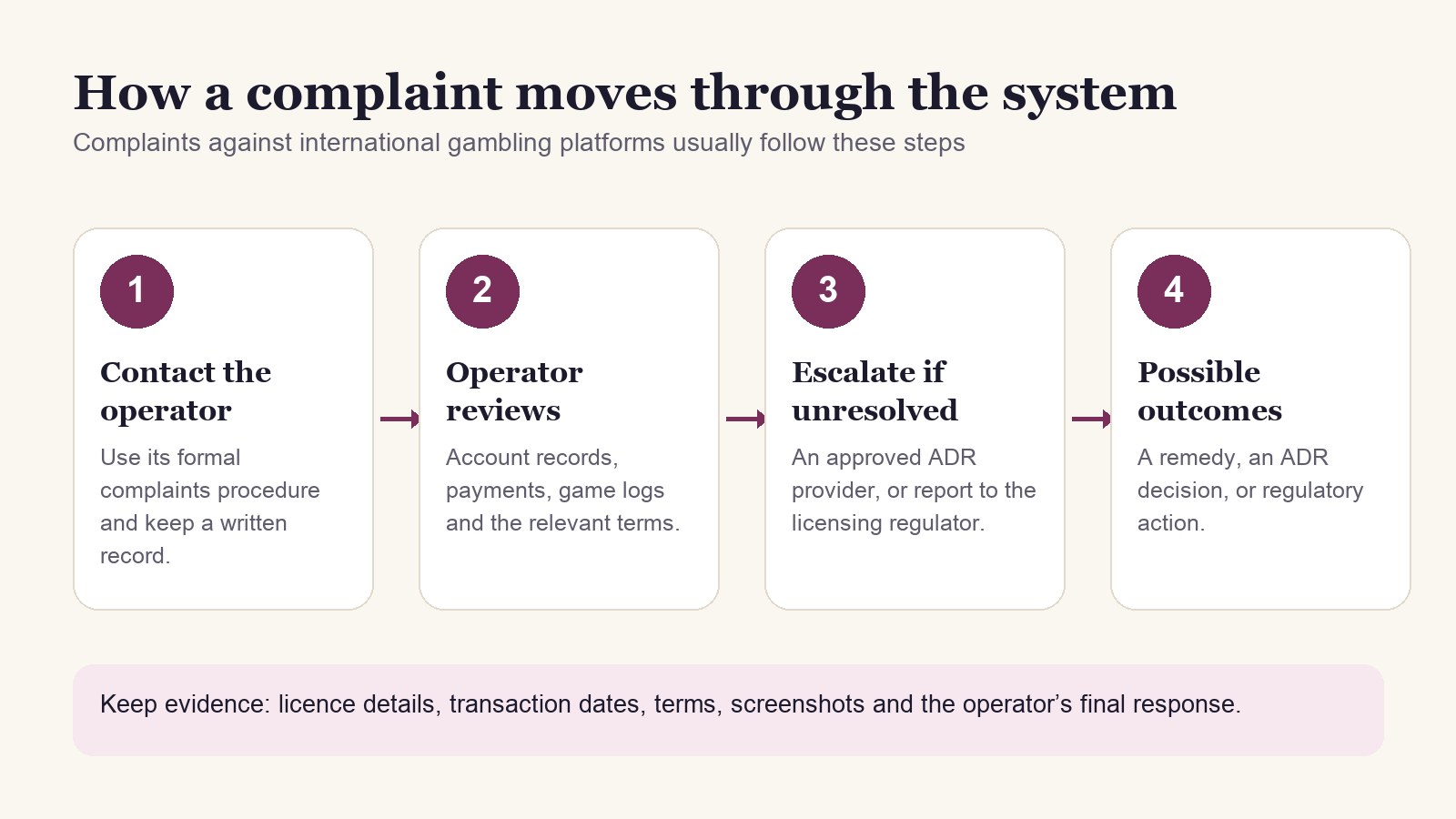
Although procedures vary by jurisdiction, complaints against international online casinos and betting platforms often follow a similar sequence.
1. The Player Contacts the Operator
The usual starting point is the operator’s formal complaints procedure. Customers should explain what happened, identify the transaction or account involved, state why they believe the decision was incorrect, and describe the resolution they are seeking.
For instance, a player disputing a withdrawal delay might ask for a written explanation of the outstanding verification requirements and an estimated timeframe for the review. A complaint about a bonus dispute should identify the promotion, the relevant terms, and the specific decision being challenged.
A written complaint creates a record of the issue and the operator’s response. It also helps establish whether the customer has completed the internal process required before escalating the matter.
2. The Operator Reviews the Evidence
The operator may examine account records, payment information, identity documents, game logs, betting histories, promotional conditions, and communications with customer support. Some investigations involve anti-fraud controls, age or identity verification, or legal obligations related to financial crime.
An account restriction or delayed withdrawal is not, by itself, proof of misconduct by either party. There may be legitimate reasons for additional checks, but the operator should handle the complaint according to the rules that apply to its licence and the customer relationship.
Customers can make the review more efficient by providing relevant documents promptly and keeping copies of all correspondence. They should avoid sending unnecessary sensitive information through unofficial channels.
3. The Complaint Is Escalated
If the operator rejects the complaint or fails to resolve it within the applicable timeframe, the customer may be able to approach an independent alternative dispute resolution (ADR) provider, a gambling regulator, or another competent body.
These routes serve different purposes. An ADR provider may assess a qualifying dispute between a customer and an operator, while a regulator focuses on compliance with its regulatory framework. A court may be an option where a customer seeks a legally enforceable remedy and other conditions for bringing a claim are met.
The correct route depends on the type of complaint, the licence involved, the applicable rules, and whether the customer has completed the required earlier stages.
Alternative Dispute Resolution: A Separate Route to Resolution
Alternative dispute resolution allows certain disputes to be considered outside court proceedings. In regulated gambling markets, an approved independent provider may review evidence from both the customer and the operator and issue a decision or recommendation under its rules.
The UK provides one example of a structured process. The UK Gambling Commission requires licensed gambling businesses to maintain clear complaint procedures and provide access to an approved ADR provider for qualifying disputes that remain unresolved after the operator’s process. The Commission’s guidance states that operators must have arrangements for referral to ADR when a dispute remains unresolved within eight weeks, or earlier if their complaint procedure has concluded.
The scope of ADR is not unlimited. A provider may be able to examine whether a gambling transaction was settled in accordance with the applicable terms, but it may not have authority to investigate every allegation about an operator’s broader conduct. Complaints about suspected illegal gambling, regulatory breaches, or risks to vulnerable customers may need to be reported separately to the relevant authority.
Players should therefore read the regulator’s guidance and the ADR provider’s eligibility rules rather than assuming that every complaint can be handled through the same process.
How Regulators Handle Cross-Border Complaints
Complaints against international gambling platforms introduce an additional question: which authority is responsible?
A player may live in one country, use a website operated by a company registered in another, and encounter a licence issued in a third jurisdiction. The answer cannot be determined solely by the website’s language, currency, or domain name.
Regulators generally assess whether the operator or activity falls within their legal remit. They may consider the licence held, the location of the customer, the nature and timing of the activity, and the specific conduct being reported. A regulator may also direct a customer to another authority or dispute-resolution process if it lacks the power to handle the case.
The Gibraltar Gambling Division, for example, advises customers to establish which regulator is responsible for the particular gambling activity and to use the relevant complaints process. It also notes that different products offered by the same operator may be covered by licences from different jurisdictions.
This is why checking the legal company name and licence details is more useful than relying on a familiar brand name alone. Customers should verify licensing information through the regulator’s official register or website and confirm that the licence applies to the service in question.
What Evidence Makes a Complaint Stronger?
Regulators and dispute-resolution bodies need enough information to understand what happened and assess the complaint against the applicable rules. A clear, chronological record is generally more useful than a long narrative that mixes unrelated concerns.
Useful evidence may include:
- The operator’s legal name, website address, and relevant licence details.
- Dates and amounts of deposits, withdrawals, bets, or disputed transactions.
- Copies of the applicable bonus terms, account rules, or other contractual conditions.
- Screenshots of account messages, transaction statuses, and relevant website information.
- Emails, live-chat transcripts, and formal complaint reference numbers.
- The operator’s final response, or evidence that the internal complaints process has not resolved the matter.
Evidence should be authentic and unaltered. Customers should also keep copies of documents before an account becomes inaccessible, while protecting passwords, payment credentials, and unrelated personal information.
A well-documented complaint does not guarantee a favourable decision, but it helps the reviewer distinguish verifiable facts from assumptions and determine which rules may apply.
What Happens After a Regulator Receives a Complaint?
The outcome depends on the authority’s powers and the information provided. In some cases, the regulator may record the report without opening an individual investigation. In others, it may request further information, contact the licensed business, or use the complaint as part of a broader compliance assessment.
If evidence suggests a breach, possible regulatory responses can include requiring improvements to procedures, imposing conditions, issuing penalties, or taking licensing action. The available measures depend on local law and the seriousness of the conduct.
Not every complaint results in enforcement. A regulator may conclude that the matter falls outside its jurisdiction, that the evidence does not establish a breach, or that another body is better placed to resolve the customer’s dispute. Even where a complaint reveals a compliance concern, the regulator may not have the authority to award compensation directly.
Players should therefore distinguish between three possible outcomes: an explanation or remedy from the operator, a decision through an eligible dispute-resolution process, and regulatory action intended to protect the wider market.
Common Mistakes When Complaining About International Gambling Platforms
Several avoidable errors can delay a complaint or send it to the wrong organisation.
Contacting the wrong regulator. A company’s registered address does not necessarily establish which authority regulates the specific gambling service. Verify the licence and its scope before escalating.
Skipping the operator’s formal process. Many regulators and ADR providers expect customers to complain to the business first. A social media post or informal chat may not count as completion of the required procedure.
Assuming a regulator can recover money. Supervisory authorities and individual dispute-resolution bodies have different powers. Check what each organisation can actually do before choosing a route.
Relying on screenshots without context. Evidence should show dates, relevant terms, transaction details, and the sequence of events wherever possible. Selective or incomplete records may make an issue harder to assess.
Ignoring deadlines and eligibility requirements. Complaint periods, response times, and the types of dispute accepted vary. Customers should follow the official instructions and keep proof of submission.
How Players Can Protect Their Position
The most effective approach is usually methodical rather than confrontational. Read the operator’s complaint policy, submit a concise written complaint, retain supporting records, and request a clear explanation of the decision. If the issue remains unresolved, identify the appropriate ADR provider or regulator using official sources.
It is also important to understand the limits of a licence held by international gambling platforms. A licence can indicate that an operator is subject to a particular regulatory framework, but it does not mean every possible dispute will be decided in the customer’s favour. Nor should a licence from one jurisdiction be assumed to establish legal authorisation in another.
Where substantial sums are involved, the complaint raises questions of contract law, or several jurisdictions may be relevant, independent legal advice may help clarify available options. Customers should be particularly cautious about third parties that promise guaranteed recovery of gambling losses in exchange for upfront fees.
Conclusion
Regulators play an important role in overseeing international gambling platforms, investigating potential breaches, and identifying patterns that may threaten fair play or customer protection. Yet their role is not always the same as that of an independent dispute-resolution provider or a court.
For players, the key is to identify the operator’s legal entity, verify the relevant licence, follow the formal complaints procedure, and preserve evidence from the outset. If internal resolution fails, the next step should be chosen according to the regulator’s jurisdiction and the remedies available through ADR or legal proceedings.
A clear understanding of these distinctions makes the complaint process more practical and helps set realistic expectations. The goal is not simply to submit a report, but to direct the issue to the organisation that has the authority to assess it and, where possible, provide an appropriate remedy.