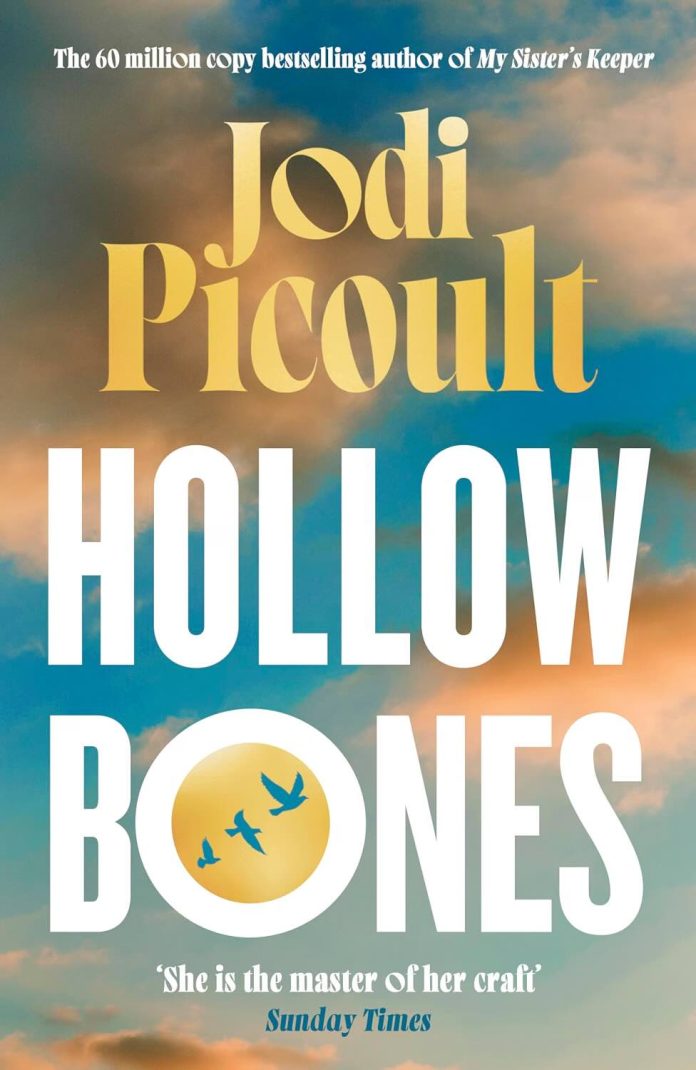
At a baby shower in a Providence restaurant, a woman seven months pregnant introduces her father to the receptionist from her obstetrician’s office. He looks at the receptionist for a long moment and calls her Eloise, which is the name of his wife, who has been dead since the morning of September 11, 2001. Hollow Bones by Jodi Picoult spends four hundred pages explaining how a person walks out of one life into another and stays there for twenty-five years. The explanation is not the one that scene invites you to reach for, and the book is a great deal angrier than its packaging suggests.
The Thread Running Through Hollow Bones
Almost everyone in this novel is either disbelieved or doing the disbelieving.
Eloise Ambrose is twenty-five, a mosaic artist, a few weeks into motherhood, and quietly certain something has gone wrong inside her head. She tells a midwife, who suggests valerian tea, a massage and a yoga class. She tells a psychiatrist, who prescribes an antidepressant that makes her feel as though her skin is burning off. And she tells her husband, who gets on a plane to California. Her best friend Evie watches her drag the sofa away from the window and decides she is being dramatic, because every time Evie starts to worry, Eloise manages three convincing minutes of being fine.
Twenty-five years on, her daughter Molly runs Rhode Island’s emergency preparedness office. She is paid, professionally, to believe warnings. Hollow Bones by Jodi Picoult sets those two facts side by side and declines to soften the join.
What Jodi Picoult Gets Right About Not Being Believed
The illness has a name, and naming it is the whole purpose of the book.
Postpartum psychosis is not the baby blues and is not postnatal depression, and this novel is unusually patient about the difference. Eloise hears a voice she cannot place. She becomes convinced she is already dead and already owned. She arrives at the certainty that the only way to spare her daughter is to send her somewhere safer first. Between episodes she is lucid, funny, capable of small talk in a waiting room. That flicker is precisely why nobody around her intervenes.
The research in Hollow Bones by Jodi Picoult stays dramatised rather than lectured for most of its length. The condition affects roughly one in five hundred women who give birth. It has never been granted its own entry in the diagnostic manual. The standard first-line medication for the illness it superficially resembles makes it considerably worse. Picoult puts each of those facts on the page as something that happens to a specific woman on a specific Tuesday, which is far harder to shrug off than a statistic.
Where the Novel Is Strongest
- The 2001 chapters. Eloise narrates her own unravelling in close first person, with the intrusive voice set off in parentheses so the reader watches it arrive, argue and win. It is the most frightening sustained writing Picoult has published.
- The Atlanta exile. A motel housekeeper called Ximena takes in a stranger with bandaged wrists and no identification, and the friendship that grows out of it carries two decades of the novel without ever tipping into sentiment.
- Kai Yazzie. A Diné police officer becomes the best romance in the book and the source of its quietest idea: the spirit line woven deliberately into a blanket so the maker is not trapped inside her own finished work.
- The refusal of a villain. Nobody in Hollow Bones by Jodi Picoult is malicious. Everyone is doing what looks, from where they stand, like the loving thing, and the damage still runs for a quarter of a century.
Four Things That Weaken Hollow Bones
- The last hundred pages reach for plot. A late development arrives that the novel has not earned and does not need, and it converts a study of illness into something closer to a television finale.
- Adam stays thin. The husband is required to be oblivious in 2001 and warm in 2027, and Picoult never quite reconciles the two men.
- Research turns into dialogue. One long broadcast interview near the end exists to deliver clinical information directly to the reader, and it reads like it.
- The Evangelical backstory is broad. Eloise’s childhood in Alabama is effective and also entirely made of parts you have met before: the tyrant preacher, the silent mother, the white ribbon, the doomed sister.
None of that sinks it. Hollow Bones by Jodi Picoult is a better and braver book than her last several, and the Author’s Note, built on a hundred pages of correspondence with a woman writing from a jail cell, is not an appendix. It is the reason the novel exists.
Do You Need to Read My Sister’s Keeper First?
No, but you will get more out of it if you have.
Molly’s husband Jesse is Jesse Fitzgerald, the arsonist teenager from My Sister’s Keeper, now a police polygraph examiner in his forties and by some distance the most likeable adult in this book. Kate, Brian and the memory of Anna all appear. Nothing in the plot depends on recognising them, and the novel explains what it needs to. Readers who have carried that family around since 2004 will simply find one of its loose ends tied off with real tenderness.
Read These Next
Five for readers who finish Hollow Bones by Jodi Picoult and want more of the same:
- My Sister’s Keeper by Jodi Picoult. The novel this one quietly continues, and still her sharpest courtroom family.
- By Any Other Name by Jodi Picoult. Her other braided two-timeline book about a woman written out of the record.
- The Seven Daughters of Dupree by Nikesha Elise Williams. For mothers who protect daughters by withholding, across four generations.
- Cursed Daughters by Oyinkan Braithwaite. For a young woman handed an identity that belonged to somebody else first.
- The Fact Checker by Austin Kelley. For a missing woman, a post-9/11 New York and a narrator who cannot verify anything.
What Stays With You
Late in the book, a weaver shows Eloise a line of near-invisible white dots running through an otherwise flawless band of red at the bottom of her loom. It is a mistake made on purpose, she explains, so the artist’s spirit is not sealed inside the finished piece.
That is the image the novel hands you on the way out. Hollow Bones by Jodi Picoult is about a woman who spent twenty-five years believing she was the flaw, when the flaw was the thing that let her get out alive. The book sags where it tries to be a thriller and it recycles a childhood you have read before. It is also the clearest account of postpartum psychosis I have encountered in fiction, and it is furious, correctly, that a woman in 2001 could say the words something is wrong with me to four separate professionals and be handed a cup of tea.







