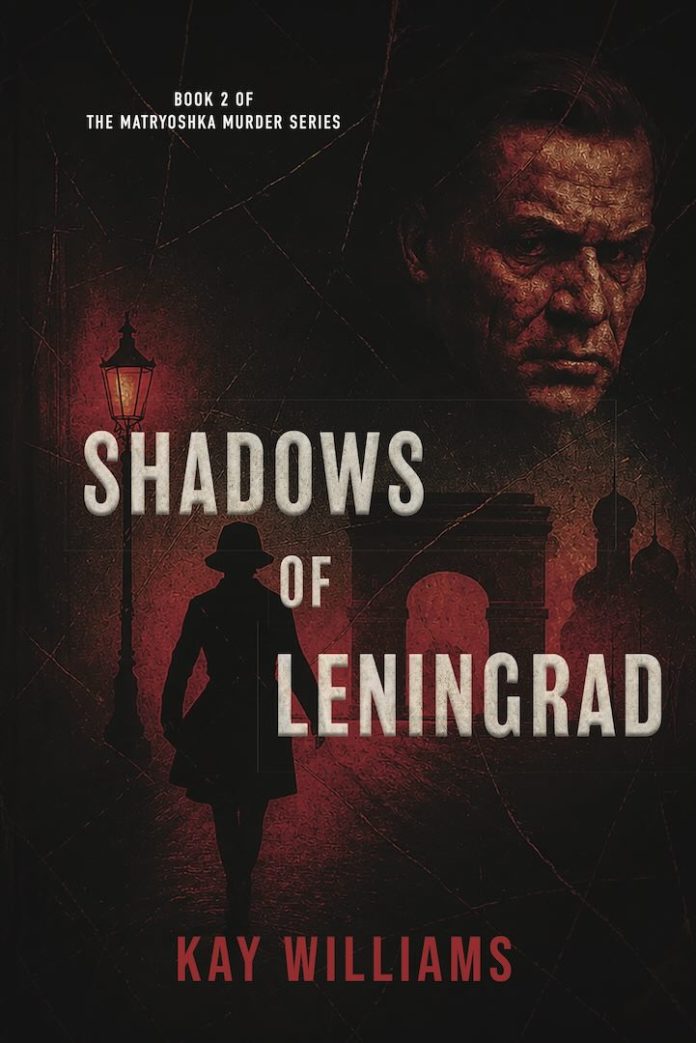
Most sequels open by reminding you who everyone is. Shadows of Leningrad opens with a wounded man dragging a deflated dinghy into a rotting Hudson River warehouse, counting what he has left, and deciding whom to break first. By page three you know exactly what kind of book you are holding, and you know the author is not going to waste your time.
A sequel that stands on its own two feet
Shadows of Leningrad, Book two of The Matryoshka Murders series, moves the action from a collapsing Leningrad to New York City in August 1991, and the shift is smart. Kate Hennessey came home from Russia with her videotapes strapped to her body and the conviction that the worst was behind her. It isn’t. Shadows of Leningrad by Kay Williams understands something many thriller sequels miss, which is that survival is not the same as safety, and that trauma has a long commute.
Newcomers are looked after. A short publisher’s recap covers what happened in book one, and Williams seeds the rest through natural conversation rather than lecture. You will lose nothing essential by starting here, though readers of the first novel get a richer payoff from the callbacks.
The film set is the best idea in the book
Kate is an apprentice filmmaker, and when her mentor Dominick Block turns up in his apartment with a gash in his scalp and no working language, she has to run his production, his money, and his recovery all at once. Her apartment has already been converted into a production office. There are ducks in her bathtub. She is cooking for seventeen people a day while trying to work out who tried to kill her boss.
This is where Shadows of Leningrad by Kay Williams earns its authority. Williams spent real time on independent film sets, and it shows in details nobody invents:
- Screen Actors Guild reps quizzing Kate weekly about overtime she has to lie about
- The arithmetic of a 400-foot roll giving eleven minutes before a reel change
- A spool unwinding in a changing bag and wiping out an entire day’s shoot
- Free beer delivered in exchange for showing labels on camera
- Paying two real cops on the spot to act as cops, plus the use of their cruiser
The filmmaking sequences are not garnish. The same skills that let Kate frame a shot let her read a face, catch a background figure in a cutaway, and notice who keeps reappearing at the edge of the frame. The investigation and the craft feed each other, which is a genuinely elegant piece of design.
Aphasia as a mystery engine
The most original thread here is Dom’s brain injury. A blow to the left hemisphere leaves him with his intelligence intact and his vocabulary gone. He knows who attacked him. He simply cannot say it. His first written statement to Kate is a page of consonants.
Decoding that page becomes its own slow investigation, and the tension is exquisite, because the witness and the evidence are the same damaged man. What makes it land is how unsentimental Williams is about the process. Dom relearns one word a day. He asks for “orbs” at breakfast and means eggs. He calls Kate “Cart,” then “Kat,” then finally “Kaate,” and the moment he gets it right is more moving than any gunfight.
The recovery thread does several things at once:
- Supplies clues on a drip feed that keeps the middle third taut
- Gives the book a real emotional subject beneath the crime plot
- Makes Dom an active participant rather than a passive victim
- Raises an uncomfortable question the novel refuses to answer too neatly, which is how much Dom actually forgot and how much he would rather not remember
Kate and Gilly
The relationship at the centre is the other reason this book works. Kate is impulsive, loyal past the point of sense, and convinced she has to save everybody. Gilly is a painter, careful where Kate is reckless, and the one who says the hard thing out loud. Their arguments are about real pressures: money, absence, a father facing a grand jury, the slow theft of their private life by someone else’s emergency.
Williams writes them as a couple in 1991 without turning the period into a lesson. They cannot marry. They discuss a domestic partnership bill moving through the City Council. Gilly’s father will not say Kate’s name. All of it sits inside the story as fact rather than argument, which makes it far more affecting than a speech would have been.
What the writing does well
- Short scenes with hard cuts, closer to a shooting script than a novel, which keeps 400 pages moving
- Villain chapters that let you watch the trap being built while the heroes are still finding string
- Physical action grounded in real training rather than movie choreography, with Kate’s Taekwondo sessions paying off exactly when they should
- Precise use of 1991 as more than backdrop, with the August coup, the ruble’s collapse, and the rise of criminal networks out of Soviet wreckage all bearing directly on the plot
- Genuine period texture in a New York of peep shows, park dealers, and a murder rate the characters quote from memory
Who will enjoy this most
- Readers who like their thrillers procedural and grounded rather than high-concept
- Anyone drawn to post-Cold War crime fiction and Russian organised crime
- Readers who want queer protagonists in a mainstream thriller without the relationship being the entire plot
- Film and theatre people, who will find the production chapters close to documentary
- Fans of slow-build suspense where the pressure comes from money and paperwork as often as from weapons
About the author and related reading
Kay Williams is an award-winning novelist, actress, and screenwriter, and a member of Mystery Writers of America and Sisters in Crime. She wrote The Matryoshka Murders with her longtime collaborator Eileen “Jo” Wyman, to whom this book is dedicated. That novel was a finalist for both the USA Best Book Award and the Montaigne Medal. The pair also wrote Butcher of Dreams, a Hell’s Kitchen thriller set in the Off-Broadway world, and Williams co-authored the comic romance One Last Dance with her sister Jerri Lawrence. Her own credits include City Women, which screened at Cannes.
If this appeals, try these next:
- The Matryoshka Murders by Kay Williams, for the origin of everything happening here
- Gorky Park by Martin Cruz Smith, for Soviet-era procedural atmosphere
- Child 44 by Tom Rob Smith, for state paranoia and a dogged investigator
- Red Sparrow by Jason Matthews, for post-Soviet tradecraft and intelligence texture
- Butcher of Dreams by Kay Williams and Eileen Wyman, for the same New York backstage grit
- The Secrets We Kept by Lara Prescott, for Cold War history told through women’s working lives
- A Rising Man by Abir Mukherjee, for a similarly period-precise crime series with heart
Final thoughts
Shadows of Leningrad by Kay Williams is longer and more patient than the average thriller, and that patience is the point. The suspense is cumulative. You spend months with these people, watching a man rebuild a vocabulary and two women hold a life together while somebody circles, and by the time the last act arrives you care enough that it genuinely hurts.
What lingers afterward is not the violence. It is a filmmaker at his typewriter, pecking out one word at a time with the ferocity of a man refusing to disappear. Shadows of Leningrad by Kay Williams is a thriller about resilience that actually shows you the work resilience takes, and it is far richer for it.







