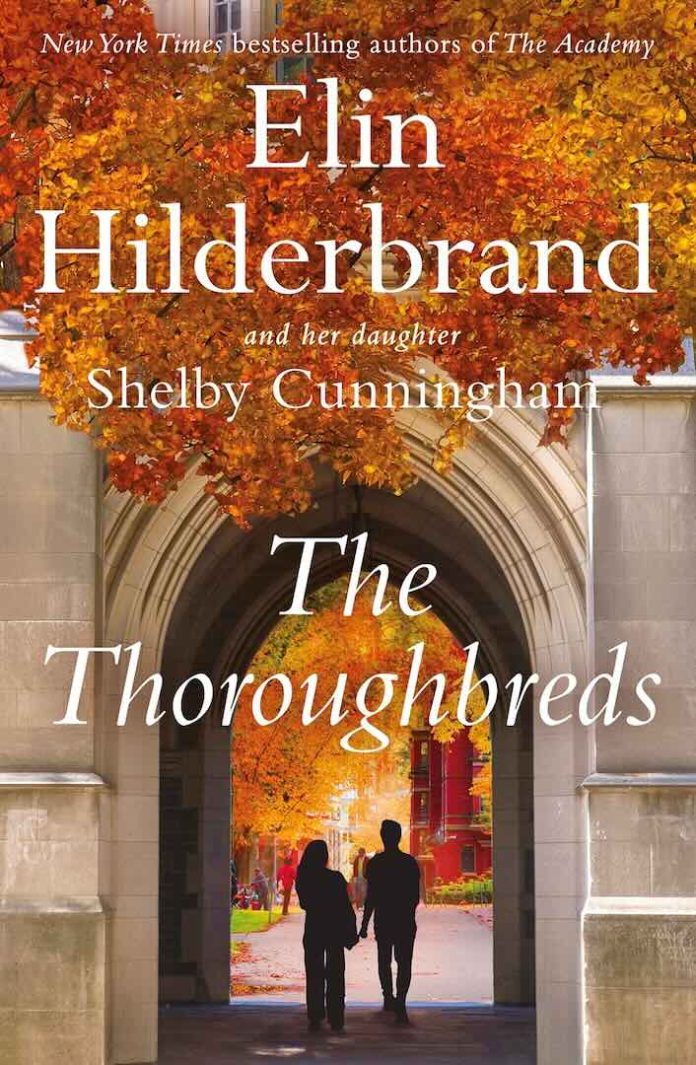
On move-in day at a boarding school in western Massachusetts, a sixth-former arrives from Queens on the bus from Springfield carrying everything he owns in a bin liner. Upstairs, somebody he has never met has already filled his room: six oxford shirts, a monogrammed wash bag, a laptop still in its box, board shorts in the right size. He asks whether all of it is really for him. The Thoroughbreds by Elin Hilderbrand and Shelby Cunningham spends the next four hundred pages on that transaction and every one like it, because at Tiffin Academy almost nobody pays their own way, and almost everybody eventually finds out what they owe.
Where Elin Hilderbrand Picks Up the Story
This is the second Academy novel, and it behaves like a proper middle book rather than a retread.
Charley Hicks is back for senior year, no longer the terrified new girl but the editor of the school paper, half of its most-watched couple, and locked in a two-tenths-of-a-point war for valedictorian. The reading order is simply The Academy, then this one. Everyone is where the first book left them, a year more confident and a year more exposed.
What changes is the scale. The first book belonged to Charley. The Thoroughbreds by Elin Hilderbrand belongs to the institution, and the authors hand the microphone to roughly a dozen people to prove it: the head of school, the college counsellor, the quarterback, the influencer, the chef, the head of security, and a first-person-plural chorus of students who narrate the chapters called Tiffin Talks.
What Elin Hilderbrand and Shelby Cunningham Add
The spine of the book is money, and specifically what money buys exemption from.
Head of School Audre Robinson opens her laptop in September and finds a quarter of the operating budget gone, vaporised by a financial adviser and a crypto start-up. She tells nobody. Meanwhile a board president’s twenty-million-dollar donation turns out to have come with a written schedule of things his son will never be disciplined for, and a day student arrives whose mother has bought her way past every rule that constrains the boarders.
Set against that is the college process, which the book prices out with unusual precision. Early decision letters land in December and flatten almost the entire year group at once. A gay quarterback watches five scholarship offers quietly evaporate once word gets round. A scholarship student misses a test because he covered a shift for a sick colleague. Nothing is editorialised. It is simply itemised, which lands harder.
What Works
- The chorus. The Tiffin Talks chapters are narrated by the student body as a collective we, and they are the best formal idea in either book. The we is catty, observant, self-aware and occasionally devastating, and it lets the authors cover ground no single narrator could reach.
- Olivia Hudezech-Tottingknaffer. The desperate hanger-on of book one becomes the most interesting person in The Thoroughbreds by Elin Hilderbrand. Her revenge plot is genuinely uncomfortable to read because you can see exactly how she got here, and her arc resolves in a way nobody would predict.
- The adults are people. A closeted admissions director who invented a dead husband twenty-three years ago. A lonely English teacher mining his own humiliations for short stories. A chef working off an embezzlement charge. None of them are furniture.
- One chapter as a multiple-choice exam. A girl works through an unplanned pregnancy in the form of a test paper, options A through C. It is the most formally daring thing in the book and it earns every bit of the device.
Four Places Elin Hilderbrand Loses the Thread
- The ending unties everything. Almost every departure announced across nine months is reversed in the final fifty pages. It is warm and it is wildly unconvincing.
- A predatory adult gets treated as gossip. The novel discovers that an adult has been grooming one of its pupils since she was sixteen, then files the whole thing under scandal rather than crime. Two lines about the age of consent do not begin to cover it.
- The English teacher’s subplot is broad farce. His misadventures are funny in a novel that elsewhere deals with suicide, overdose and miscarriage, and the tonal join never quite holds.
- Brand names do a lot of the characterisation. The bags, trainers and labels arrive at a rate that will date the book inside three years.
None of that sinks it. The Thoroughbreds by Elin Hilderbrand is more ambitious than its predecessor and much angrier under the surface, and the final ceremony is genuinely moving.
Do You Need to Read The Academy First?
Yes, and it is not a hardship.
The friendships, the rivalries, the speakeasy under the dorms and the death that hangs over the whole year all originate in book one, and the authors do not recap them. A reader starting here will follow the plot perfectly well and miss most of the weight, because half the payoffs in this novel are collecting on debts the first book ran up. The good news is that the first book is short, propulsive and rather better than its beach-read packaging suggests.
Read These Next
Five for readers who finish The Thoroughbreds by Elin Hilderbrand and want to stay in this world:
- The Academy by Elin Hilderbrand and Shelby Cunningham. Where Tiffin begins, and required reading before this one.
- Swan Song by Elin Hilderbrand. Her other novel that hands a whole community the narration and lets it gossip.
- The Five-Star Weekend by Elin Hilderbrand. For the same trick of running several women’s secrets in parallel.
- Come As You Are by Dahlia Adler. A boarding school romance with a warmer heart and a tighter focus.
- Switzy by Emma Cline. For what a school like Tiffin does to someone fifty years after they leave it.
Worth Your Shelf
At the graduation ceremony there is one empty seat in the front row of the class. Nobody announces it from the podium. A third-former near the back asks what the chair is for, and somebody who never met the girl explains, in a whisper, that she died here two years ago. The chapel bells toll once for each graduate, and the count is short.
That chair is what stays. The Thoroughbreds by Elin Hilderbrand is about a place that ranks its children constantly and in public, by grade point average and college letter and family donation, and then quietly keeps a seat for the one it could not save. The book sags into wish fulfilment at the end and it badly fumbles a storyline it should have taken more seriously. It is also sharper about class than anything else on the summer shelf, and the teenagers narrating it are cleverer and considerably kinder than the adults running the place deserve.







