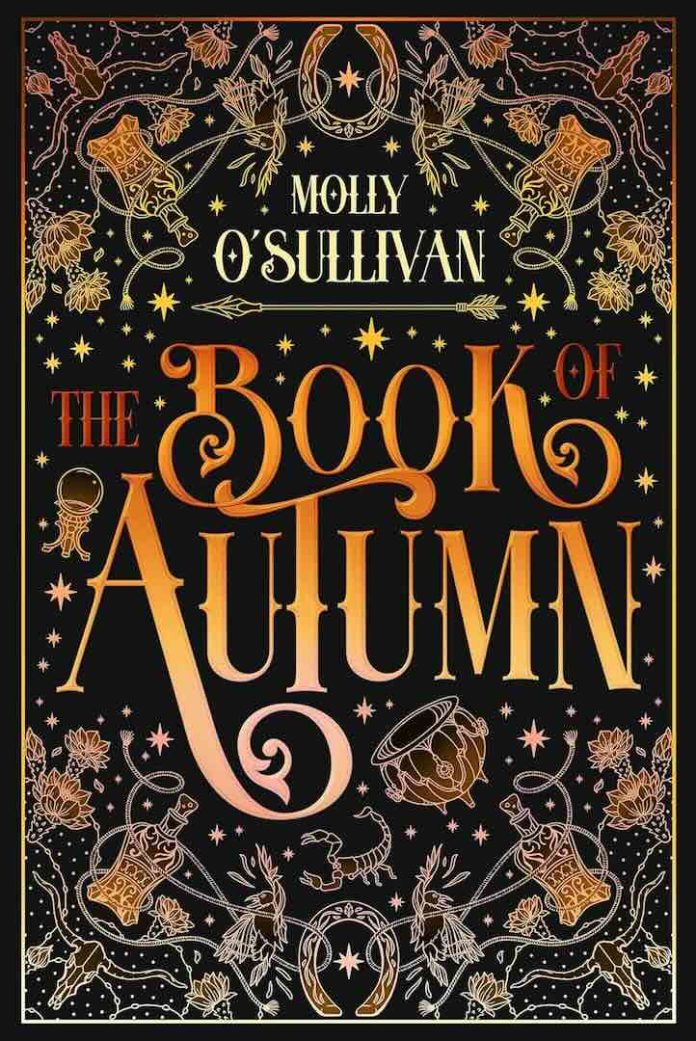
Molly O’Sullivan’s debut novel arrives like a dust storm across the New Mexico desert—unexpected, engrossing, and impossible to ignore. The Book of Autumn plants itself firmly within the dark academia tradition while carving out its own distinctive territory, one where Pythagorean philosophy meets contemporary magical realism, and where the weight of ancient texts threatens to crush those who dare to unlock their secrets.
The novel opens with anthropologist Marcella “Cella” Gibbons reluctantly returning to Seinford and Brown College of Agriculture (and Magic), a sun-bleached institution nestled among the red mesas of rural New Mexico. She’s sworn off magic, academia, and most critically, her complicated history with Max Middlemore, her dimidium—the other half of her magical soul. But when one student lies dead and another floats unconsciously in the infirmary, growling in ancient tongues, Cella’s expertise in Object Theory becomes indispensable.
O’Sullivan constructs a world where magic operates through carefully studied objects and methodical practices, creating a system that feels both academically rigorous and wonderfully strange. The Three Arts of magic taught at Seinford and Brown serve as a protective framework, distinguishing this institution from its rival Britton Arcane, where students practice wilder, more dangerous forms of spellwork.
The Architecture of Atmosphere
What immediately distinguishes O’Sullivan’s work is her masterful command of setting. The New Mexico landscape becomes a character unto itself—parched earth, towering mesas, the rust-red dirt that seems to stain everything it touches. Seinford and Brown’s campus, with its Spanish colonial architecture and enchanted buildings that seem to have minds of their own, pulses with an eerie vitality. Ludlow House, in particular, with its meandering hallways that turn back on themselves and its portraits of mad matriarchs, captures the unsettling beauty of magical spaces gone slightly wrong.
The author’s background in cybersecurity engineering brings an unexpected precision to her worldbuilding. The magical system based on Object Theory feels methodically constructed, with clear rules and fascinating limitations. Objects serve as conduits and protective mechanisms, each imbued with personal significance to their magical wielder. This grounding in systematic thinking prevents the magic from feeling arbitrary while maintaining a sense of wonder and danger.
Characters Caught Between Past and Present
Cella Gibbons emerges as a refreshingly complex protagonist. She’s prickly, brilliant, insecure, and fiercely independent—a woman who’s spent years trying to escape the shadow of her more charismatic magical partner. O’Sullivan captures the particular frustration of capable women whose achievements are constantly attributed to the men they work alongside. Cella’s internal struggle between her desire for recognition and her genuine passion for magical anthropology gives the narrative its emotional weight.
The dimidium bond between Cella and Max provides the romantic backbone of the story, but O’Sullivan resists easy sentiment. Their connection is messy, complicated by resentment, miscommunication, and the fundamental unfairness of being magically bound to someone who once broke your heart. Max, with his cowboy charm and easy confidence, could have been a mere romantic archetype, but the author reveals layers of vulnerability and genuine devotion beneath his swagger. Their relationship unfolds with authentic awkwardness and unresolved tension that will satisfy readers seeking emotional complexity.
The supporting cast, from loyal librarian Vern to the possessed Danica Stewart, serves both narrative function and thematic purpose. Each character illuminates different aspects of academic ambition, the hunger for belonging, and the prices people pay for power.
Ancient Texts and Modern Dangers
At the novel’s heart lies the Book of Autumn itself—an ancient magical text attributed to a mysterious author known only as “S,” a follower of Pythagoras. O’Sullivan demonstrates impressive research into Hellenistic philosophy, Pythagorean mysticism, and the history of grimoires. The incorporation of real historical texts and philosophical concepts lends authenticity to the fictional elements, creating a seamless blend that makes readers question where history ends and invention begins.
The mystery surrounding the Book of Autumn unfolds with satisfying complexity. O’Sullivan plants clues throughout the narrative—symbols appearing on campus, cryptic Pythagorean sayings in notebooks, references to secret societies—without overwhelming readers with exposition. The investigation balances academic detective work with genuine magical danger, as Cella and Max must decode ancient texts while navigating campus politics and escalating threats.
Where Ambition Meets Its Limits
The novel’s treatment of ambition and its consequences provides its most thoughtful dimension. O’Sullivan explores how the desperate desire to matter, to be remembered, to transcend ordinary limitations can corrupt even well-intentioned individuals. The modern incarnation of the Order of Autumn, masquerading as a campus fraternity, represents the dangerous evolution of ancient mystical traditions into something darker and more self-serving.
The author particularly excels at depicting academic culture’s peculiar cruelties—the rankings, the competition, the way students can disappear into the background of more charismatic peers. Danica Stewart’s storyline serves as a haunting meditation on invisibility and the lengths people will go to be seen, to matter, to leave a mark on the world.
Narrative Structure and Stylistic Choices
O’Sullivan employs an interesting narrative structure, incorporating Cella’s footnotes, journal entries from ancient texts, and excerpts from the Book of Autumn itself. This layered approach enriches the worldbuilding while occasionally interrupting narrative momentum. The footnotes, while providing valuable context and world-building details, sometimes feel excessive, particularly in the novel’s middle section where the pacing slows as Cella obsessively studies the ancient text.
The prose itself strikes a balance between academic precision and contemporary accessibility. O’Sullivan’s voice captures Cella’s intellectual approach to problems while maintaining emotional immediacy. The dialogue crackles with wit and genuine feeling, particularly in exchanges between Cella and Max, where years of history inform every barbed comment and tender moment.
However, some readers may find the extensive passages devoted to decoding ancient texts and explaining magical theory somewhat dense. O’Sullivan’s enthusiasm for the research occasionally overwhelms the narrative drive, particularly in the second act where the investigation seems to stall as Cella disappears into books and theories.
Technical Craft and Occasional Stumbles
For a debut novel, The Book of Autumn demonstrates remarkable technical proficiency. O’Sullivan manages multiple plot threads with general competence, though the mystery’s resolution, when it arrives, feels somewhat rushed after the methodical buildup. The final confrontation, while emotionally satisfying, doesn’t quite match the complexity of the philosophical and magical questions the novel raises.
The book’s treatment of Christian symbolism and its tension with magical practice adds an interesting dimension, particularly given the setting’s cultural context. However, this aspect could have been developed more deeply rather than remaining largely in the background. Similarly, the novel gestures toward contemporary issues—social media influence, toxic online communities, the commodification of knowledge—without fully exploring these parallels.
A Promising Foundation
What O’Sullivan achieves most successfully is the creation of a fully realized magical world that feels both fantastical and grounded. The magical system’s emphasis on objects and careful study distinguishes it from many contemporary fantasy novels, while the academic setting provides natural opportunities for both intellectual investigation and interpersonal drama.
The romance, while not without its predictable beats, succeeds because it’s fundamentally about two people learning to see each other clearly rather than through the distorting lens of magical connection or romantic idealization. Cella and Max must choose each other not because fate demands it, but because they recognize what they have together is worth the work of maintaining it.
For Readers Who Appreciate…
This novel will particularly resonate with readers who enjoyed:
- Ninth House by Leigh Bardugo for its dark academia atmosphere and secret societies
- The Atlas Six by Olivie Blake for its focus on ambitious young magicians and morally complex choices
- A Deadly Education by Naomi Novik for its academic magical setting and survival stakes
- The Historian by Elizabeth Kostova for its blend of academic research and supernatural mystery
- Practical Magic by Alice Hoffman for its exploration of how magic complicates relationships and identity
Final Thoughts
The Book of Autumn announces Molly O’Sullivan as a fantasy author to watch. While the novel occasionally stumbles under the weight of its ambitious worldbuilding and could benefit from tighter pacing in its middle section, it succeeds as both an entertaining mystery and a thoughtful exploration of ambition, identity, and the dangerous allure of forbidden knowledge.
O’Sullivan demonstrates particular strength in crafting atmosphere and developing complicated characters who refuse easy categorization. The magical system feels fresh and intellectually engaging, while the romance provides genuine emotional stakes without overwhelming the plot. The incorporation of Pythagorean philosophy and ancient mysticism adds depth and originality to familiar dark academia tropes.
For readers seeking a magical mystery that rewards careful attention and intellectual engagement, The Book of Autumn offers a satisfying blend of romance, academia, and ancient secrets. It’s a novel that asks important questions about the price of knowledge, the nature of ambition, and what it means to step out of someone else’s shadow and claim your own place in the world.







