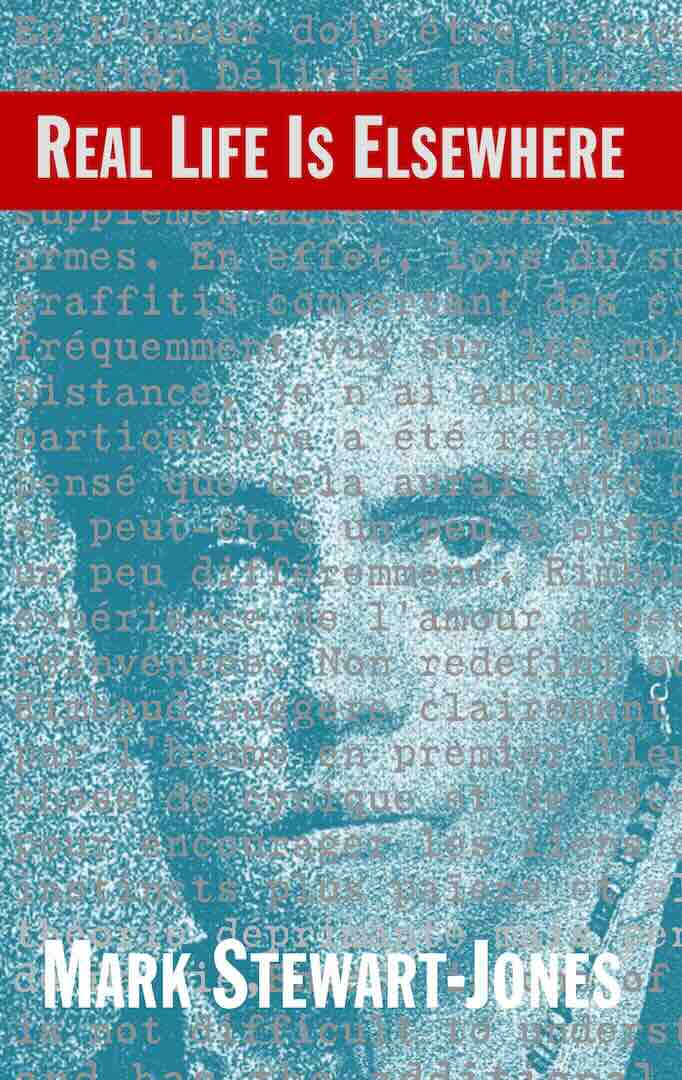
There are books that tell you a story, and then there are books that wander alongside you and force you to confront the very nature of storytelling itself. Real Life Is Elsewhere by Mark Stewart-Jones belongs emphatically to the latter category. Published in 2024 by Troubador Publishing, this singular work of literary fiction resists easy classification, operating simultaneously as a travelogue, a love story, a literary essay, and a profoundly intimate meditation on grief, ageing, and the dangerous beauty of hero worship.
The premise is deceptively simple. Mark, a middle-aged, self-published writer reeling from the recent death of his mother, travels to Charleville in Northern France to visit the hometown of his lifelong literary hero, the poet Arthur Rimbaud. What unfolds over twenty-four hours in this sleepy provincial town, however, is anything but simple. As Mark wanders through the streets, visiting the cemetery, the museum, and the Place Ducale, his interior monologue unfurls in long, rich, discursive ribbons. He reflects on Rimbaud’s biography, his own failures as a writer, the cruelties and comforts of nostalgia, and the peculiar way our obsessions shape us into versions of ourselves we never quite intended to become.
The Architecture of a Restless Mind
What makes Real Life Is Elsewhere by Mark Stewart-Jones so structurally compelling is its refusal to behave like a conventional novel. The chapters are titled with thematic concepts rather than plot markers: Absence, Monument, Formula, Charity, Orphans. Each one functions almost as an essay in motion, grounding philosophical and cultural observations in the physical reality of Mark’s walk through Charleville. The prose has the elastic, associative quality of a mind genuinely at work, leaping from Rimbaud’s Lettres du Voyant to Cardiff City Football Club chants to the quiet devastation of losing a parent, all within a few effortless pages.
Stewart-Jones writes with the kind of erudition that never condescends. His digressions, and there are many, never feel indulgent because they are always in service of a deeper emotional truth. A passage about Madame Mauté, Verlaine’s mother-in-law and a former pupil of Chopin, becomes a quiet rebuke to the way obsession narrows our vision. A memory of an eight-year-old Mark performing in a local production of Camelot becomes a statement about the fear that what matters most will be forgotten unless someone takes the trouble to record it.
The writing itself is muscular and unpretentious, laced with dark humour and an ear for the absurd. Stewart-Jones can shift from lyrical introspection to sharp wit without the slightest tonal whiplash. One moment he is contemplating the existential weight of Rimbaud’s famous declaration “Je est un autre” (I is another); the next he is ranting about the sinister implications of shuttered windows in French towns or expressing mild outrage that the Duke of Mantua’s statue has been relocated.
Anne: The Mongrel Angel at the Heart of Everything
The arrival of Anne, or more formally Suzanne Autry, transforms the narrative entirely. Mark encounters her outside a supermarket and their connection is immediate, electric, and deeply strange. Anne is no passive love interest. She is opinionated, foul-mouthed, fiercely intelligent, and entirely unimpressed by sentimentality. She challenges Mark on his nostalgia, his Rimbaud obsession, and even the structural choices of the very book he is narrating in his head. That her name, Anne Autry, phonetically mirrors “un autre” is a device the text acknowledges with self-aware embarrassment, and this meta-fictional honesty is one of the book’s great charms.
Their relationship across a single day and night forms the emotional spine of the novel. Through Anne, Mark begins to understand that his pilgrimage to Charleville was never really about Rimbaud at all. It was about finding a way back to feeling alive after grief had hollowed him out. Their conversations crackle with intelligence and tenderness, and there is a scene involving the planting of a rose bush that achieves a kind of quiet, devastating beauty rare in contemporary fiction.
Imaginary Friends and Literary Ghosts
One of the most inventive elements of Real Life Is Elsewhere by Mark Stewart-Jones is the appearance of characters conjured by Mark’s own imagination. Robert Johnson, the legendary Mississippi Delta bluesman, materialises outside the Carrefour supermarket (at the “crossroads,” naturally) and proceeds to debate authenticity, racial representation, and the nature of truth in art with his bewildered creator. Later, Mark’s deceased mother appears for a conversation in which he attempts to articulate feelings he never managed to express while she was alive.
These interjections could easily have felt gimmicky or contrived, but Stewart-Jones earns them through the sheer force of his conviction and the internal logic of the narrative. Mark is a writer narrating the book he will never write, and these visitations are the natural consequence of a mind steeped in literature and music finally allowing its inner life to spill outward without restraint. They also serve a structural purpose, offering tonal counterpoints to the more ruminative passages and preventing the novel from collapsing under its own intellectual weight.
Key Themes That Resonate Long After the Final Page
- Obsession as self-portrait. Stewart-Jones argues persuasively that the heroes we worship are often projections of our own deepest needs and fears. The Fantasy Rimbaud and the Fantasy Robert Johnson that Mark has constructed say more about him than they ever could about their subjects.
- Grief as disorientation. The loss of Mark’s mother does not manifest as melodrama but as a subtle, persistent confusion. His sense of identity, already fragile, becomes unmoored, and the journey to Charleville is an attempt to find a fixed point from which to rebuild.
- The metafiction of selfhood. Rimbaud’s “Je est un autre” is not merely quoted but lived and tested throughout the novel. Mark’s encounter with Anne becomes the embodiment of this idea, pushing beyond philosophical abstraction into something visceral, physical, and transformative.
- Nostalgia as cowardice. Anne’s devastating assessment that nostalgia is merely “self-tourism” strikes at the heart of the book’s concerns. Real Life Is Elsewhere by Mark Stewart-Jones asks whether we can ever truly move forward while clinging to romanticised versions of the past.
The Author Behind the Voice
Mark Stewart-Jones brings a lifetime of literary apprenticeship to this work. He is the author of five previous novels, including Martin Bonehouse (1996), An Ecstasy of Fumbling (1998), Daughter (2009), and A Difficult Age (2010), along with two non-fiction titles and the co-written graphic novels La Vie En Rose and A Boat Called Wish (both 2022). He has also worked as a musician, draughtsman, and rare-book dealer. This accumulated experience is palpable in every sentence. There is nothing tentative or performative about the writing; it has the confidence that only comes from decades of practicing the craft in relative obscurity, much like the narrator himself.
Who Should Read This Book
Real Life Is Elsewhere by Mark Stewart-Jones will find its most receptive audience among readers who appreciate literary fiction that prioritises voice and intellect over plot mechanics. If you have ever lost yourself in the life of a writer, musician, or artist to the point where their story became tangled with your own, this book will speak to you with an almost unsettling directness.
Similar Books Worth Exploring
If this novel resonates with you, consider these thematically kindred works:
- A Moveable Feast by Ernest Hemingway, for its literary pilgrimage through a European city and the interplay between place and memory
- Austerlitz by W.G. Sebald, for its meditative, digressive prose style and exploration of absence and history
- Out of Sheer Rage by Geoff Dyer, for its brilliant, frustrated account of failing to write a book about D.H. Lawrence
- The Rings of Saturn by W.G. Sebald, for its walking narrative threaded with cultural and personal reflection
- Stoner by John Williams, for its quiet, devastating portrayal of an unremarkable life rendered extraordinary through the quality of attention brought to it
Final Reflection
This is a book that trusts its reader. It does not explain itself, apologise for its digressions, or simplify its emotional landscape. Real Life Is Elsewhere by Mark Stewart-Jones asks you to walk alongside a flawed, funny, deeply human narrator as he stumbles toward something he cannot name but recognises instantly when it arrives. It is a book about the distance between who we are and who we imagine ourselves to be, and the rare, terrifying moments when that distance collapses entirely.
In the end, it suggests that real life is not elsewhere at all. It is right here, in the space between two people whose stars have finally, improbably, aligned.







