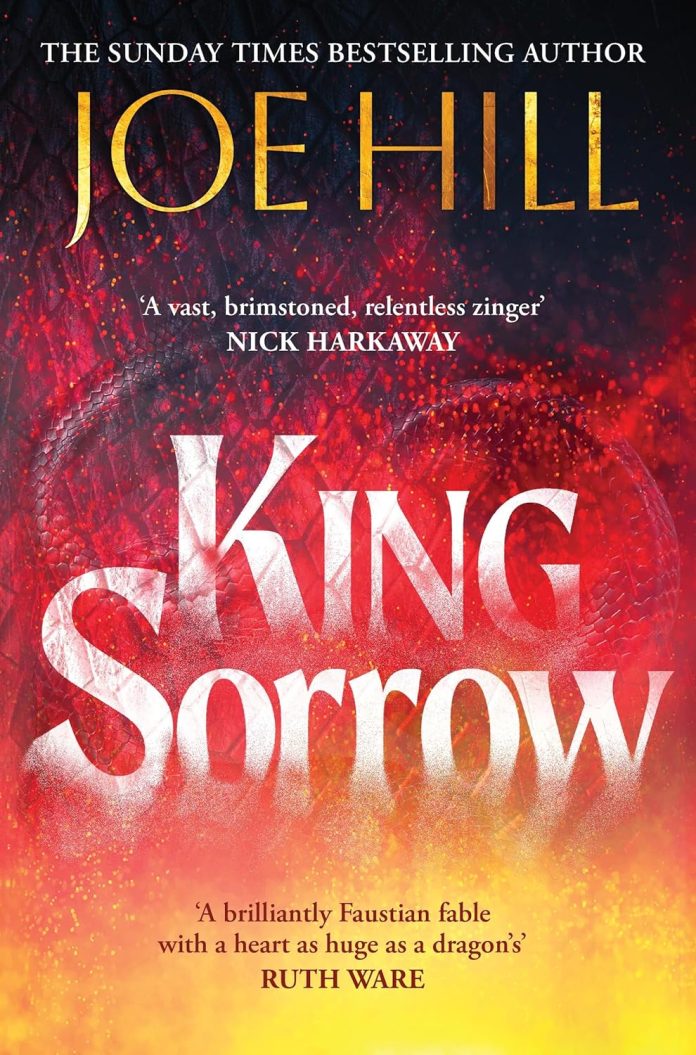
King Sorrow arrives like a fever dream caught between the stacks of an ivy-covered library and the howling darkness beyond reality’s edge. Joe Hill’s latest novel is a sprawling meditation on friendship, consequence, and the terrible price of believing too deeply in the impossible. It’s also one of the most ambitious and structurally daring books he’s written to date.
The Spell That Changed Everything
Arthur Oakes never intended to summon a dragon. He only wanted to save his mother, an incarcerated minister serving time for a crime of conscience. When local drug dealers Jayne and Ronnie Nighswander force him to steal rare books from Rackham College’s Special Collection, Arthur finds himself trapped in a moral vise. Among his thefts is the infamous Crane journal, bound in the tanned skin of its author—a seventeenth-century witch-trial victim who claimed to have trafficked with devils and dragons.
What begins as a desperate act of self-preservation transforms into something far stranger when Arthur shares his predicament with his closest friends at The Briars, the gothic mansion belonging to Colin Wren’s grandfather. These six students—Arthur, Colin, the brilliant and irrepressible Gwen Underfoot, twins Donna and Donovan McBride, and the compassionate Allie Shiner—decide to attempt the unthinkable. Following the instructions in Enoch Crane’s journal, they conduct a ritual to summon King Sorrow, an ancient dragon from “the Long Dark,” hoping to use him to solve Arthur’s problem.
The ritual succeeds. And that’s when their real problems begin.
A Dragon’s Bargain
Hill’s genius lies in understanding that the most terrifying monsters aren’t the ones that kill you outright, but those that offer you exactly what you want—at a price you don’t discover until it’s too late. King Sorrow doesn’t devour the six friends immediately. Instead, he offers them a deal: once a year, they must choose someone for him to kill. Someone whose death the world won’t mourn. Someone who “deserves it.”
This premise transforms what could have been a straightforward supernatural thriller into an unnerving ethical puzzle box. The novel asks uncomfortable questions about vigilante justice, moral certainty, and whether anyone truly has the wisdom to decide who deserves to die. As the years pass and the body count rises, the friends scatter across the country, bound together by their terrible secret and the mark King Sorrow has burned into their flesh.
The structure Hill employs is audacious. The book unfolds across five distinct sections, each employing different narrative techniques. Book One establishes the 1989 origin story in traditional third-person narrative. Book Two, “Flight or Fright,” takes place almost entirely aboard an airplane in real-time, told through timestamps that ratchet up tension with metronomic precision. Book Three shifts into screenplay format, complete with stage directions. This isn’t mere stylistic showboating—each formal choice reflects the psychological state of the characters and the nature of King Sorrow’s reality-warping presence.
The Weight of Words
Joe Hill, the author of NOS4A2, The Fireman, and the Locke & Key graphic novel series, has always demonstrated remarkable range. Yet King Sorrow represents something new in his oeuvre—a self-aware, literate horror novel that wears its academic influences on its sleeve while never forgetting to deliver genuine scares and emotional devastation.
Arthur Oakes, our central consciousness, is a Black student at an overwhelmingly white institution, a detail Hill handles with nuance. Arthur’s outsider status isn’t melodramatic; it’s woven into every interaction, every assumption others make about him, every moment of hypervigilance. When the Crane journal goes missing, Arthur knows immediately that suspicion will fall on him—the scholarship kid whose mother is in prison. This social reality makes his entrapment by the Nighswanders all the more vicious.
Gwen Underfoot emerges as the novel’s moral center, though Hill wisely avoids making her simplistically heroic. She’s practical, loyal, and possessed of a working-class pragmatism that cuts through the philosophical abstractions the others sometimes indulge in. Her relationship with Arthur forms the novel’s emotional core, rendered with aching tenderness even as doom encircles them.
Colin Wren is perhaps the most fascinating and troubling member of the group. Wealthy, brilliant, and possessed of resources that seem to multiply impossibly over the years, Colin becomes something like King Sorrow’s prophet. His transformation from charismatic student to morally compromised puppet master provides one of the novel’s most chilling arcs.
Dragons in the Details
Hill’s research into dragon mythology is evident throughout, but he wears his learning lightly. References to Father Ruin, the ouroboros, and medieval bestiaries feel organic rather than ostentatious. The Crane journal itself, with its anthropodermic binding, evokes real historical artifacts while remaining distinctly Hill’s invention.
The sequences describing the summoning ritual showcase Hill at his most atmospheric. Marijuana smoke twists into serpentine shapes. Time itself seems to fracture into “Scatterday,” a phantom day between Friday and Saturday. Reality becomes porous, allowing glimpses of the Long Dark—that infinite space beyond the bars of our bright cage of consciousness. Hill captures the precise texture of altered states without ever losing narrative coherence.
When King Sorrow finally manifests, he doesn’t disappoint. He’s not merely a monster but a presence—ancient, sardonic, possessed of the patient cruelty that comes from living five thousand years. He speaks in riddles and relishes psychological torture as much as physical consumption. Most disturbingly, he feeds not on flesh but on pain, grief, and hopelessness. Every victim must die in despair.
Structural Ambition and Minor Stumbles
The novel’s experimental structure is mostly successful, though not uniformly so. The real-time airplane sequence in Book Two generates tremendous suspense, as Donna McBride races against the clock while King Sorrow stalks the aircraft. The screenplay format of Book Three takes more adjustment but ultimately justifies itself, creating a surreal quality appropriate to the narrative’s descent into magical thinking.
However, at roughly 700 pages, the novel occasionally feels its length. Some of the middle sections, particularly when characters are separated and pursuing parallel investigations, lose momentum. The interludes focusing on Gwen’s perspective, while beautifully written, sometimes interrupt the forward thrust of the main narrative.
The finale, when it arrives, is both devastating and cathartic. Hill doesn’t offer easy answers or convenient redemptions. Characters who made terrible choices must face consequences. Yet there’s also space for grace, for the possibility that even the worst mistakes don’t define us completely.
The Literary Landscape
King Sorrow exists in conversation with several literary traditions. It’s part coming-of-age story, part dark academia thriller, part meditation on the price of power. Readers familiar with Donna Tartt’s The Secret History will recognize the closed circle of elite students bound by a terrible crime. The novel’s interest in folklore and fairy tale logic recalls Neil Gaiman’s work, particularly Stardust and American Gods.
Yet Hill’s voice remains distinctly his own. There’s a pulp energy here, a willingness to embrace genre thrills even while interrogating deeper themes. The novel delivers genuine horror—moments that make you want to put the book down and turn on all the lights—while never losing sight of its human center.
For readers seeking similar experiences:
- The Secret History by Donna Tartt—for the closed circle of friends bound by crime
- Mexican Gothic by Silvia Moreno-Garcia—for atmospheric gothic horror with academic elements
- The Historian by Elizabeth Kostova—for literary horror rooted in historical research
- Ninth House by Leigh Bardugo—for dark academia with supernatural elements
- The Magicians by Lev Grossman—for the corruption of youthful idealism through magical power
The Verdict
King Sorrow is an impressive achievement—ambitious, intelligent, and genuinely moving. It’s not perfect; its length and structural experiments may test some readers’ patience. But Hill has crafted something rare: a horror novel that’s genuinely frightening while also functioning as a serious examination of moral responsibility, the seductiveness of power, and the long shadows cast by youthful mistakes.
The novel reminds us that the stories we tell about ourselves, the narratives we construct to justify our choices, can be as dangerous as any dragon. King Sorrow is terrifying not because he’s impossible to defeat, but because he gives us exactly what we think we want—the power to remake the world according to our will. And in Joe Hill’s skilled hands, that proves far more horrifying than mere monsters in the dark.
For fans of Hill’s previous work, this represents a significant evolution—more literary, more structurally adventurous, more philosophically engaged. For newcomers, it’s a powerful introduction to a writer at the height of his powers. Just be prepared: once you invite King Sorrow into your world, he doesn’t leave easily. And neither will this novel.







