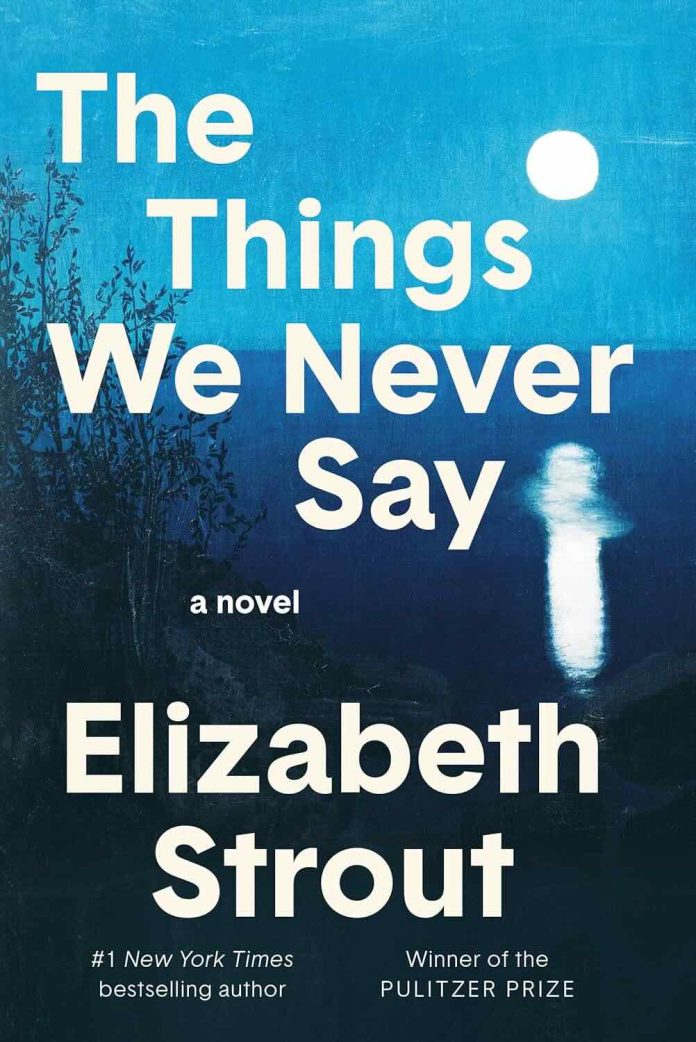
There is a kind of book that asks you to slow down. Not because its language is dense, but because its quietness demands attention you may not have given to your own life. The Things We Never Say by Elizabeth Strout is that kind of book. It is small in scope and enormous in feeling, gathering the daily routines of a high school history teacher in coastal Massachusetts and stretching them, slowly, until they hold the weight of an entire interior universe.
Strout, whose career has been a long study of small towns and the people inside them, returns here with the same compassionate eye she brought to Olive Kitteridge and My Name Is Lucy Barton. The novel sits a little differently in her body of work, though. It is more openly preoccupied with politics, with mortality, and with a particular kind of late-in-life loneliness that resists tidy resolution.
The Premise, Spoiler-Free
Artie Dam is fifty-seven. Married for three decades. Beloved by his students. Kind to his neighbors. He sails on weekends, teaches the Civil War, gets a little teasing about his white socks. From the outside, his life looks settled. From the inside, something quieter is happening. He is asking himself a question the novel never quite lets go of: how is it that we know so little of one another, even those we have shared a life with for thirty years?
A chance event, the kind Strout often plants like a small seed and then waters across hundreds of pages, eventually opens a door Artie has not been brave enough to open himself. What he learns reframes everything. Or almost everything. Strout, ever wise, knows that some realizations do not so much transform a life as recolor it.
What Strout Does Best Here
The Roving Compassion
Few writers move so naturally inside the heads of secondary characters. Within a single chapter you may sit with Artie, then briefly with a student named Rhonda, then with the boy who mocked her, then with the high school principal, then with the wife of a plumber who has just told a stranger his marriage is collapsing. This is Strout’s signature gift, and The Things We Never Say by Elizabeth Strout leans on it with confidence. The effect is a portrait of a community as a single nervous system. Each person carries something hidden. Each interaction is a small negotiation with what cannot be said.
The Carl Jung epigraph that opens the novel is the thesis: loneliness is not the absence of people but the inability to share what feels most important. Strout spends the rest of the book proving it.
A Few Elements That Linger
- The way she writes teachers. Artie’s classroom scenes feel earned, not performed. You believe he loves his students. You believe they have figured out, in their teenage way, that he is safe.
- Her ear for the tiny, embarrassing tendernesses of long marriage. A drop on a nose at breakfast. The wrong shoes for a wedding. A jar of face cream.
- Her treatment of class. Artie grew up in a basement apartment in Revere. Evie comes from old money. The book is honest about how that gap shapes a life without ever turning it into melodrama.
- Her willingness to sit with the political present. The novel is set against an American election and its aftermath, and Strout does not pretend she is writing in some timeless vacuum.
Where the Novel Holds Back
A four-star book is rarely a flawless one, and The Things We Never Say by Elizabeth Strout has its uneven patches. The pacing in the middle section softens. Some readers will find a key incident handled almost too lightly, the language slipping into a register so calm it borders on detachment. The political material, while honest, occasionally pulls the reader out of the close personal lens that is her strongest mode. And there are moments when the narrator intrudes with sweeping pronouncements about human blindness that feel more declarative than the surrounding prose can carry.
The epilogue, which moves the reader forward in time, will divide opinion. Some will find it the perfect open hand of a finish, all grief and grace, the way real lives actually end. Others may find it rushed, a compression that asks for feeling the book has not fully built. I leaned, finally, toward the first reading. I understand the second.
There is also an imbalance in the supporting cast. Francesca, the daughter-in-law and a concert pianist, deepens in every scene she appears in. Rachel, a younger woman who enters the story midway, never quite arrives as a person. The unevenness is felt.
Strout’s Voice, Inside a Man’s Mind
Strout has spent much of her career inside the consciousness of women. Olive Kitteridge. Lucy Barton. Amy and Isabelle. To live for nearly three hundred pages inside Artie Dam is a different experience, and she writes him with real care. He is not a symbolic everyman. He is specific. And he whistles when he is nervous. He cannot fix a faucet. He thinks of his dead sister Maria almost daily and has never told anyone what he once saw of her childhood. The interior life she gives him is one of the quiet achievements of the book.
A Few Reading Notes
Things to Keep in Mind Going In
- The book rewards slow reading. It is not about plot mechanics.
- The political backdrop is unmistakable. Readers who want their fiction to stay above the fray may bristle.
- Many characters appear briefly and never return. This is a feature, not a flaw. It is part of how the book argues for the unknowability of strangers.
- The Jung epigraph is doing more work than it first appears.
A Note on Where to Start with Strout
For first-time readers, this is a fine entry, though I would still steer newcomers to Olive Kitteridge if they want her at the height of her powers. For longtime readers, it offers something new and something familiar at once.
If You Loved This, Try
For readers who close The Things We Never Say by Elizabeth Strout wanting more of the same quiet attention to interior life, the following will land well:
- Stoner by John Williams, for the slow life of an unassuming teacher.
- Crossroads by Jonathan Franzen, for marriage, secrets, and a long American moment.
- Plainsong by Kent Haruf, for small-town tenderness done plainly.
- Foster by Claire Keegan, for compressed emotional power.
- A Gentleman in Moscow by Amor Towles, for the dignity of a contained life.
- The Wapshot Chronicle by John Cheever, for the New England undercurrent of melancholy.
From Strout’s own backlist, in rough recommended order: Olive Kitteridge, My Name Is Lucy Barton, Anything Is Possible, Oh William!, Lucy by the Sea, The Burgess Boys, and the recent companion Tell Me Everything.
Final Word
The Things We Never Say by Elizabeth Strout is not her most ambitious novel, and I do not think it is trying to be. It is something quieter. A meditation on the parts of a self that go unnamed. A late-career study of how decent people carry private weights, often for years, often without asking for help. It is uneven in places, but its best pages glow with the recognition you sometimes find only when you have lived long enough to know what is not being said.
Worth the time. Worth the slow read. And worth keeping near the bed.







