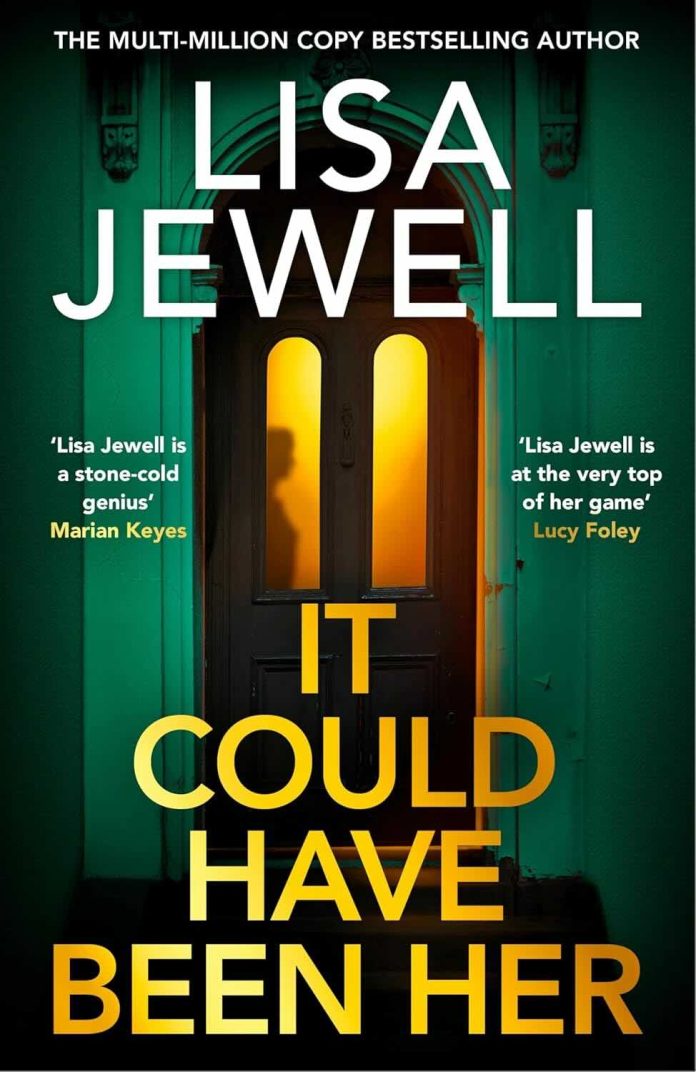
Jane Trevally is fifty-five, twice divorced, and rattling around a Dorset estate she can neither afford to keep nor bring herself to leave. Her four dogs are her whole family. So when a small white terrier trots out of her bluebell woods one spring morning with no owner anywhere in sight, returning him to the London address on his microchip feels like an easy bit of kindness. It is not. The shabby house in the Vale of Health, a hidden hamlet on the edge of Hampstead Heath, is one Jane has stood outside before, on a night twenty-five years ago when she was young, drunk, freshly heartbroken, and very nearly did not make it home alive.
That is the hook of It Could Have Been Her by Lisa Jewell, and it is a clever one. A small good deed snags on a buried memory, and the floor quietly gives way beneath it. This is the second outing for Jane, who readers first met as a sharp-tongued side character in Don’t Let Him In (2025), and here she is promoted to the heart of the story. The setup is pure Jewell: an ordinary woman, a chance encounter, and a house that knows things.
A Story Told in Layers, and Why That Matters
Jewell rarely tells a story in a straight line, and she does not start now. The novel braids several voices and timelines that circle the same address from different decades. We get Jane in the bright, anxious present of 2026, half playing at being a detective and half terrified of what she might find. We get the slow confessions of people connected to the house, each one peeling back a little more of what happened there. The reader is always slightly ahead of Jane on some threads and far behind her on others, and that gap is where the tension lives.
When the structure works, it is genuinely difficult to put down. Jewell is a master of the well-placed reveal, dropping a single line at the end of a short chapter that reframes everything before it. The pieces lock together in the final third with a satisfying click. A few of the early chapters, though, feel more like scaffolding than story, and the constant timeline-hopping asks a lot of a reader who prefers a clear chronological path. If you have a linear brain, keep a mental map handy.
The Woman at the Center
The biggest pleasure here is Jane herself. She is funny, vain in an honest way, impulsive, and quietly wounded, a woman who married wealthy men because she was looking for rescue and is only now, in late middle age, learning to rescue herself. Jewell uses her to explore something thrillers usually ignore: the inner life of a woman past fifty who refuses to become invisible. Jane’s running commentary on aging, money, loneliness, and the difference between being alone and being lonely gives the book a warmth that its darker chapters badly need. Her bond with her gentle stepson Dexter is the emotional anchor, and their scenes together are some of the best in the book.
The supporting cast is more uneven. Some figures are drawn with real, uncomfortable precision, the kind of people who feel safe right up until they do not. Others arrive, serve their purpose in the puzzle, and exit before they fully breathe. That is the trade-off of a wide ensemble built around a mystery box.
What Lands
- A genuinely creepy central setting that earns its gothic dread without leaning on cheap haunted-house tricks.
- Jane as a lead: vivid, flawed, and good company even when the plot drags.
- Smart chapter breaks and reveals that keep you reading “just one more.”
- A serious, unflinching interest in how childhood horror shapes the adults who survive it.
- The cozy texture of London and Dorset life, the food, the dogs, the weather, which makes the menace underneath hit harder.
Where It Wobbles
- The shifting timelines occasionally trade clarity for cleverness, and a few chapters read as filler.
- Readers who want one knockout twist may find the reveals more accumulated than explosive.
- Some secondary characters stay thin, existing mainly to move information around.
- The “house of horrors” premise pushes into very dark territory that will not be for everyone.
The Voice: Cosy on Top, Rot Underneath
Style is where Jewell shows her experience. Jane’s chapters run in a close present tense that makes the reader feel every flicker of her nerve and appetite, from a salted caramel muffin cut into four neat pieces to a spicy margarita sipped alone at a candlelit table. The prose is sensory and a little greedy, full of the small comforts Jane reaches for to keep the dark at bay. Then Jewell switches registers entirely for the confessional chapters, where the voices are colder, more self-justifying, and quietly terrifying precisely because they sound so reasonable. That contrast, warmth against rot, is the engine of the whole book. It is a hard trick to pull off, and Jewell mostly pulls it off.
What keeps It Could Have Been Her by Lisa Jewell from feeling like a pure shock machine is its real subject. Underneath the missing-girl plot, this is a study of trauma and of why people stay close to the very places that broke them. One late line, about how trauma pins you in place even when you believe you have moved on, lands with more weight than any of the plot twists. That is the difference between a thriller that entertains and one that lingers.
Should You Read It?
If you come to It Could Have Been Her by Lisa Jewell for a tidy, fast, linear whodunit, you may feel the friction of its ambitions. If you come for atmosphere, a wonderful older heroine, and a slow burn that pays off, this is an easy recommendation. It rewards patience. It is not Jewell’s most flawless book, and longtime fans may rank Then She Was Gone or None of This Is True higher, but it is confident, character-rich, and properly unsettling.
A small note worth flagging: the story touches on child neglect, abusive parenting, abduction, and sexual violence, handled mostly off the page but present throughout. Sensitive readers should go in aware.
If You Liked This, Read These Next
For readers who want the same blend of buried secrets, layered timelines, and domestic dread, try:
- None of This Is True by Lisa Jewell: a podcaster and a stranger collide, and the truth keeps shifting. Jewell at her most claustrophobic.
- The Family Upstairs by Lisa Jewell: another London house full of long-hidden horrors, and a clear cousin to this book.
- The Last House on Needless Street by Catriona Ward: a gothic, unsettling tale of a house that hides far more than it shows.
- Behind Closed Doors by B.A. Paris: a perfect-looking home with something very wrong inside it.
- Local Woman Missing by Mary Kubica: a multi-voice mystery about vanished women and the long reach of the past.
Readers who want a friendship that soured at fifteen and is still doing damage twenty-five years later should look at Heart of Glass by Jennifer Hillier.
Final Word
It Could Have Been Her by Lisa Jewell is a dark, generous, slightly overstuffed thriller carried by one of the most likeable leads Jewell has written in years. It asks for your patience with its many moving parts, and it mostly repays it. Come for the missing girl and the creepy house; stay for Jane Trevally, her dogs, and the quiet truth that some doors, once opened, never really close.