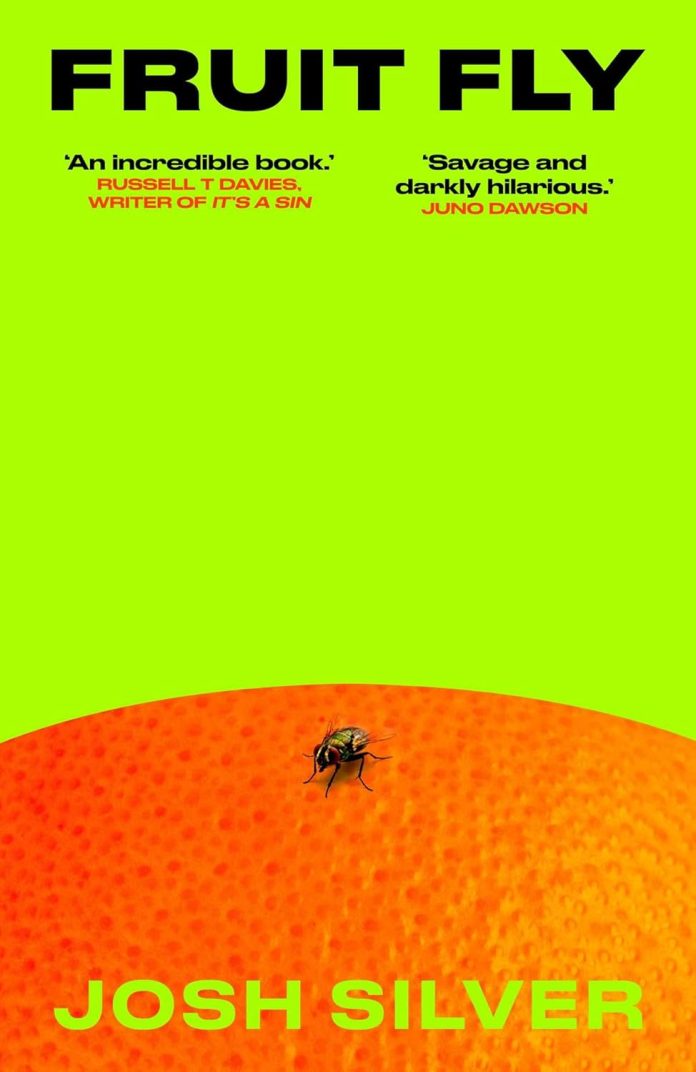
Somewhere on Reddit there is a post explaining how to write a bestseller. Follow the trends, it advises. Dark is good. Sad sells. And the gold dust, the guaranteed prize-winner? Gay and sad together. Josh Silver’s adult debut, Fruit Fly, takes that advice literally, hands it to the worst possible person, and lets us watch what it costs.
Fruit Fly by Josh Silver introduces Mallory Maddox, a one-hit novelist seven years past her moment, hiding in the bathroom at her own party playing Candy Crush while her husband soaks up the adoration downstairs. She has no second book, three counselling clients she is barely qualified to see, and a marriage that looks enviable from every angle except the inside. What she needs is a story. What she finds, on an app she downloads for research, is Leo: twenty-two, homeless, addicted, funny as an open wound, and exactly the kind of raw material the market is paying for.
A Bestseller Recipe Written in Someone Else’s Blood
The premise sits in obvious conversation with Yellowface, but Silver is working a different seam. Where Kuang skewered authorial theft after the fact, Silver stages the theft in real time. Mallory poses as a therapist to harvest Leo’s sessions for a manuscript she is quietly shopping to publishers, and we read her chapters as she writes them, watching a boy’s worst nights turn into marketable prose while the bruises are still fresh. The industry gets no cover here. An editor’s letter praising the project as necessary and urgent, while gently asking whether Mallory has the right sort of personal connection to the material, is the most quietly vicious set piece I have read all year.
The joke underneath the whole novel is its title. Fruit flies hover over sweetness as it turns. So do publishers. So does Mallory, who would tell you, sincerely, that she is one of the good ones.
From HappyHead to Here: Silver Leaves YA Behind
Readers who know Silver from his HappyHead duology (HappyHead and Dead Happy) will recognise the preoccupations: institutions that promise care and deliver control, young men performing wellness for an audience. What is new is the freedom. Silver trained as an actor and now works as a mental health nurse, and both lives are all over this book. The recovery meetings, the halfway-house breathalyser rules, the crisis-line scripts: none of it reads researched. It reads lived.
Two Liars, One Manuscript
The novel alternates between Mallory’s voice and Leo’s, both in present tense, and the gap between them is where everything happens. Mallory narrates in curated interiors and brand names, a woman furnishing her own denial. Leo talks in short, profane bursts, interrupted by the poems he posts anonymously to four thousand Instagram followers. Silver often replays the same scene from both sides, and the trick never wears out, because each narrator is wrong about the other in ways the reader can see and neither of them can.
Be warned that nobody in Fruit Fly by Josh Silver is the mark they first appear to be. The con runs in more directions than Mallory knows, and the book is at its best when it lets its two damaged schemers circle each other, each convinced they are the spider.
What Works
- The dual narration. Mirrored chapters turn dramatic irony into the book’s engine. You wince pages before the characters do.
- The publishing satire. Pre-empts, trend-chasing editors, authenticity as a box to tick, endings reverse-engineered to make a sales team cry. Anyone who works near books will laugh, then feel slightly ill.
- Leo’s voice. Sardonic, self-aware, secretly literary. His poems, deliberately rough, carry more feeling than anything Mallory manages in polished prose.
- The marriage. Ronan is a coercive controller drawn with horrible precision, all soft linen and concern, and his slow tightening of the household is as gripping as any thriller plot.
- The comedy. A chemsex party greeted with vol-au-vents. Drugs snorted off a self-help bestseller. The laughs are frequent, and they always leave a mark.
Where It Stumbles
An honest reading of Fruit Fly by Josh Silver has to name the friction, because there is some.
- The middle slows. A long stretch of backstory around Mallory’s marriage arrives in one dense block, and the momentum built by the opening act sags under it.
- The mirrored structure repeats itself. Seeing one scene twice is the point, but by the final third you can predict the rhythm, and a few replays earn less than they cost.
- The bleakness is relentless. Silver satirises the market for queer misery while writing a book that contains an enormous amount of it. He knows this, and the novel winks at the tension, but some readers will feel the wink does not fully settle the bill.
- The ending is a gamble. The climax resolves through a structural sleight of hand that I found genuinely daring and some readers will find evasive. It withholds exactly the certainty most novels exist to provide.
How Dark Does It Get
Very. This is not misery tourism, but it is unflinching.
A Word on Content Warnings
Readers should know the book depicts drug addiction and overdose on the page, sexual violence, suicidal ideation and a suicide attempt, coercive control within a marriage, and references to child sexual abuse. The violence is never decorative, and the most brutal chapter is written with real formal care, but sensitive readers should take this list seriously.
Who This Is For
Reach for Fruit Fly by Josh Silver if you want scalpel-sharp satire, unreliable narrators you catch yourself rooting for, and fiction that asks who gets to profit from pain. Skip it if you need a likeable protagonist, a tidy ending, or a gentle read. It is dark, it is angry, and it is frequently very funny, sometimes in the same sentence.
Read These Next
For readers who finish and want something in the same bloodstream:
- Yellowface by R.F. Kuang. The obvious companion piece: authorial theft, industry complicity, and a narrator you cannot trust or quit.
- A Little Life by Hanya Yanagihara. The modern touchstone for queer suffering in fiction, and a book Silver’s characters pointedly discuss.
- John of John by Douglas Stuart. Working-class queer boyhood rendered with the tenderness Mallory only fakes.
- Open, Heaven by Seán Hewitt. Queer longing written by a poet, for readers drawn to Leo’s hidden verses.
- She’s a Lamb! by Meredith Hambrock. Another delusional striver narrating her own unravelling, played for savage comedy.
- Trainspotting by Irvine Welsh. The vernacular addiction classic the blurbs invoke, and for once the comparison holds.
- Boy Parts by Eliza Clark. Transgressive, funny, and equally ruthless about art that feeds on other people.
The Last Word
Fruit Fly by Josh Silver is an uneven book in places, slow in its middle stretch and merciless past the point where some readers will want mercy. It is also the sharpest novel about the business of books I have read since Yellowface, powered by two of the most compellingly dishonest narrators in recent fiction. Silver has taken the cynical recipe his own industry runs on and cooked it into something that tastes, unmistakably, like the truth.
Wash your fruit. Something has been walking on it.