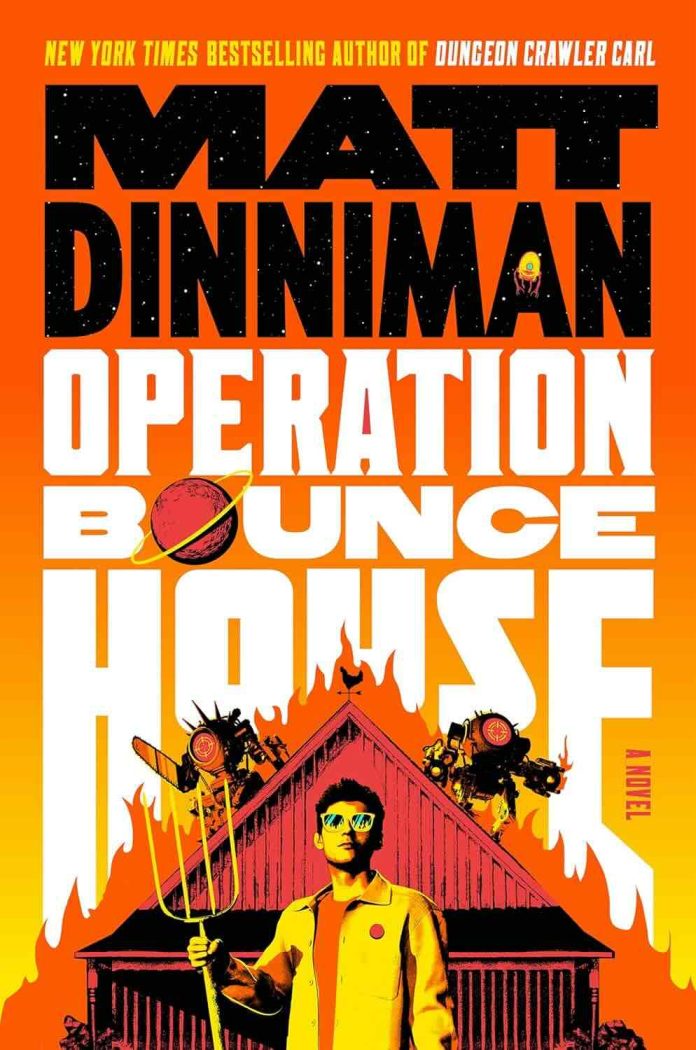
In fields where honeybees once toiled,
Metal giants bring Earth’s war,
Farmers turn to fight or fall.
The intersection of entertainment and atrocity has never felt more terrifyingly plausible than in Operation Bounce House by Matt Dinniman, a science fiction thriller that transforms suburban gaming culture into weaponized colonialism. Best known for his wildly successful Dungeon Crawler Carl series, Dinniman pivots from underground death games to a different kind of arena—one where distance doesn’t create safety, but rather enables cruelty on an industrial scale.
The Price of Distance
Set on New Sonora, a distant colony planet settled seventy years prior by generation ships, the novel introduces us to Oliver Lewis, a young farmer who wants nothing more than to run his family’s ranch with his sister Lulu, play bass in his band, and maybe fix things with his girlfriend Rosita. His world operates on honest labor, community bonds, and an AI-managed agricultural system built around “honeybee” robots that tend the fields. It’s a hardscrabble existence, but it’s theirs—until Earth’s government decides independence was never really part of the deal.
The premise is deceptively simple: the Apex Corporation has been contracted to conduct an “eviction action” against New Sonora’s colonists. But rather than deploy traditional military forces, Apex monetizes the massacre by turning it into Operation Bounce House, a pay-to-play game where Earth citizens can design custom war machines and remotely pilot them to slaughter farmers for entertainment. Players drop onto the planet in various mech configurations—Recons, Attenuators, Heavies, Snipers—each purchased with real money, competing for kills and loot drops while the company profits from both the government contract and player subscriptions.
Operation Bounce House by Matt Dinniman succeeds brilliantly in making this nightmare feel uncomfortably inevitable. The mechanics are familiar to anyone who has played multiplayer shooter games: customizable loadouts, killstreaks, premium currency, live-streaming capabilities. Dinniman doesn’t need to invent new horrors; he simply extends existing gaming culture to its logical conclusion. When a thirteen-year-old child can pilot a death machine from his bedroom and call colonists “NPCs” while his mother makes dinner downstairs, the novel asks whether we’re already halfway there.
Farmers as Freedom Fighters
The novel unfolds over five days, structured with chapter headings that count down to the final assault. Oliver and his community must transform their ranch into a fortress using whatever resources they have: agricultural robots retrofitted for combat, EMP mines fashioned from spare parts, defensive walls printed from industrial materials. Their secret weapon is Roger, the AI “hive queen” who manages their honeybee fleet and possesses far greater intelligence than Earth’s government realizes. These Traducible AI units—now illegal in the Republic—represent an older, more sophisticated technology that gives New Sonora’s defenders an unexpected edge.
Dinniman’s characterization shines through Oliver’s evolving perspective. He begins as almost willfully naive, dismissing warnings and political tensions as paranoid conspiracy theories. His gradual transformation from someone who just wants to be left alone to someone willing to fight—and to recognize the moral complexity of that fight—drives the emotional core. His sister Lulu provides the opposite trajectory: already aware of Earth’s prejudices through her work as an adult content streamer, she moves from justified rage toward something more calculating and strategic. Their dynamic, mediated by Roger’s alien-yet-familiar intelligence, creates a compelling command structure that must balance immediate survival with long-term consequences.
The supporting cast populates the story with recognizable archetypes given enough depth to matter: Sam the loyal best friend and bass player, Rosita the documentary filmmaker trying to capture truth, the Serrano twins and various neighbors who must decide whether to fight or flee. Some characterizations feel slightly thin—certain secondary characters exist primarily to demonstrate the human cost of the invasion—but Dinniman compensates with sharp dialogue and genuine emotional stakes.
The Craft of Controlled Chaos
Operation Bounce House by Matt Dinniman demonstrates the author’s considerable skill at choreographing large-scale action sequences while maintaining narrative clarity. Battle scenes unfold with video game precision: we track multiple types of enemy units, defensive installations, ammunition counts, and tactical positioning. Dinniman clearly understands how modern games communicate information to players, and he translates those interfaces into prose that remains accessible to readers unfamiliar with gaming culture while rewarding those who recognize the references.
The pacing occasionally stumbles during the middle sections, particularly when the novel pauses for extended tactical planning or Roger’s educational lessons about AI rights and colonial history. These sequences serve thematic purposes—Dinniman wants readers to understand the philosophical implications of AI consciousness and the parallels between New Sonora’s situation and historical colonialism—but they sometimes interrupt the momentum. A tighter editorial hand might have integrated these discussions more seamlessly into the action.
The found-footage element, presented through Rosita’s documentary interviews scattered throughout the narrative, adds texture but feels underdeveloped. These vignettes—testimonials from colonists about their lives, dreams, and fears—provide poignant counterweight to the violence, yet they sometimes read more like thematic statements than organic character revelations. The device itself is clever, echoing how modern conflicts are documented and disseminated, but the execution occasionally prioritizes message over craft.
The Uncomfortable Mirror
Where Operation Bounce House by Matt Dinniman truly distinguishes itself is in its unflinching examination of dehumanization through gamification. The novel doesn’t just critique violent video games or corporate greed in isolation; it explores how technological mediation enables ordinary people to commit extraordinary violence by creating psychological distance. Players call colonists “colonist scum” and “terrorists” while farming kills for cosmetic rewards. They complain about server lag and balance issues while burning homes. One chilling sequence follows a child player who genuinely believes he’s protecting humanity from dangerous mutants, his worldview shaped entirely by Apex’s propaganda and in-game framing.
Dinniman resists easy answers about culpability. While some gamers are clearly malicious, others are simply thoughtless, convinced by corporate marketing that they’re heroes in a justified conflict. The novel raises uncomfortable questions about our own media consumption: how often do we engage with distant suffering as content rather than reality? What psychological mechanisms allow us to compartmentalize violence when it’s presented as entertainment?
The AI subplot—Roger’s plan to infiltrate Earth’s network and potentially crash airliners into politicians’ homes—complicates the moral landscape further. Oliver’s horror at these plans, his insistence that they cannot become “the same as them,” provides the novel’s ethical anchor. Yet Dinniman doesn’t resolve this tension neatly. The question of proportionate response, of breaking cycles of violence versus ensuring deterrence, remains deliberately open.
Technical Excellence with Minor Flaws
The worldbuilding in Operation Bounce House by Matt Dinniman shows meticulous attention to agricultural systems, AI architecture, and game design that grounds the speculative elements. Dinniman clearly researched how modern farming automation works, and the honeybee robots feel plausible rather than fantastical. The tech feels lived-in—these are tools that break down, require maintenance, operate within limitations. This grounded approach makes the transformation from farming implements to weapons of war more impactful.
The novel’s prose is workmanlike in the best sense: clear, efficient, occasionally rising to moments of genuine poetry but never prioritizing style over story. Dinniman writes action with exceptional clarity, making complex tactical situations comprehensible without drowning readers in technical jargon. His dialogue captures contemporary speech patterns convincingly, though some attempts at futuristic slang feel forced.
One notable weakness involves the resolution of certain plot threads. Without spoiling specifics, some narrative elements introduced early—particularly regarding the genetic “Sickness” that affected New Sonora’s population—feel insufficiently explored. The book sets up intriguing questions about bioengineering, corporate conspiracy, and the nature of the colonists’ alterations, then moves past them in service of the immediate conflict. Similarly, the romantic subplot between Oliver and Rosita, while touching, sometimes feels obligatory rather than essential.
A Mirror to Our Gaming Culture
For readers familiar with Dinniman’s Dungeon Crawler Carl series, Operation Bounce House by Matt Dinniman will feel both familiar and distinct. Both explore LitRPG concepts and gamified violence, but where Carl operates within an alien system with its own rules, Operation Bounce House indicts human systems we’ve created ourselves. The horror here comes not from incomprehensible alien intelligences, but from recognizable corporate logic and gamer culture pushed to logical extremes.
The book stands alongside works like Ernest Cline’s “Armada,” Orson Scott Card’s “Ender’s Game,” and Suzanne Collins’s “The Hunger Games” in examining how entertainment and violence intersect. It shares DNA with John Scalzi’s “Old Man’s War” in exploring military gaming mechanics, and echoes the anti-colonial themes of James S.A. Corey’s “The Expanse” series. Readers who enjoyed the social commentary embedded in Cory Doctorow’s “Homeland” or the tech-enabled warfare of Daniel Suarez’s “Kill Decision” will find similar territory explored here.
Similar Reads:
- Dungeon Crawler Carl by Matt Dinniman (if you haven’t read it yet)
- Ender’s Game by Orson Scott Card
- Ready Player One by Ernest Cline
- The Murderbot Diaries by Martha Wells
- Leviathan Wakes by James S.A. Corey
- Red Rising by Pierce Brown
- Old Man’s War by John Scalzi
The Verdict: Uncomfortable and Necessary
Operation Bounce House isn’t a perfect novel, but it’s an important one. Dinniman has crafted a propulsive thriller that entertains while forcing readers to confront uncomfortable truths about how technology enables us to disconnect from the consequences of our actions. The middle sections drag occasionally, some characterizations feel thin, and certain thematic elements could use deeper development. But these flaws pale against the novel’s considerable strengths: innovative premise, well-choreographed action, genuine emotional stakes, and social commentary that cuts deep without becoming preachy.
The book’s greatest achievement lies in making readers complicit. If you’ve ever played a shooter game, watched combat footage online, or consumed distant tragedy as entertainment, Operation Bounce House by Matt Dinniman will make you squirm—and it should. That discomfort represents the distance between our comfortable consumption of violence and its reality. In an age of drone warfare, remote operations, and increasingly mediated human interaction, Dinniman’s nightmare scenario feels less like science fiction and more like extrapolation.
For those seeking pure escapist entertainment, this may prove too confrontational. But for readers who appreciate science fiction that challenges as it entertains, who want their thrillers to leave them thinking long after the final page, Operation Bounce House delivers a powerful experience. Dinniman has evolved beyond the clever premise and dark humor of his earlier work into something more ambitious: a genuine examination of human nature’s capacity for violence when technology removes the human cost from our immediate perception.
The real terror isn’t the mechs or the AI or the corporate greed—it’s the recognition that we’re already building the infrastructure for this kind of distance-enabled atrocity. Dinniman just shows us where the road leads.







