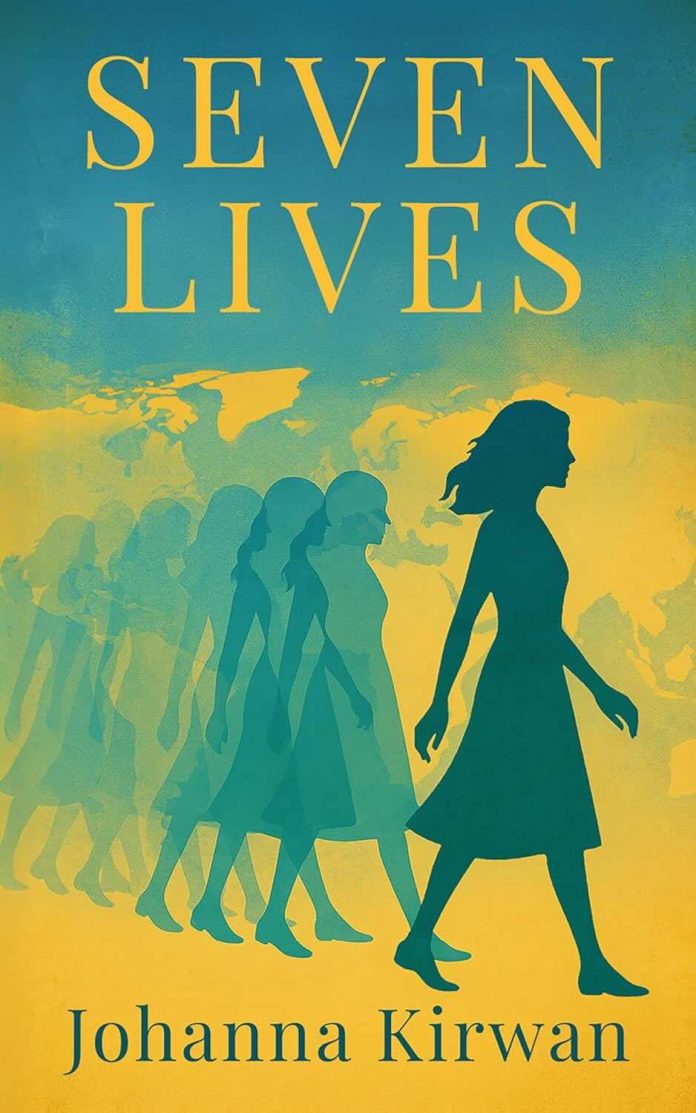
There is a particular kind of loneliness that belongs to women who choose to live far from everything familiar, not because they are running away, but because something deep and unnamed pulls them toward a life of purpose in places where purpose comes wrapped in dust, danger, and moral ambiguity. Seven Lives by Johanna Kirwan inhabits this loneliness with such quiet authority that you feel it settle into your bones long before the final page.
This debut novel, published in 2025 by Fire & Feather Publishing, traces the intersecting paths of seven women across three decades of humanitarian and development work, spanning Nepal, South Sudan, Lesotho, Pakistan, Egypt, the United States, and the Philippines. It is not a novel that shouts. It whispers, and those whispers carry the weight of entire continents.
The Architecture of Seven Parallel Worlds
What makes Seven Lives by Johanna Kirwan so structurally compelling is its refusal to follow a single protagonist. Instead, Kirwan constructs seven discrete yet interconnected narratives, each named for a woman, each rooted in a specific country and era.
Nancy arrives in Nepal in 1979, a slightly overweight, endearingly uncertain English engineer who trades her government desk in Watford for the dusty temples of Kathmandu. Lisa lands in the war-scarred terrain of South Sudan in the mid-1980s, stepping off a Twin Otter plane into a landscape where even the airport is little more than a hut. Marie Louise navigates the stark beauty and hidden violence of Lesotho. Rebecca, painfully shy and luminously beautiful, finds her voice amid the ornate carpets and complex politics of Pakistan. Anna confronts mortality in its most brutal forms in Egypt. Geeta wrestles with the collision of career ambition and personal longing in post-9/11 New York. And Patricia, perhaps the most seasoned of them all, closes the circle in the Philippines, where typhoons are only the most visible of the storms she must weather.
Each section functions almost as a novella unto itself, yet Kirwan weaves a connective thread through all seven: these women first meet at the Institute of Development Studies in Brighton in 1979, young and hungry for a world larger than the one they were born into. They scatter across the globe, and the novel follows them as they are transformed, challenged, and in some cases, broken by the very work they believed would give their lives meaning.
The Emotional Archaeology of Aid Work
The true achievement of Seven Lives by Johanna Kirwan lies not in its geographical sweep, impressive as that is, but in its emotional excavation. Kirwan, who herself spent over three decades in international development working for the UN and NGOs, writes with the unmistakable authority of someone who has lived inside the contradictions she portrays. This is not development work as seen from the outside, sanitized and noble. This is the view from the inside: the moral compromises, the bureaucratic absurdities, the relationships sacrificed on the altar of career, and the slow, corrosive realization that the systems designed to help are sometimes entangled in the very power structures they claim to dismantle.
Consider how Kirwan handles the theme of institutional failure. Through Nancy, we watch a well-designed sanitation project collapse when border customs officers demand bribes and the government refuses to intervene. Through Patricia, we witness the ostentatious UN office building in Manila’s wealthiest district, a headquarters dedicated to addressing poverty yet perched in opulence. These are not didactic lectures; they are lived moments, rendered with the understated frustration of someone who has swallowed that bitter pill many times.
The novel’s treatment of gender is particularly incisive. Kirwan does not belabor the point, but it hums through every chapter like an underground current. The foreword states it plainly: a man in this field is often accompanied by a partner, a quiet infrastructure of support, while a woman who chooses to do it alone is expected to carry everything herself. That observation ripples through every story, from Geeta’s agonizing choice between a career she has built from nothing and a love she did not expect, to Patricia’s reflections on how women over fifty are quietly sidelined by the very institutions that once celebrated their ambition.
A Prose Style That Trusts the Reader
Kirwan writes with a clarity that feels almost documentary at times, yet never clinical. Her prose carries a quiet warmth, an observational patience that allows scenes to breathe. She is especially gifted at capturing the sensory texture of place: the red dust that coats everything in Juba, the carved wooden temples of Kathmandu crumbling with age and beauty, the suffocating heat on the road to Luxor moments before gunfire shatters the air.
What is most admirable about the writing in Seven Lives by Johanna Kirwan is its restraint. Kirwan does not sentimentalize suffering, nor does she dramatize danger for its own sake. When violence arrives, it arrives as it does in life: suddenly, absurdly, without the dramatic foreshadowing that fiction usually affords. The aftermath lingers far longer than the event itself, which is precisely how trauma works.
The dialogue, too, deserves mention. It carries the slightly formal, careful quality of people who have spent years communicating across cultures and languages, people who have learned to measure their words because a misplaced phrase can mean something entirely different in a room full of diplomats, drivers, and government counterparts.
What This Novel Does That Few Others Attempt
Several qualities distinguish this book from the broader landscape of literary fiction:
- Authentic insider perspective that transforms what could have been a surface-level portrayal of aid work into a deeply textured, morally complex narrative drawn from decades of lived experience.
- A structural ambition that gives equal weight to seven distinct voices without letting any single story dominate or diminish the others, creating a mosaic rather than a hierarchy.
- Unflinching honesty about the personal toll of humanitarian careers, particularly for women, examining everything from failed relationships and cultural isolation to the quiet grief of watching colleagues die and communities remain unchanged despite billions invested.
- A refusal to offer easy conclusions, letting the reader sit with the tension between idealism and disillusionment without rushing toward redemption or despair.
The Epilogue That Earns Its Weight
The novel’s epilogue reunites the surviving women in Brighton, decades after their first meeting, and it is a masterclass in restrained emotion. They have aged, shifted, lost. One among them is absent, mourned with a raised glass and a silence that says more than eulogy. Seven Lives by Johanna Kirwan earns this final gathering because we have walked the dusty roads, survived the gunfire, and endured the loneliness alongside each of these women. The reunion is not a tidy resolution; it is a reckoning, and a farewell, and the quiet admission that the life they chose was both the making and the unmaking of them.
For Readers Who Hunger for These Worlds
If Seven Lives by Johanna Kirwan resonates with you, consider exploring these kindred works:
- The Poisonwood Bible by Barbara Kingsolver, for its sweeping portrayal of Western idealism colliding with African realities through the eyes of women
- Emergency Sex (and Other Desperate Measures) by Kenneth Cain, Heidi Postlewait, and Andrew Thomson, a raw non-fiction account of humanitarian workers in the field
- The Ministry of Utmost Happiness by Arundhati Roy, for its sprawling, multi-voiced narrative spanning decades and continents
- Cutting for Stone by Abraham Verghese, for its rich cultural immersion and the personal cost of lives lived in service
- The Shadow of the Sun by Ryszard Kapuscinski, for its deeply personal journalism from the African continent
- Small Great Things by Jodi Picoult, for its examination of systemic injustice through intimate personal narratives
Final Reflection
This is a debut novel, and that fact alone is remarkable given its scope and assurance. Kirwan has spent decades accumulating the knowledge, the grief, the wonder, and the disillusionment that fuel these pages. One senses that this book had to be written, not because the market demanded it, but because the stories demanded release. In an era of development narratives that are either relentlessly optimistic or performatively cynical, this novel occupies the honest, aching middle ground where most of the real living happens. It is a book about women who arrived in distant countries with suitcases full of good intentions and returned, years later, carrying something heavier and more valuable: the truth of what it costs to care.