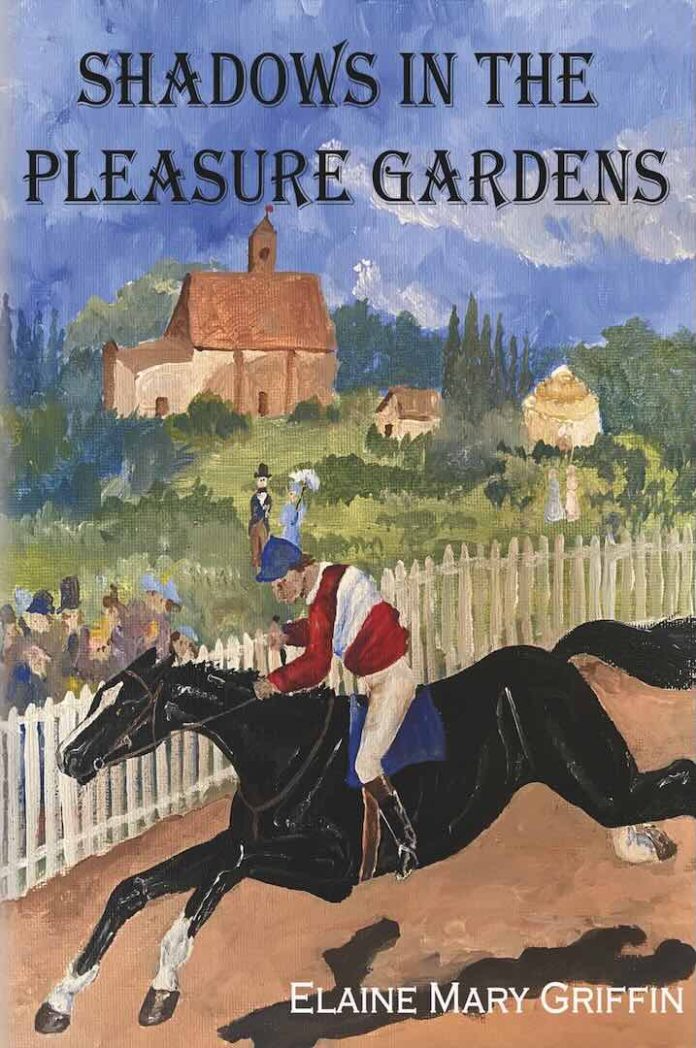
The summer heat hangs heavy over early nineteenth-century Fairmount, and with it comes a tale that unfolds like the lengthening shadows across a well-worn racetrack. Elaine Mary Griffin’s debut novel, Shadows in the Pleasure Gardens: Regarding Robberies and Racehorses, transports readers to a world where bank notes change hands as quickly as loyalties, where the thunder of hooves provides momentary escape from life’s pressing questions, and where a young man discovers that the path to purpose rarely runs straight.
An Unconventional Coming-of-Age Tale
At its heart, this novel follows Chester Carter, a self-described unambitious young man apprenticing at Tate’s Banking and Loans in the quiet village of Fairmount. Chester himself might argue that he is not unambitious but rather independent-minded, a distinction the narrative explores with considerable nuance. When he witnesses a brazen daylight robbery committed by men disguised with war paint, Chester finds himself thrust into an investigation that will upend every comfortable assumption he has about his future.
What makes Chester such a compelling protagonist is his ordinariness. He is neither hero nor hapless fool, but something far more recognizable: a young person caught between the expectations of family, society, and his own restless heart. Griffin renders him with such warmth and authenticity that readers will find themselves rooting for him even as they occasionally wish to shake some sense into his stubborn head.
The Pleasure Gardens Come Alive
The titular pleasure gardens emerge as more than mere setting; they become a character unto themselves. Griffin paints the horse racing grounds with such vivid detail that readers can practically feel the dust settling on their clothes and hear the distant call of the bugler signaling the next race. The contrast between Chester’s stifling existence behind the bank counter and the raw vitality of the racetrack illuminates the novel’s central tensions with remarkable clarity.
What distinguishes Griffin’s portrayal of this world is her evident expertise in equestrian matters. The author’s background as both an attorney and an avid horsewoman informs every scene involving the animals. When she describes the particular way a horse’s eye might show white like a person’s eye, or the precise choreography of saddling a racehorse with three men working in concert, readers sense the hand of someone who has spent countless hours in barns and paddocks.
Authentic Period Voice and Narrative Structure
Griffin demonstrates considerable skill in crafting a narrative voice that feels genuinely of its period without becoming impenetrable to modern readers. Chester’s distinctive speech patterns, peppered with regional dialect and period expressions, create an immersive reading experience. The conversational prose flows naturally, maintaining accessibility while preserving historical authenticity.
The novel’s framing device proves particularly effective. Counselor Lindsay Worthingham’s prologue establishes that what follows is Chester’s own written account of events, a memoir that the lawyer describes as far longer and more personal than the simple legal affidavit he originally requested. This meta-narrative layer adds depth, reminding readers that they are experiencing events filtered through Chester’s particular consciousness, with all its biases and blind spots intact.
Themes That Transcend Time
While firmly rooted in its historical setting, Shadows in the Pleasure Gardens explores themes that resonate across centuries. The novel examines:
- The tension between truth and loyalty as Chester grapples with testimony that might condemn someone he has come to consider a friend
- The pressure to conform to societal expectations whether in pursuing a respectable banking career or maintaining proper courtship rituals
- The corruption that can lurk beneath polished surfaces in legal proceedings where the powerful protect their own
- The search for authentic purpose as Chester discovers that the professional path laid before him may not be the one he wishes to walk
- The escape that horses provide from the constraints and complications of human society
These thematic concerns never feel heavy-handed. Griffin weaves them organically through the narrative, allowing them to emerge naturally from Chester’s experiences rather than forcing didactic moments upon the reader.
A Rich Supporting Cast
The novel’s secondary characters are drawn with considerable care. Sheriff Hoogkirk emerges as an affable figure whose folksy demeanor conceals a sharper investigative mind than first appears. The Drink family, particularly the enigmatic Berton and his spirited sister Corrine, bring the world of the pleasure gardens to vivid life. Mr. Tate, Chester’s employer, represents the professional world that both beckons and repels our protagonist. Each character, from the toothless stable hand Green Gene to the formidable Counselor Worthingham, contributes meaningfully to the narrative tapestry.
The romantic elements, too, are handled with a light touch. Chester’s relationships with the women in his life, including the refined Alida and the intriguing Rebecca, add dimension to his character without overwhelming the central narrative.
Legal Authenticity Shines Through
Griffin’s background as an attorney proves invaluable in the novel’s courtroom sequences. The trial scenes crackle with authenticity, from the precise rhythms of examination and cross-examination to the procedural maneuvers between prosecution and defense. Legal terminology is deployed accurately but never overwhelms the narrative. Concepts like attorney-client privilege, witness tampering, and the presumption of innocence become plot elements rather than mere window dressing.
For Readers Who Appreciate Historical Fiction
Those who enjoyed the following works will find much to appreciate in Shadows in the Pleasure Gardens:
- True Grit by Charles Portis, for its distinctive period voice and coming-of-age narrative
- The Name of the Rose by Umberto Eco, for its blend of mystery and atmospheric historical setting
- Seabiscuit by Laura Hillenbrand, for its immersive depiction of horse racing culture
- The Alienist by Caleb Carr, for its exploration of early American justice systems
- Barchester Towers by Anthony Trollope, for its wry observation of provincial society
Final Reflections
Shadows in the Pleasure Gardens succeeds on multiple levels. As a mystery, it maintains suspense while playing fair with readers. As a character study, it charts one young man’s growth with insight and compassion. And as historical fiction, it recreates a vanished world with admirable authenticity. Griffin proves herself a writer of considerable talent, and readers will eagerly anticipate whatever she produces next.
What lingers after the final page is not simply the resolution of Chester’s various predicaments but rather a meditation on the choices that define us. The novel suggests that purpose is not found but forged, that truth and loyalty need not always conflict, and that sometimes the dusty road away from everything we thought we wanted leads us precisely where we need to go.
For anyone seeking literary fiction that combines genuine historical atmosphere with timeless questions about identity and integrity, this novel comes highly recommended.







