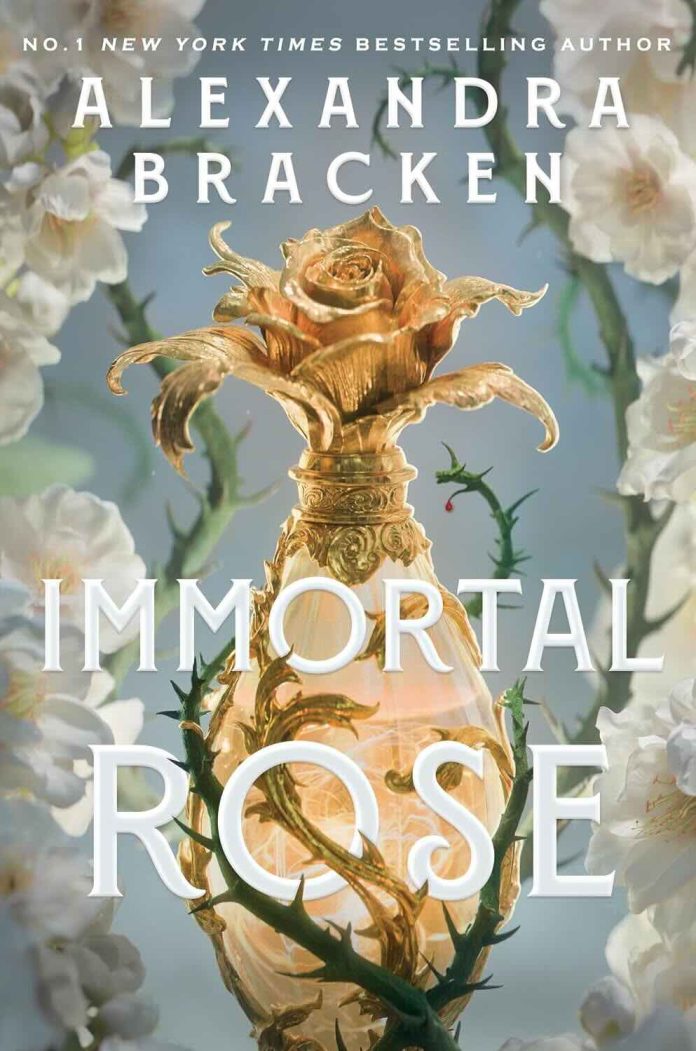
Viola Lockwood has strawberry curls shot through with streaks of white, and they are not a fashion. They are a receipt. In the world of Immortal Rose by Alexandra Bracken, a perfumer who blends magic into a bottle has to pay for it out of her own life, and the beauty perfume she sells to society matrons was bought with the colour of her hair. The luck charm cost her a fire in her room, a twisted ankle, a ruined dress and two market nights without a sale.
She sells these things at an illegal midnight market, because the law of Albion is simple: the nobility may keep fairy relics and buy fairy perfumes, and anyone else caught with a drop of magic goes to Fairgate Prison. Then a soldier with silver eyes and no scent at all catches her in an alley, and by the time she is hauled out of her cell she has a royal pardon on the table and a fortnight to recreate a perfume that has not existed for centuries.
A Magic System Made of Debt
The scent-work in Immortal Rose by Alexandra Bracken is the best invention in recent romantasy, and it does two jobs at once.
First, Viola smells emotion. Deceit is sour, like milk on the turn. Fear is wet fur. Guilt smells of rust, greed of minerals, lust of cinnamon. Everyone she meets arrives as a paragraph rather than a face: a solicitor betrayed by wig powder and one rotting tooth, a footman who smells of oil paints, a cook who smells of nightshade.
Second, and better, the blending itself is a transaction. Want a perfume that draws love? Someone gives up love. Want beauty? Someone gives up beauty. The family grimoire lists the trade beside each formula in a later hand, because the fairy plants that once supplied the magic for free are extinct and the bargains were invented to replace them. It is a rule with teeth, and it turns every errand in the plot into a question of what the heroine is willing to amputate.
Where Immortal Rose by Alexandra Bracken Actually Lives
Not, it turns out, in the romance, though the romance is perfectly good. It lives at Foxcourt House.
The earl who arrests Viola keeps a household slowly revealed to be something other than a household: a Deaf footman who signs with his employer and forges documents so well that a famous painter doubted his own memory; his brother, who has a gang tattoo a street child recognises on sight; a maid hired because magic does not work on her; a butler who faints; a cook and a housekeeper who married after a war spent trying to assassinate each other. There is a spaniel who will only eat from a palm, and only to a tragic fairy ballad.
They are funnier, stranger and more alive than the plot they are serving, and Immortal Rose by Alexandra Bracken knows it. A maid dresses down an earl for having a woman arrested and threatens to walk out. He apologises. That scene does more for the romance than any of the kissing.
What Works
- The prose commits to the conceit. Grief smells of snow. A house has an essence assembled from everyone who has lived in it. It could have been a gimmick and reads instead like a different way of being in a room.
- The banter is sharp and specific. An entire running joke turns on the earl being unable to work out the difference between two pieces of Regency street slang, and it pays off in the last place you would expect.
- The princess is the best character in the book. Sixteen, orphaned, publicly polite and privately steel, and the most satisfying turn in the last quarter is hers rather than either lead’s.
- The period is used, not decorated. Coverture, the marital settlement, the impossibility of divorce for a woman, the peerage’s exemption from arrest. The plot runs on real legal cruelty, not invented rules.
Where It Stumbles
For all that, Immortal Rose by Alexandra Bracken is not a lean book.
- It is 493 pages and roughly 380 pages of story. The middle is largely errands, coach rides and conversations restating the previous conversation.
- One refrain is worn to nothing. The heroine’s internal insistence that she will never want this man appears so often that its eventual collapse lands as relief rather than revelation.
- The villain is reported rather than met. He is genuinely frightening in his two big scenes, and for two hundred pages before them he exists only as other people’s warnings.
- The unmasking speech is stock. A late reveal is well seeded and cleanly earned, then delivered in a grievance monologue lifted from any number of lesser books.
The Last Hundred Pages Change the Book
Up to the final act this is an accomplished, slightly overlong Regency fantasy romance. Then Bracken reveals what the King’s restorative perfume is actually made of, and the thing turns genuinely cold.
The answer implicates a beloved dead character, recasts every warm scene in the house, and lands on a man who was once a child and whose life was spent keeping a monarch comfortable. The horror is specific rather than gothic: he cannot smell anything any more, which in this novel is closer to blindness than readers will expect, and which real medicine treats as a serious loss of the sense of smell rather than a curiosity. It is the moment Immortal Rose by Alexandra Bracken stops being decorative and starts being about who pays for other people’s beauty.
It also sets up a choice with only bad options, and the heroine makes it without flinching. That is the strongest writing in the book.
Who Immortal Rose by Alexandra Bracken Is For
Reach for it if you want romantasy with an actual system rather than vibes, if enemies to lovers plus a marriage of convenience is your exact order, or if you have followed Bracken from Lore and Silver in the Bone and want to see what she does with an adult register.
Skip it if you need a tight book, or if a slow burn that stays unconsummated for four hundred pages will frustrate you. Which brings us to the thing you should know before starting.
It ends on a cliffhanger. Not a gentle sequel hook. The final chapter breaks off on a line of dialogue with the antagonist at large, the true culprit free, one character’s survival unconfirmed and the heroine back where she began. No series name appears anywhere in the book. Go in knowing that.
Read These Next
If the household and the scent-work are what kept you in Immortal Rose by Alexandra Bracken, these go next.
- The Gentleman and His Vowsmith by Rebecca Ide. Regency, contract magic, a house full of secrets, and the closest match in tone.
- Emily Wilde’s Encyclopaedia of Faeries by Heather Fawcett. Cosier and drier, for the fairy scholarship rather than the blood.
- A Marvellous Light by Freya Marske. Edwardian rather than Regency, but the same pleasure in a magic system with paperwork.
- Silver in the Bone by Alexandra Bracken. Her own closest relative to this, and useful as a measure of how far the register has moved.
- The Night Circus by Erin Morgenstern. For readers who came for the sensory writing and would happily lose the plot entirely.
The Last Word on Immortal Rose by Alexandra Bracken
It is a rich, overstuffed book with one truly original idea and a supporting cast good enough to carry the stretches where the plot idles. The final act has a moral seriousness the first half never promises.
What it withholds is an ending, and that is a real cost rather than a quibble. Immortal Rose by Alexandra Bracken spends five hundred pages insisting that nothing beautiful comes without someone paying for it, and then hands the bill to the reader.







