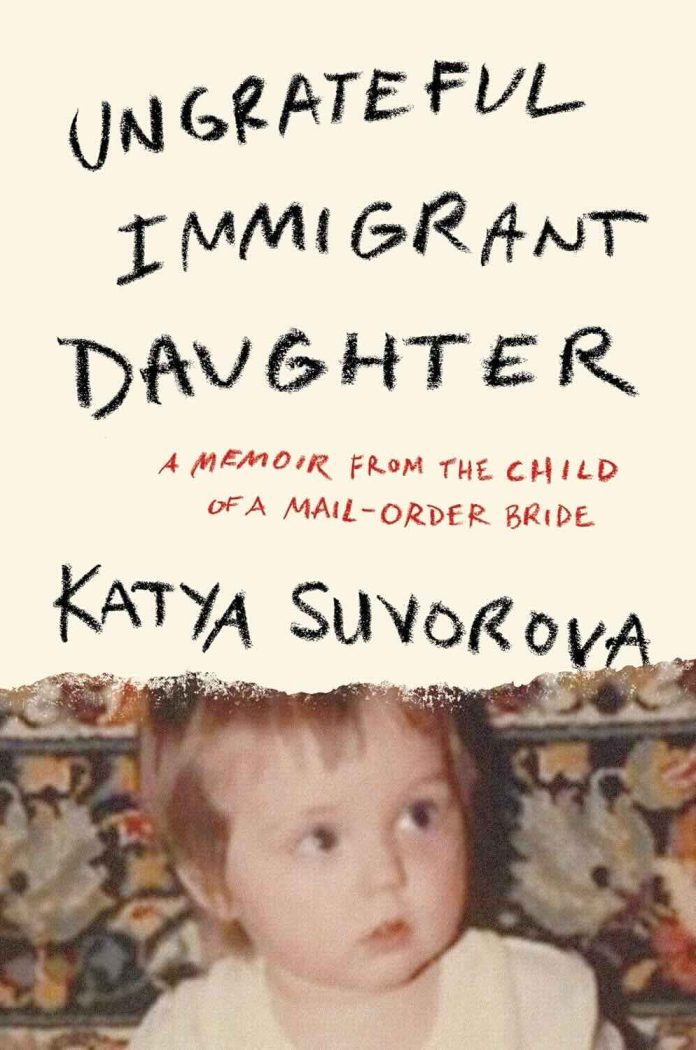
Every chapter of Ungrateful Immigrant Daughter by Katya Suvorova is stamped with its coordinates before a word of it begins: season, year, the narrator’s age, and her school grade. Fall, early 2000s, eight years old, third grade. It reads like housekeeping. It is the most consequential decision in the book, and once you notice what it is doing you cannot stop seeing it.
How Ungrateful Immigrant Daughter Is Built
Three hundred pages: an author’s note, a prologue, seven parts, sixty-odd titled chapters.
The author’s note is a content warning, a statement that the book is drawn from memory with details changed, and a list of the twenty-five pseudonyms in use. A reader knows, before the prologue, what is coming and how much has been masked.
Then two timelines, cut against each other for the whole length of Ungrateful Immigrant Daughter by Katya Suvorova. One runs from a Moscow airport in the late nineties, where a three-year-old is being pried off her grandmother’s legs, through Mexico, a border crossing, Idaho and Houston. The other is headed 2020, 2021, 2022, 2024, and begins with a woman in her late twenties clicking the add-friend button on her biological father’s profile during lockdown.
The Child’s Vocabulary
The childhood chapters of Ungrateful Immigrant Daughter by Katya Suvorova are in present tense, in the words the child actually had.
This is the technical achievement and it is harder than it looks. A woman is strangled in a kitchen and the seven-year-old holding her toddler sister cannot name it; her first guess is that the man might be about to kiss her mother. A five-year-old pushes a doll’s shoe up her nose, an ambulance is called over her mother’s objections, and that is how she learns, in shaky Russian, that they are not supposed to be here.
Suvorova almost never cheats by reaching forward for the adult word. She allows herself a sentence or two per chapter to say what she understood later. The gap between what the narrator can describe and what the reader can is where the effect lives.
The Second Timeline
The adult strand is not atmosphere. It is the question the childhood strand is asking.
The deepest subject of Ungrateful Immigrant Daughter by Katya Suvorova is not poverty or violence or immigration law, though it is about all three. It is being believed. By her account she disclosed what a stepfather had done when she was eleven and was told not to repeat it to the lawyers, because it would make her mother look negligent. At nineteen she reported him to the police to keep her sister out of his house, and the district attorney dropped it: the only evidence was her word, a decade on. Her mother’s own lawyer told her this happens all the time.
So the 2020s chapters, in which a father she was taught to think of as a monster turns out to have spent twenty years learning English against the chance of a call, are not an epilogue. They are the answer, withheld for two hundred pages.
Ungrateful Immigrant Daughter and the Word in Its Title
The title is not a slogan being reclaimed. It is the charge sheet.
Ungrateful is what two stepfathers call her, in her account, what her mother calls her, and what she spends Ungrateful Immigrant Daughter by Katya Suvorova frightened of being. Gratitude is the instrument everyone reaches for: be grateful for the citizenship, the house, the man who paid for it, the country that let you in. The counter-case is built rather than asserted. A school friend’s family, undocumented for longer and for the same reasons, mow lawns and clean houses while the narrator’s mother holds a desk job; when that friend’s father runs a stop sign he is taken to the border, and is still on the wrong side of it fourteen years later.
The book never says the quiet part and then rests on it. It lays the two families side by side and lets you finish the sentence. The law is sketched with the same restraint, including the provision under the Violence Against Women Act a woman in her mother’s position could have used, and, the adult narrator discovers, did eventually try.
Where Ungrateful Immigrant Daughter Thins Out
- The adult chapters sag in the middle. Several 2020 and 2021 sections are a conversation on a sofa in which the husband asks a well-aimed question and she answers it. Ungrateful Immigrant Daughter by Katya Suvorova does not need commentary; the childhood strand supplies its own.
- The mother is withheld exactly where the book needs her. We get the casino in post-Soviet Russia, the freezer, the massacre nobody reported. Then the reasoning stops. Why she refused the father’s offer to pay for college, why she cut off her own mother: asked, never answered.
- Sixty-odd chapters means some are two pages. A few land hard. Others repeat what the surrounding chapters established, and Parts 4 and 5 add nothing.
- The compulsion deserved more. The narrator counts the letters of her own thoughts on her fingers for most of a decade, needing them to land on the little finger. One of the best things here, retired in half a sentence about a diagnosis in college.
Read It If, Skip It If
Read it if:
- You want to see how much structural work a dateline can do.
- A grandmother is the kind of character you read for. Valentina peels bark off an American tree to prove Russian trees are sturdier, runs a lemonade business out of a Home Depot bucket with no cups, and is the only unambiguously good adult here.
- You like a morally unresolved teacher. A geography teacher decides this child is not stupid and hands her an advantage she has not earned, arguing that everyone else was born holding one. She felt like a fraud, wore the medals anyway, and became clever because she was treated as clever.
Skip it if:
- You need a memoir to arrive at forgiveness. This one ends in estrangement, stated plainly, with no reconciliation scene.
- The content notes below are a wall you cannot get over. They are not decorative.
Content Notes
The author’s own note to Ungrateful Immigrant Daughter by Katya Suvorova names rape, kidnapping and the physical and sexual abuse of a child, and that is the floor. The sexual abuse of a child by a stepfather runs across several chapters, told in the child’s vocabulary and without graphic detail, and the disclosure is suppressed by an adult. A rape occurs off the page, overheard by a child shut in a closet. Domestic violence throughout: strangulation, hair-dragging, objects thrown at a face, a woman locked in her own house. An adult strikes a teenager and denies it. Neglect: a four-year-old alone overnight, a seven-year-old made responsible for a toddler, untreated lice, hunger. Self-harm, including a scene in which a girl asks a friend to cut her. Suicidal ideation and one overdose. Two coerced terminations, described obliquely. Parental alcoholism and drunk driving with a child aboard; cocaine use; an unnamed eating disorder. Immigration detention and deportation. Racist speech from family members, and anti-immigrant abuse at school. A pet’s death on the page.
Read These Next
Five of ours for readers who finish Ungrateful Immigrant Daughter by Katya Suvorova.
- How to Lose Your Mother by Molly Jong-Fast is the nearest neighbour on the difficult-mother shelf.
- The River’s Daughter by Bridget Crocker solves the same disclosure problem differently.
- On Earth We’re Briefly Gorgeous by Ocean Vuong if the immigrant child writing to the immigrant parent is your thread.
- I’ll Tell You When I’m Home by Hala Alyan for displacement with comparable formal nerve.
- The biographies and memoirs worth reading once.
Worth Your Shelf
The last chapter is set in an airport, which is where the first one was set, and the symmetry is earned rather than arranged. Between them sit three hundred pages in which almost every adult who could have helped did not. The two who did were a grandmother on a three-month visa and a teacher who bent a rule.
This is a debut, and it shows wherever the argument gets spoken aloud instead of built. It also does the thing this kind of memoir most often fails at: it refuses to let a reader round the narrator’s age up. She was three and a half at the airport, seven on the worst day, ten when a household became her job. The chapter headers will not let you forget it, and that is why the book works.







