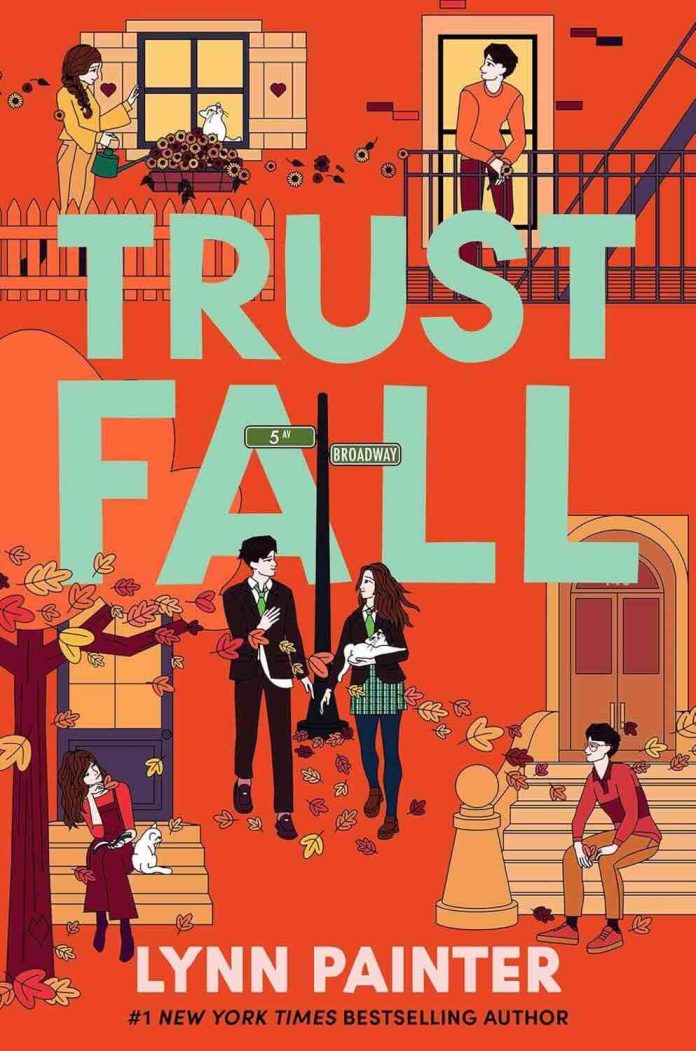
A silver-haired stranger in an expensive suit knocks on a house in Springfield, Nebraska, and the seventeen-year-old who answers the door is holding an ice cream bucket, because she has spent the afternoon in an emergency room arguing with a cashew. That is page one of Trust Fall by Lynn Painter, and it is fair warning about the three hundred and seventy-one that follow: the machinery is going to be enormous, and the girl operating it is going to be funny about it.
What Trust Fall Inherits
The housekeeping first, because the catalogue is confusing.
This is a standalone. Painter’s shelf does contain a genuine pair, so the instinct to treat any new title as the second half of something is reasonable, and wrong here. Nothing in the text, the copyright page or the also-by list ties it to another book. Start cold.
What it does inherit is a frame. Painter is running Edith Wharton deliberately. The Age of Innocence is named, costumed and danced at, and she borrows Wharton’s actual subject rather than her furniture. The question is not who ends up with whom. It is what a closed society does to someone who wants the wrong thing out loud.
The Will, and Its Two Conditions
Remington Rutledge, known to one Nebraska family as the strange rich old man who turned up every summer, dies and leaves them a house on the Upper West Side.
There are two conditions. The family must live in it for six months, and the twins, Julia and Liam Lowell, must enrol at Gardenwood Academy, Remi’s old school. Bernard Elizando, the executor, delivers this with the air of a man who knows a great deal more than he intends to say, and keeps that air for four hundred pages.
The person who expected the house is Damion Rutledge, Remi’s great-nephew, a Gardenwood senior whose father promptly files to contest the will on the grounds that the old man was not in his right mind. So the romance in Trust Fall by Lynn Painter begins with the two leads on opposite sides of active litigation, which is a cleaner engine than most of the genre bothers to build.
The Wallet Comes Before the Girl
Here is the thing the book is cleverest about.
Damion ends up holding Julia’s dropped wallet before he has met her, and spends too long looking at the photograph inside, which shows a girl laughing with a pile of dogs. By the time he meets the original, he has already fallen for the picture, and his immediate response is to be appalling to her. She breaks his nose for it.
That sequence does real structural work. It makes his early cruelty legible as panic rather than villainy, and it gives the book its one proper rhyme: a moment near the end that lands only because the opening set it up without announcing itself. Painter also never lets him explain it. He narrates half the book in first person and manages not to say the obvious thing for three hundred pages, which is accurate to eighteen and maddening to read.
Trust Fall by Lynn Painter and the Gardenwood Season
The middle is a season, in the social sense, and these are its working parts.
- Fifty-eight epigraphs. Two prologues, fifty-five chapters and an epilogue, and every single one opens with a one-line fragment attributed to Remington. He never gets a chapter. He gets the first word every time.
- Dual first person, almost evenly split, twenty-eight sections for Julia and twenty-nine for Damion, with italicised interior thought running underneath his dialogue as a second channel, saying the opposite.
- Skins and Toms, Gardenwood’s vocabulary for the money and the legacy, against which Julia is New Money and the Corn Queen.
- Secret maths tutoring. She needs the test section; he is the best tutor in the school and cannot be seen doing it. This is the furnace of Trust Fall by Lynn Painter and it runs for two hundred pages.
- A costume ball at the Cloisters, Julia in red, Damion dressed as Wharton’s blank canvas in white, and a process server in the room.
- Nebraska. A fishing cabin, a rowboat, a cornfield, a pickup truck driven out of it, and a trellis.
Where Trust Fall Gives Ground
- The premise does not survive questioning. A will that compels a family of four to relocate across the country and enrol two teenagers in a named private school is a plot engine, not a legal instrument. Bernard’s real job is deflecting the obvious objections.
- Sixty pages too many. The middle third keeps establishing the same two facts: the rich are cruel, and these two cannot stay away from each other.
- The bullying is dropped. The Skins and Toms apparatus arrives with teeth and quietly stops mattering. Nobody answers for it, and Julia is never made to decide what she thinks of the people who did it.
- The public humiliation is settled cheaply. Julia says the single worst available thing to Damion, in front of the people who have been saying it to him all year, and Trust Fall by Lynn Painter treats the episode as a wound he has to apologise for. The asymmetry goes unexamined.
Read It If, Skip It If
Read it if:
- You want the inheritance structure as much as the kissing. The estate plan is the most interesting character in Trust Fall by Lynn Painter.
- A hidden-softness trait that actually carries plot appeals. Damion’s birding is a dead man’s hobby, a career his father will not fund, and the content of the last gift.
- You like a sibling who is a person. Liam has his own friendships, the two best lines in the book, and the hand on the climax.
Skip it if:
- You need your contemporary romance under three hundred pages.
- Social cruelty introduced and then abandoned is the kind of loose end that ruins a book for you.
Content Notes
Grief throughout, for a recently dead grandfather figure mourned on the page by both narrators. A severe nut allergy and an emergency-room visit. Sustained class-based bullying of a teenager, including jeering about her family’s money and her home state, and one scene of public humiliation. A punch between teenage boys, and a broken nose earlier. Teenage drinking at a party. Litigation against a bereaved family, and a process server at a formal event. A parent coercing a child over his education and career. Kissing and some heat, nothing explicit. The book also carries a dedication to a real young woman who died in 2026, which is not fiction and should not be read as such.
Read These Next
Five of ours for readers who finish Trust Fall by Lynn Painter.
- Fake Skating by Lynn Painter is the nearest neighbour on her own shelf, and the fairest comparison.
- The Inheritance Games by Jennifer Lynn Barnes for the other great young-adult novel built on an impossible will.
- I Could Give You the Moon by Ann Liang if the money and the class gap are what hold you.
- First and Forever by Lynn Painter for her voice at its most unguarded.
- Young adult book tropes worth knowing for the pattern map behind all of this.
What Stays With You
The epigraphs. Fifty-eight scraps of a man nobody in the book can ask a question of any more, arranged so that he comments on scenes he did not live to see. It is the only formal invention here and it does what a flashback structure would have done badly: by the last page you know the dead man better than you know most of the living.
And then the ending, which is better than the genre usually permits. Damion does not win. He gets a negotiated settlement from a father who has moved perhaps fifteen per cent, and he takes it, because that is the deal on offer. Trust Fall by Lynn Painter is sixty pages longer than it needs to be and drops a thread it should have carried, and it still understands something most teenage love stories refuse to: that the people who shaped you rarely capitulate, and a partial yes is sometimes the whole victory.







