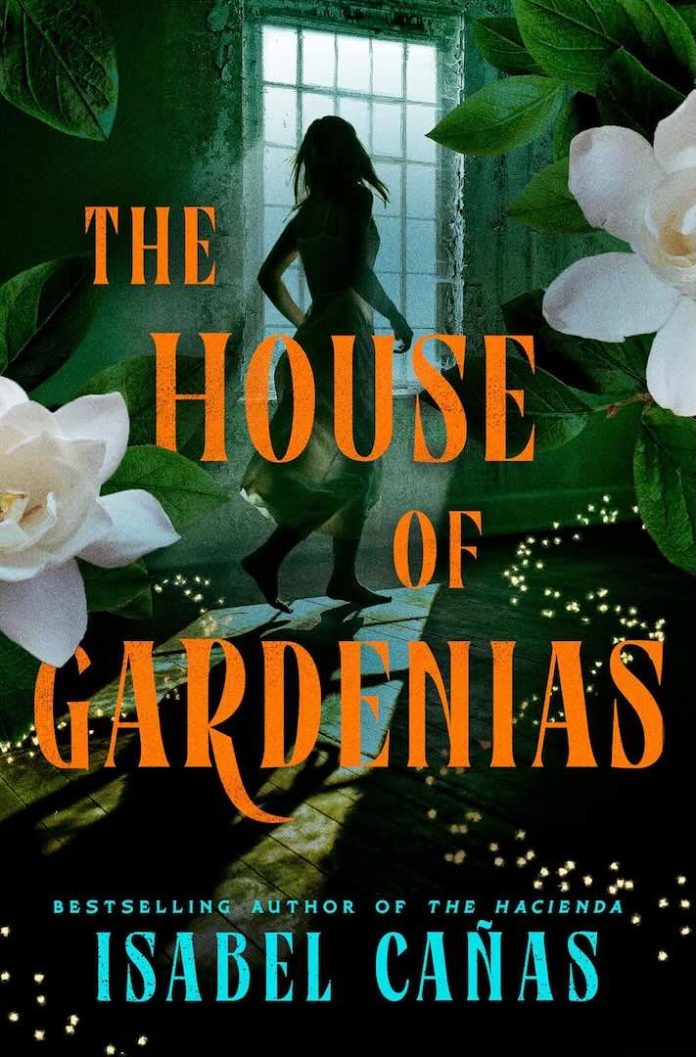
A sixteen-year-old from the Capital’s slums is handed a lamp. There is no wick and no oil, only a knob in the tarnished base, and when her employer turns it a golden butterfly lifts out of a trapdoor, beats its wings three slow times as though moving through water, and comes apart into pollen that settles into honey-coloured light. She grew up by candle and cooking fire. Her father goes down a mine before dawn to dig it out of the dark. The House of Gardenias by Isabel Cañas spends two hundred pages letting the reader enjoy those lamps before saying what is inside them.
What Isabel Cañas Puts in the Lamps
The substance is called chispa. It lights houses, heats bathwater, drives printing presses and fires guns, and it is why a Viceroy ruled this country at all. Nobody in the slums knows what it is. Childhood gossip says the breath of dead gods; Minerva’s older brother scoffs that it came out of the ground, made the Viceroy rich, and will always belong to the wealthy.
He is wrong, and the correction is the spine of the book. Chispa is human life. It sits in the chest from birth until burial, and the mine south of the Capital is not a mine. Every lamp on the smart end of town is somebody, pried out of consecrated ground and sold by the jar.
That single idea in The House of Gardenias by Isabel Cañas does enormous work. It makes the magic an extraction economy, the war a fight over a soul deposit, and the ghost both aggrieved and fed. And it reframes a hundred pages of small domestic pleasure, because the warm bath and the reading lamp and the glow the narrator falls asleep watching were all people. Cañas does not oversell it: the reveal arrives mid-argument, almost in passing.
The House of Gardenias by Isabel Cañas and Its Two Narrators
Two voices, named at the head of every chapter.
The first is Ygnacio, who narrates all of Part One in the present tense and talks directly to the reader, correcting their assumptions, promising that this is not where the story began at all. He is a ghost, tethered to the house, and he is hungry. His two tools are patience and nightmares. He spends the opening section choosing a human being to manipulate into murder on his behalf, and he tells us so.
The second is Minerva Treviño, first person past tense, who enters service with an elderly del Valle on Calle Jacaranda and is dragged up to the family stronghold when the army overthrows the president. She calls herself a coward and means it. Her gift, the novel says plainly, is fear.
What makes the pairing work is that Ygnacio is wrong about her, and we watch him be wrong in real time. He measures her in chapter one as underfed and submissive, a tool that will bend. By the midpoint she has him pinned against a tree with a butcher knife at his throat. He is not redeemed; he is made to want something other than feeding, which is harder to write.
The Old Woman at the Centre
The best character in the book is not either narrator.
Encarnación del Valle is old, half blind, imperious and spectacularly snobbish. She cackles at bad news about the elected government, and refers to the Capital’s dark-skinned majority, which includes the girl who dresses her, by a word the novel does not soften. Her family have abandoned her and she curses their portraits every morning over her chocolate.
She also buys Minerva a year’s worth of clothes and calls it nothing, leaves painkillers by her bed so the girl need not ask, insists she read aloud nightly because nobody in her house leaves cleverness to rot, and when Minerva’s father turns up to drag her home, puts her cane between them. She is the only person who has ever looked after this girl, and she is a monster’s cousin, and both are true at once.
The novel never resolves her, and refusing to is its most adult decision. Minerva’s loyalty to a woman who would have despised her in other circumstances drives everything that follows, and The House of Gardenias by Isabel Cañas is honest enough to call it both real and compromised.
Running underneath is a board game called Mice and Hounds. Pieces starting on white can only defend, pieces on green can attack, and the strategy is choosing which of yours are which. It is not predestined which piece has power, and the game returns at every hinge in the plot.
Where The House of Gardenias by Isabel Cañas Gives Ground
- One betrayal is unearned. A fellow maid gets warmth, a shared joke and a genuine friendship, then turns informer off the page. The preparation amounts to one turned back: the single moment where the plot needs something and takes it.
- Part One front-loads. Five chapters before the co-protagonist speaks for herself, and the second-person address is a device the novel abandons after Part Two.
- The three things in the attic never become anything. The most intriguing objects in the book, exhumed from the foundations and desecrated before a stone was laid, get two growls and a job.
- The last act’s geography is muddled. Hall, drawing room, stairwell and ballroom blur in a sequence that depends on knowing who is where.
Read It If, Skip It If
The House of Gardenias by Isabel Cañas is her first book for teenagers, and the move has not made her gentler.
Read it if:
- You want a magic system that is also an argument. This is the cleverest colonial-extraction conceit in recent fantasy.
- You can take a protagonist whose defining quality is fear, and who is allowed to stay frightened while doing brave things.
Skip it if:
- You need the ending of a young adult novel to be safe. This one is not.
- Slow, detailed deaths are something you avoid. There is one mid-book that runs for pages.
Content Notes
Sustained child abuse: a father’s belt, a child thrown against a wall, and a stepmother who counts the food and beats the narrator when a piece is missing. Starvation, scavenging in a dump, feral dogs. A sixteen-year-old groped by her employer’s son, with bruises on another girl’s neck implying worse. A poisoning described at length. Political murder, firing squads, disappeared persons, torture in a named prison, the rape of prisoners stated plainly and the forced adoption of their children, discussed as after-dinner conversation. A guard flogged until his back is raw. A person caged. A knife to a throat hard enough to break skin. A woman set on fire. A protagonist shot in the chest. Alcoholism throughout.
Read These Next
Five of ours for readers who finish The House of Gardenias by Isabel Cañas.
- The Possession of Alba Diaz by Isabel Cañas is her most recent adult novel, the fairest comparison.
- Bochica by Carolina Flórez-Cerchiaro for another Latin American house with a colonial grievance.
- Japanese Gothic by Kylie Lee Baker for a haunting with its own cultural logic.
- It Was Her House First by Cherie Priest on who a house actually belongs to.
- The Sisters of Crimson House by Melissa Anderson Sweazy for another building that watches.
What Stays With You
The image the book leaves is the butterfly. Chispa appears as one each time a lamp is lit, real ones drift through the gardens in cobalt and ruby, and in the last pages migrating monarchs arrive over an overgrown garden. The novel builds its metaphysics on a creature famous for travelling thousands of miles to a place it has never been, guided by something nobody can explain, then puts its characters in a house they cannot leave.
What makes that land is a piece of string. Seven knots tied in a thread and blessed with the wearer’s breath, passed to Minerva by a dead mother through a brother who is also gone, the thing miners wore into the dark. It is the only protection in The House of Gardenias by Isabel Cañas that works. And at the climax the same rite turns up in the hands of the people who built the house, scaled up, nailed to a floor, seven knots and seven points of light, chanted by a man whose family stole it along with the mountain. Cañas never explains. She puts it on the page and lets a fourteen-year-old work it out.







