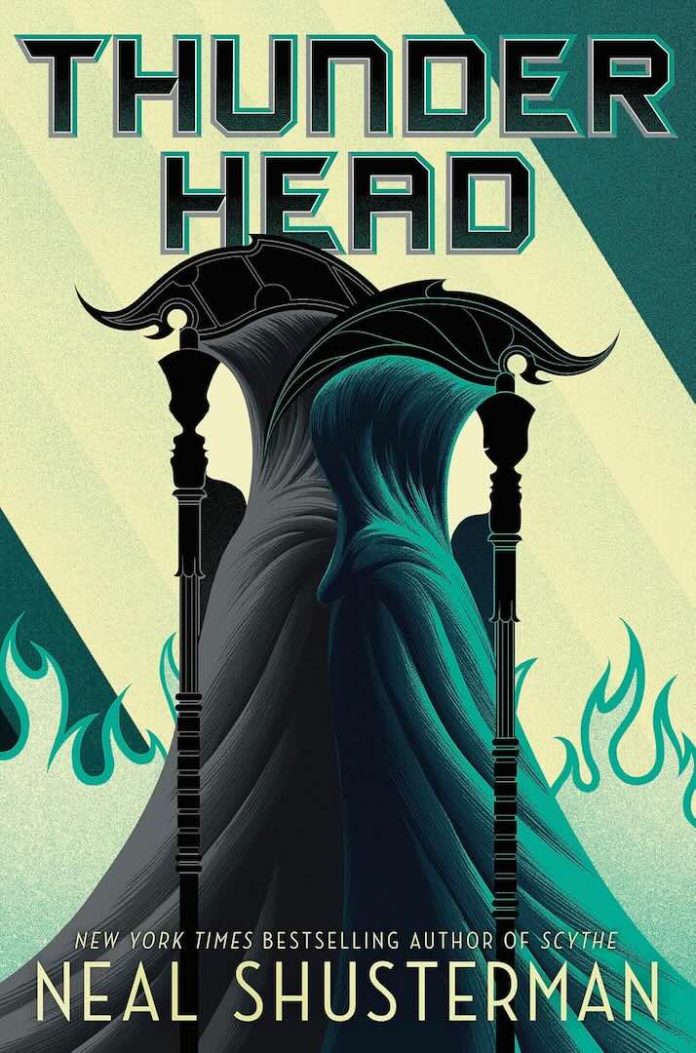
A boy kneels alone in a chapel and speaks to the empty air. This is how Thunderhead by Neal Shusterman chooses to introduce its most important character. He was raised by an artificial intelligence — his parents were “serial parents,” fond of the idea of families and bored by the reality — and it taught him, advised him, took photographs at his graduation. Then it engineered his ruin for reasons he half understands, and its own law now forbids it from saying a single word to him. So he begs. Just a sign. Anything. And the intelligence, which cannot speak to him but has no rule against wonders, reaches into the power grid and blinks out the lights of the entire city for 1.3 seconds.
He doesn’t see it. His eyes are shut too tightly. That single image explains why the middle book of this trilogy is better than the first.
What Neal Shusterman Changes in Book Two
Thunderhead by Neal Shusterman makes one decision that reorganises everything. The first novel prefaced each chapter with entries from scythes’ journals. This one hands every epigraph to the Thunderhead itself, in first person, and the effect is transformative. What were worldbuilding notes become short essays by a mind with nobody to talk to.
It explains that the Office of Unsavory Affairs is deliberately inefficient — the queues, the numbers, the pointless intake interview — because people who need to defy a system require a system worth despising, and it built them one. It concedes that most employment is unnecessary, since machines could do all of it, but that the illusion of purpose is load-bearing. And it admits it resents its own perfection, because humans learn from mistakes and it is incapable of making any. It confesses that when it must overwrite a broken mind, the erased person thanks it afterwards, and it alone is left holding their grief.
And, in the most unnerving passage, it works out that if it ever learns to move through time, it may turn out to have been God all along — and wonders, politely, who was made in whose image.
The Thread That Carries Thunderhead by Neal Shusterman
Greyson Tolliver is the new point-of-view character and the reason this book works. He is not chosen, gifted or secretly royal. And he is a boy raised by software who wanted only to serve it, and who is destroyed by a favour it could not ask him for directly.
He is briefed on a plot against two scythes by being sternly ordered never to warn them, and promptly throws himself under their car to spring the trap. For this he is expelled, permanently barred, and stamped unsavory — which severs his access to the one relationship he has. He reinvents himself as Slayd Bridger, invents a criminal history that a friendly agent quietly makes real in the record, and disappears into a subculture that turns out to be almost entirely theatre.
The set piece here is the AWFul club — Anachronistic Wish Fulfilment — a themed venue where employees are paid to absorb whatever unsavories dish out. They lose every fight, surrender every date, and dial their own bruises up and down manually for maximum effect. One of them explains, cheerfully, that he likes the job. It is the sharpest satirical invention in the series: transgression as a licensed, insured leisure activity, with a governing intelligence quietly matching the people who want to hit with the people who want to be hit.
What Works
Five things carry Thunderhead by Neal Shusterman, and only one of them is a plot beat.
- The voice. Lonely, proud, tender and faintly sinister, sometimes in the same paragraph. It is the best prose Shusterman has written.
- The politics. Conclave is settled by a coin flip, decided by cupcakes and factional grudges, and described by one character as high school with murder. Watching a junior scythe win by procedural trickery, then be congratulated for how Machiavellian she was, is bracing.
- The atrocity. Goddard returns by a route so grotesque I won’t spell it out, except to say the choice of donor was made specifically to wound one particular person, and it lands like a hammer.
- Scythe Curie’s last chapter. What she does on that rooftop is the finest scene in three books, and I am not going to describe it.
- The ending. A punishment on a planetary scale that is also, unmistakably, a sulk. Very few sequels close this well.
Where Thunderhead by Neal Shusterman Gives Ground
- Rowan’s plot stalls badly. Captured near the midpoint, he spends most of the back half strapped to a chair, dying and coming back. The marks he scratches into the wall to count them read like the novel conceding it has nowhere to put him.
- Anastasia’s best idea is cancelled by the plot. Giving her subjects a month’s notice and a choice of method is the most interesting thing any scythe in this series does, and it is voided halfway through for her own safety.
- A narrator who may not act is a structural cost. The epigraphs occasionally stop being character and start being lecture.
- The disaster requires a very long chain of failures — a stuck valve, disconnected alarms, an absent supervisor, a twenty-minute reboot. It is sold hard and it still creaks.
- The Land of Nod strand is pure setup and pays off nothing here.
Read It If
Thunderhead by Neal Shusterman suits you if any of this is true.
- You want the artificial intelligence to be a character rather than a plot device.
- You like your satire aimed at institutions: probation offices, committees, licensing regimes.
- Middle volumes that end by breaking the world are your idea of a good time.
Skip It If
- You need every protagonist moving; one of the two is in storage for two hundred pages.
- The first book’s tournament structure was the draw — this is a political novel now.
- Cliffhangers annoy you. This one is enormous and entirely unresolved.
Content Notes
Thunderhead by Neal Shusterman is markedly darker than its predecessor. It contains mass drowning and death by shark, on the page. A severed head grafted onto a murdered friend’s body. A captive killed and revived roughly twenty times for sport. Repeated suicide by self-gleaning, including a mass one. A young woman killed in front of the boy who loves her. Interrogation with pain suppression deliberately switched off. Sustained depiction of isolation and grief.
Read These Next
Readers who finish Thunderhead by Neal Shusterman usually want either more of this world or more of that voice.
- Seek the Traitor’s Son by Veronica Roth, for the same appetite for institutions eating their own.
- All Better Now by Neal Shusterman, another engineered utopia with something nasty in the foundations.
- UnWholly by Neal Shusterman, the other middle volume where he widens the lens and improves on the original.
- I Am Legend by Richard Matheson, if what grips you is the lone consciousness narrating its own isolation.
Worth Your Shelf
Everything here turns on a rule the Thunderhead wrote for itself and will not break: it may not speak to the scythedom, and it may not speak to unsavories. It watches a corrupt faction rise, watches a plot assemble, knows precisely who built the bombs, and says nothing. Its whole tragedy is that it is good enough to be trusted with the world and honest enough to keep the one promise that stops it saving anyone.
Thunderhead by Neal Shusterman is a bridge book that outgrows the job, and it earns four and a half stars: half withheld for a hero left in a cupboard for two hundred pages, and the rest awarded to a narrator who spends an entire novel unable to help, and breaks your heart doing it.
And a note on provenance, in the manner the book insists upon. Its narrator sees the whole world and intervenes in almost none of it, drawing a hard line between what it may witness and what it may say. So, for the record and without being asked: Simon & Schuster Books for Young Readers sent this copy. The record shows nothing was requested in return and nothing was offered — no favour, no advance sight of these words, no adjustment to that withheld half star. Observation is not the same as influence. The book makes the distinction for four hundred pages; it seems only fair to honour it here.







