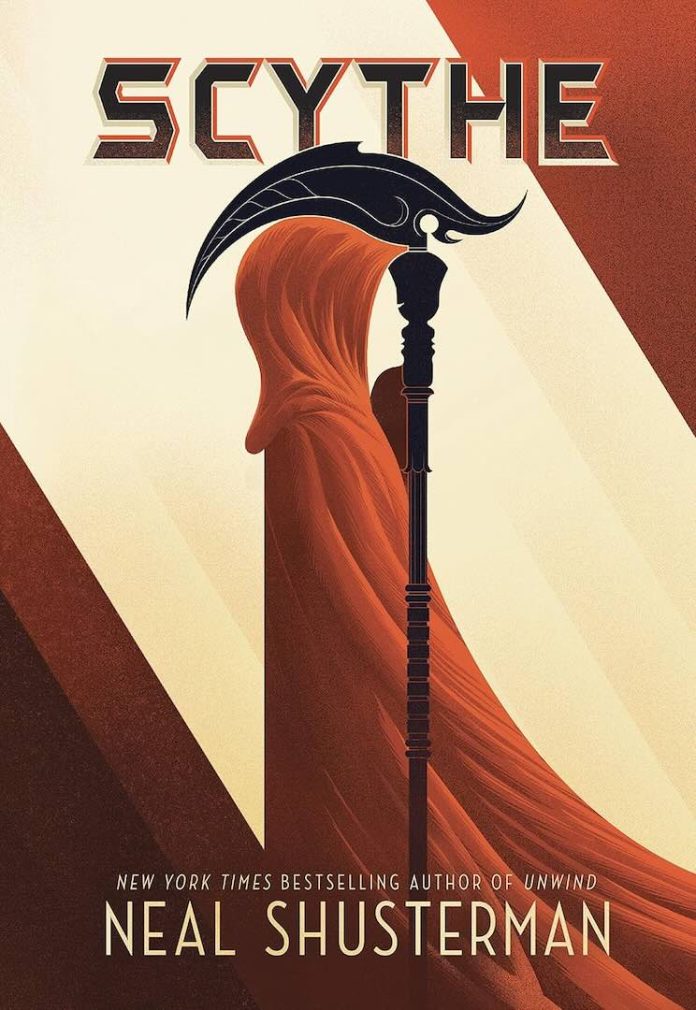
A scythe knocks on the Terranovas’ door on a cold November afternoon. He asks about everyone’s work, then dismisses it — the past never changes, he tells the historian, and neither does the future. He eats the baked ziti and calls it the best in MidMerica. Nobody can ask him to leave, because he is licensed to end any of their lives and answers to no one. Then he grants the mother a year of immunity and goes next door to kill the neighbour. That is chapter one of Scythe by Neal Shusterman, and it is a nearly perfect piece of table-setting.
Here is the world. Around 2042 humanity cured death. The Thunderhead — an artificial intelligence grown out of the cloud — took over governance and did it flawlessly: no hunger, no disease, no war, no crime, no government. Ageing is reversible; injury is temporary. Teenagers throw themselves off buildings for the rush and call it splatting.
Which leaves one problem. People still have to die, or the planet fills up. Since taking a life was ruled a matter of conscience no machine could be trusted to own, the work went back to people: the Scythedom, whose members glean by quota, wear coloured robes, keep public journals, and are — by their tenth commandment — beholden to no laws beyond their own ten.
How Scythe by Neal Shusterman Works
Two sixteen-year-olds, Citra Terranova and Rowan Damisch, are strangers until Honourable Scythe Faraday picks them both. This is irregular; scythes take one apprentice, not two. Neither wants the job, which is precisely the qualification: those who would most refuse to kill, Faraday tells them, are the only ones who should.
Then a rival faction amends the terms at conclave, and Scythe by Neal Shusterman acquires its engine: at the end of the year, only one will be ordained — and their first act as a scythe will be to glean the other.
Chapters alternate between the apprentices, each preceded by an italicised extract from a scythe’s gleaning journal. That epigraph device is the smartest formal decision in the novel: it carries the worldbuilding without stopping the plot, and it hands the villain his own pages, in which he sounds calm, reasonable and almost persuasive.
The Best Thing Neal Shusterman Does Here Is the Paperwork
Everyone remembers the premise. The surprise is that the funniest, most vicious material in Scythe by Neal Shusterman is administrative.
Scythes are audited annually on the ethnic distribution of the people they kill, and disciplined for coming up short in any category. One is reprimanded for gleaning too few rich people and sentenced to glean only the wealthy until the next conclave. A notoriously handsome scythe is censured for a pattern of gleaning unattractive people; the room finds this hilarious. Vendors get ten-minute slots to pitch new killing products, and the best of them demonstrates a transdermal poison by having the Weaponsmaster use it on her, live — whereupon the Scythedom buys fifty vials from a dead woman. Meanwhile everyone eats donuts and complains that the memorial recitation is overrunning.
That is the book’s real argument, and a better one than the tournament: an institution with absolute power spends most of its energy on procedure and factional positioning, and files the horror under any other business.
What Works
Five things carry Scythe by Neal Shusterman, and only one of them is the plot.
- Scythe Curie. The Grande Dame of Death kills strangers in the street without warning, then finds their families, cooks them dinner, listens to every story they can tell, and finally lays her knife on the table and invites the widow to use it. Ashamed of her own legend and very funny about it. Best character here by a distance.
- Rowan’s arc. He is the one who genuinely changes, in increments: pain nanites switched off, a ritual beating, blades into straw dummies, then into paid living targets, then into a person.
- Goddard as argument, not monster. His journals make a case — that the founders’ shame is affectation, that a predator despising its own nature is absurd — and it is allowed to tempt.
- The Thunderhead’s cameo. It cannot legally speak to a scythe’s apprentice, so it waits until she is dead and talks to her then — patient, precise, faintly envious of humans, who can learn from misdeeds it is incapable of committing.
- The final test. Every scythe has secretly had to render someone they love deadish. What Citra does with the ten minutes beforehand is the finest writing here.
Where Scythe by Neal Shusterman Gives Ground
- The romance is the flimsiest thread. Forbidden by rule, discharged in one kiss, mutually denied, then parked until it is needed at the end.
- Citra loses the middle of her own book. Rowan gets a transformation; she gets a research project. She reclaims the novel spectacularly in the last forty pages, but it is late.
- The central rule is a contrivance and the book knows it. Half the cast says out loud that “the winner must glean the loser” is barbaric and arbitrary. Saying so does not stop it being the engine.
- The escape hatch deflates the stakes. The way out is genuinely clever, but a year-long moral impasse resolved by a technicality in ninety seconds costs something.
- The arithmetic doesn’t hold, and the novel admits it. Five million gleanings a year is conceded, in a scythe’s own journal, to be nowhere near enough to check population growth — deliberate groundwork for later books, but here it makes the whole terrible institution decorative.
Read It If
Scythe by Neal Shusterman is for you if any of the following is true.
- You want a dystopia whose ideas are load-bearing rather than decor for a love triangle.
- You like institutional satire: committees, quotas, audits, conference catering.
- You will follow a book willing to make its teenage protagonist a very good killer without flinching.
Skip It If
- You need a romance with real heat; this one is a formality until the last chapter.
- Casual on-page killing, children included, is not something you can read past.
- You want airtight worldbuilding logic — this leaks by design, and stays unplugged for two more volumes.
Content Notes
A young adult novel with an unusually high body count. Scythe by Neal Shusterman has continuous matter-of-fact killing, including of children; two mass gleanings and the massacre of a religious community, classroom included; a suicide by wrist-cutting on the page; a teenager beaten unconscious with his painkillers deliberately disabled; a decapitation; death by fire; a girl compelled to kill her younger brother; an adult making persistent sexual remarks to a sixteen-year-old; and recreational suicide played for laughs.
Read These Next
Readers who finish Scythe by Neal Shusterman generally want either more of this world or more of this argument.
- All Better Now by Neal Shusterman, the closest cousin in his own catalogue: another engineered utopia with a nasty premise underneath.
- The Sixth Faction by Veronica Roth, if the testing machinery hooked you.
- Our guide to the YA tropes that keep teen readers hooked, because this book uses about six of them and improves most.
- Unwind by Neal Shusterman: one monstrous policy, followed to its logical end.
The Last Word
The word itself is the tell. To glean, in its older agricultural sense, meant to walk behind the harvesters and gather what they left — a form of charity for the poor. The Scythedom chose that word deliberately, because “killing” is not socially or morally correct, and a profession that must file annual diversity reports on its victims needs vocabulary it can live with.
That instinct — to dress an atrocity in a kinder word and then build a committee around it — is what Scythe by Neal Shusterman is really about, and it is why the book outlasts its own tournament plot. Four and a half stars: half a star off for a romance that never catches and a rule everyone agrees is stupid, and the rest awarded gratefully for a dystopia with an actual argument in it.
A note, in the form the book prefers. From the gleaning journal of this reviewer: we must, by law, keep a record. Simon & Schuster Books for Young Readers sent this copy, unbidden and unpaid for, and the record shows that no immunity was granted in either direction — no favour asked, none given, and the half star withheld above stayed withheld. A scythe is required to write down not just the deed but the feeling behind it, lest anyone doubt there was one. So: it was a gift, and it was still judged. Both states are undeniably true.







