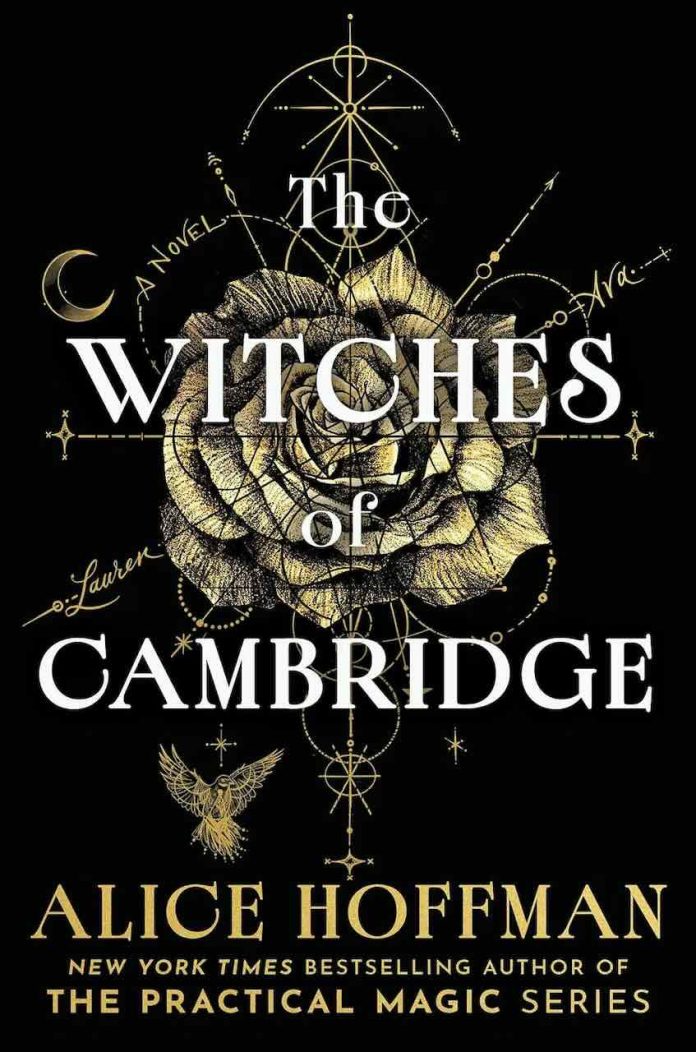
Cambridge Common is a wedge of grass with paths cut across it and traffic on three sides. In 1692 a tree stood on it that women were hanged from. In 1950 there is nothing but the paths, and on an October night a group of freshmen is summoned to stand where the tree used to be. The Witches of Cambridge by Alice Hoffman is built on that piece of ground and the two and a half centuries stacked on top of it, and the thread it pulls end to end is the least comforting one available: the machinery that hanged women in Massachusetts was never dismantled. It only changed clothes.
The Thread That Runs Through The Witches of Cambridge
Two strands, and they are not equal.
The modern strand covers four academic years, 1950 to 1954, one per section, following two Radcliffe students from the week they arrive to the morning they graduate. It is third person, roving, generous with everybody’s interior life, the dogs included.
The older strand is a sequence of letters written by the first witch of Cambridge between 1692 and 1707, addressed to Dear Reader. She is a Londoner pulled out of Bridewell prison, shipped across the Atlantic as a servant in a famous Puritan household, and set loose on marshland that is now a university.
The braid works because the letters are not backstory. Objects cross between the strands. Something buried in the seventeenth century is dug up in the twentieth by a girl who has read about it, and by the fourth section it is clear the older woman has been writing to one particular reader all along.
The letters are also the better prose. Hoffman has been writing this voice her whole career and it is unimprovable, which is the one structural cost The Witches of Cambridge by Alice Hoffman never quite covers: the 1950s chapters can feel thin beside them.
Two Girls Who Should Not Have Been Roommates
Ava arrives from a town in Maine on a scholarship nobody can explain to her, with red hair, a scar where a sixth finger was removed in infancy, and twelve crows that follow her at a polite distance.
Lauren lives on Brattle Street, has money, white-blond hair cropped to nothing, sharp little teeth and a great deal of black ink under her clothes. She has kept her extra finger. She is rude to nearly everyone and correct about most of them.
Both are recruited into the Lilith Society, which has run out of a house near the Common since before Harvard had a president, and exists because the men’s clubs would not have them.
What works in The Witches of Cambridge
- The friendship refuses to be sweet. Lauren betrays Ava twice, deliberately, and the novel softens neither occasion.
- The crows. Twelve of them, then thirteen. Hoffman gets startling structural mileage out of a bird count.
- Lionel Bell. Lauren’s brother, a medical student in love with a Boston detective in 1952, given the most quietly frightening plotline here.
- The dogs. There is a black dog called Jack who will get his own paragraph from every reader.
What Alice Hoffman Does With Radcliffe
The Witches of Cambridge by Alice Hoffman is a campus novel before it is anything else, and the campus is specific.
Radcliffe women in 1950 attend Harvard’s classes and are seated on chairs in the corridor outside the laboratory. There is a rulebook governing hemlines, curfews and gentlemen callers, and a separate library, yard and ceremony. Radcliffe College had been graduating women for sixty years by then and still could not get them past a lab door, and Hoffman lays this out without editorialising once.
Her acknowledgements thank the Schlesinger Library and the Peabody Museum, and the research shows in small things: the museum’s dim upper floors, the exact humiliation of a thesis that goes into print under somebody else’s name.
Salem in Gray Suits
The central argument is stated once, plainly, and then trusted.
The judges did not disappear after 1693. They changed venue. The Witches of Cambridge by Alice Hoffman sets its 1690s letters against a 1950s America of loyalty oaths, blacklists and neighbours who inform, and puts an ambitious professor in the middle who means to sell the federal government his expertise at identifying dangerous people on sight.
The parallel could have been a lecture. It is saved by being concrete. A woman in 1692 confesses to something she did not do so that she can sleep. A man in 1952 keeps a secret about who he loves because the alternative is his job, his family and possibly a hospital. The novel sets them side by side and lets the reader do the arithmetic.
Where The Witches of Cambridge by Alice Hoffman Gives Ground
Four things keep this short of the top shelf.
- The villain is a type. A predatory academic with a laboratory and no interior contradictions, explained in one late expository burst.
- Coincidence does heavy lifting. The parentage reveal, the artefact, the timely arrival: several third-act joins are visible from a distance.
- The aphorisms are relentless. Italic second-person asides and a high per-page rate of pronouncements about love. Readers who love this mode will love it. Others will start counting.
- The men are thinner than the women. The love interest in particular is charming, absent when it counts, and forgiven more readily than the text earns.
How Much Magic Is in It
Enough to matter, not enough to explain anything.
There are spells in Latin, a grimoire, a poison garden, familiars and a netherworld, but the magic in The Witches of Cambridge by Alice Hoffman is closer to inheritance than to a system. Nobody levels up. The one hard law is that you cannot take a life or return one without paying, and the plot is honest about the invoice.
There is also a late cameo, in a hospital garden, from a real American poet who is never named and does not need to be. Best scene in the novel, and I am not going to spoil it.
Do You Need to Have Read Alice Hoffman Before?
No. It shares no characters and no bloodline with Practical Magic or Magic Lessons, and the back matter announces no continuation. Owens readers will recognise the weather, the apples and the rule that magic has a price, and notice how much darker this one goes about institutions rather than families.
Content Notes for The Witches of Cambridge
Hangings, described. A fatal illegal abortion and the criminalisation of contraception. Forced psychiatric committal, involuntary sedation, the threat of electroshock. Medical experimentation on unconsenting subjects. On-page killing of a dog. Sexual coercion by men in authority, in both timelines. Homophobia and closeting. A suicide attempt, reported. Child death, death in childbirth, drowning. Misogynist slurs, and a cruel nickname challenged in the text.
Read it if / Skip it if
Read it if you want a witch novel about history rather than aesthetic; if the 1950s campus is the draw; if you have wanted Hoffman to write a friendship as hard as her sisters.
Skip it if you need a villain with an interior; if italicised life advice from a narrator sets your teeth on edge; if you want a magic system with learnable rules.
Read these next
Five for readers who finish The Witches of Cambridge by Alice Hoffman and want the same weather:
- When We Flew Away by Alice Hoffman. The same author on a girl and a state that means her harm, no magic at all.
- The Witches of El Paso by Luis Jaramillo. Magic handed down a family line across two centuries.
- The Women of Wild Hill by Kirsten Miller. Older women, gathered power, men who want it counted.
- The Ordeals by Rachel Greenlaw. The accusation half of this book, taken further.
- A Magic Deep and Drowning by Hester Fox. Historical magic at the same temperature.
What Stays With You
Not the confrontation, and not the reveal. What stays is an image the novel returns to and never over-explains: a woman outside a locked window in the snow, her hand flat on the glass, warm enough to melt the ice, leaving a black apple on the sill and walking back to the bus.
That is what The Witches of Cambridge by Alice Hoffman is finally about. Not the hanging tree, not the society, not even the friendship, but the long, unglamorous business of one generation of women getting a message through to the next past everybody who would prefer it lost. Some of these letters arrive two hundred and fifty years late. The argument is that they still count.







