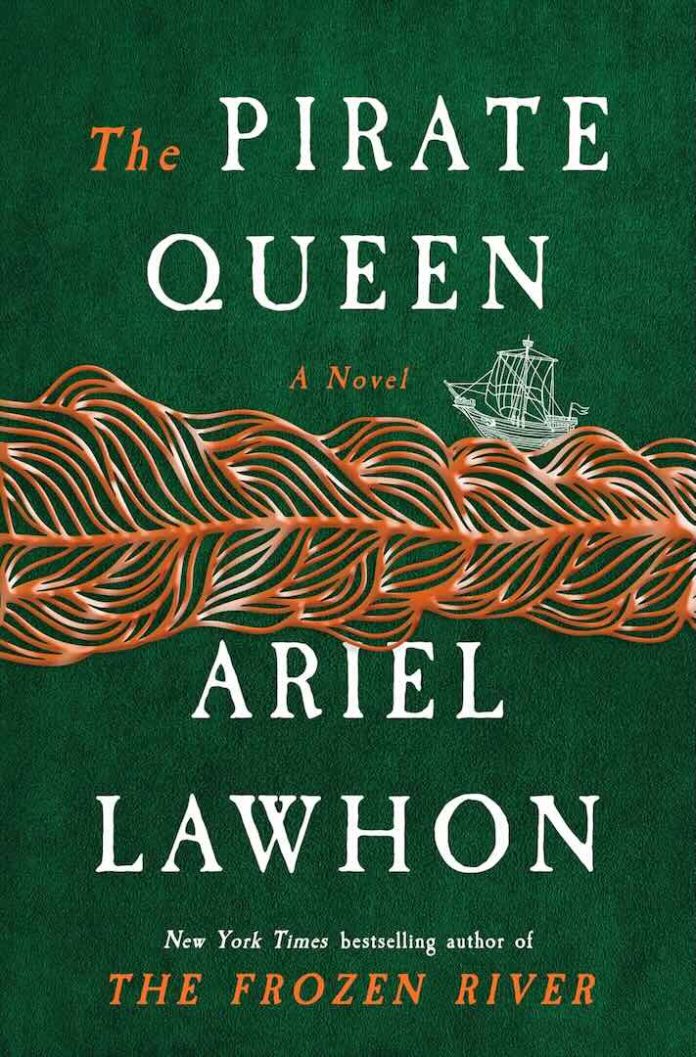
A girl of eleven stands in a boat in Clew Bay on a clear afternoon and tells her father a storm is coming. He can see nothing on the horizon. She cannot explain it either, only that the water is too cold and too dark, the air smells like a freshly turned garden row, and somewhere past the edge of hearing there are horses running. The Pirate Queen by Ariel Lawhon is a novel about Grace O’Malley, the sixteenth-century Irish chieftain whom English officials called, among worse things, the nurse of all rebellions, and it opens by handing her a gift that will make the next sixty years of her life dangerous.
Three Strands: How The Pirate Queen by Ariel Lawhon Is Built
The structure is the first thing you notice and the last thing you stop turning over.
Instead of running from birth to death, the novel is cut into three interleaved strands, each headed MAIDEN, MOTHER or MATRIARCH, each carrying a year, a title and a flat line stating Grace’s age. So the book moves from 1535 to 1550 to 1586 to 1538 and back again, and you hold a girl of eight, a woman of thirty-five and a matriarch of fifty-eight in your head at once.
Lawhon takes the shape from the triquetra, the Irish trinity knot, and says in her author’s note that it took her a year to stop arguing herself out of it. The result justifies the nerve. Reading the Matriarch chapters against the Maiden ones does something a chronological telling could not: a knife lesson given in a cellar at thirteen pays off in a palace corridor at sixty-three, forty pages before you learn how she came to be holding the knife at all.
She offers a second reading too. Take the Maiden chapters straight through, then the Mother, then the Matriarch, and the same pages give you a different novel. That is either generous or an admission that the braid asks a lot. Probably both.
The Sense, and the God Who Sends It
The fantasy shelving on The Pirate Queen by Ariel Lawhon needs a word of calibration, because this is not a magic system.
Grace inherits what her family calls the Sense: an ability to feel weather before it arrives, smelled as wet earth and heard as hoofbeats, understood to be the steed of Manannán, the Irish sea god. It skips generations, and it is supposed to skip women entirely. Manannán speaks to her perhaps a dozen times across five hundred pages, always briefly, never to solve anything.
That restraint is the right call. The Sense works the way second sight works in folklore, as a burden with a small practical use, and it lets Lawhon keep one foot in the legend without turning a documented life into a quest. Readers arriving for magic will find a thread. Readers arriving for history will not have to step over much.
What the Pirate Queen Gets Right About the Water
The sailing is where the research in The Pirate Queen by Ariel Lawhon shows without showing off.
Clew Bay is a maze of sunken drumlins, hidden sandbars and granite that will chew a hull, and the O’Malleys held it for centuries because only they knew the way through. Lawhon builds the whole political argument on that fact. Ships are boarded by pinning them against the rocks rather than by cannon. Cargo is taken as a toll for passage, offered as a choice with only one sane answer. Wrecks are stripped from small rowed boats. Ships are renamed, repaired, mourned.
What works
- Grace herself. Bawdy, impatient, tactically ruthless, weeping only where nobody can see. She is allowed to be frightened without the book apologising for it.
- The invented men. Gutty, Ultan and the Murray twins have no counterpart in the record, and the author’s note admits they arrived unplanned. They are the warmest thing here.
- The knife-lesson courtship. A boy in a chainmail shirt teaching a girl to hold a blade in a cellar before dawn beats any ballroom.
- The audience with Elizabeth. Two women in their sixties, conducting the real negotiation in Latin so the men in the room cannot follow it.
Where Ariel Lawhon Gives Ground
Four things keep The Pirate Queen by Ariel Lawhon from being flawless.
- The cast is enormous. The book opens with a character list, a pronunciation guide, two maps and a family tree, and you will use all of them. Four significant Donals. Three Richards.
- The Maiden strand is thinnest. The fosterage years give us the romance and the training, but they circle the same table and the same two suitors for a long time.
- Bingham has no inside. As an antagonist he is all appetite and spite, and his scenes rarely surprise.
- The register wobbles. The battle and political writing are flinty and exact. The bedroom writing belongs to a different and much warmer book.
None of that sinks it. But a novel this long feels its length in the middle third.
Bingham, and the Problem of the Record
The most interesting thing in The Pirate Queen by Ariel Lawhon is what it is built out of.
Grace O’Malley does not appear in the Annals of the Four Masters, the compiled history of Ireland to 1616. Her father is there. Both husbands are there. Every one of her sons is there. She is not. What survives instead is four decades of furious English correspondence, plus the eighteen questions Elizabeth’s treasurer sent her in 1593, less an interview than a trap laid for a confession of piracy.
So the only written Grace is the one assembled by people who wanted her hanged, and everything human about her comes from folklore. Lawhon says so plainly and then writes into the gap, which gives the novel its quiet argument: a woman can run a coastline for fifty years and still be left out of the ledger by the men keeping it.
Do You Need to Have Read Ariel Lawhon Before?
No. The Pirate Queen by Ariel Lawhon is a standalone with no connection to her earlier novels. Readers coming from The Frozen River will recognise the method: take a real woman documented mostly by hostile or fragmentary sources, and rebuild the daily texture around her. The container here is far bigger.
Content Notes for The Pirate Queen
There is a great deal in The Pirate Queen by Ariel Lawhon to be warned about. Two attempted rapes, both on the page, one of a thirteen-year-old. A village massacre described in detail, including murdered infants and the raped bodies of women. Sustained battlefield violence, throat-cutting and execution. Domestic violence inside a marriage. A teenage girl married against her will. Childbirth under attack. The murder of an adult child. Explicit sex. Coarse language throughout.
Read it if / Skip it if
Read it if you want a real life told at full length rather than trimmed to one famous episode; if a braided timeline sounds like a pleasure rather than a chore; if you have ever wanted a historical novel to take rigging and tides as seriously as politics.
Skip it if five hundred pages of shifting decades is more than you have patience for; if you need a clean chronology; if the content list above is more than you want to be near.
Read these next
Five for readers who finish The Pirate Queen by Ariel Lawhon and want more of the same weather:
- The Frozen River by Ariel Lawhon. Same method, colder country, a diary instead of a state paper.
- The Pretender by Jo Harkin. A barely documented figure, handled with a very dry wit.
- The Mademoiselle Alliance by Natasha Lester. Another woman who led men and lost the credit.
- The King’s Messenger by Susanna Kearsley. For the court manoeuvring and the long road.
- A Time of Witches by Madeline Martin. Women, power and a century that punished both.
The Last Word
Near the end, an old woman sits by a window at Rockfleet while visitors take turns telling her the story of her own life. She finds it hard to believe, and she lived it.
That is the novel’s best trick. The Pirate Queen by Ariel Lawhon spends five hundred pages making a legend feel like a Tuesday: cold water, aching knees, the son who will not come, the ledger that will not have her. What stays afterwards is not the audience with the Queen of England but the smaller fact underneath it. A woman in sixteenth-century Connaught commanded a fleet, and the men who wrote the histories decided she had not.